Q. 372 – Superimposition and Memory

Q: What is the relationship between memory and superimposition (adhyAsa)? In the metaphor of rope and snake, we say that we fail to see the snake clearly, because of inadequate light – there is partial knowledge and partial ignorance. When we superimpose a snake on the rope, we are drawing on fear and memory. We must have seen a snake (or image of one in a film or book) before in order to be able to mistake the rope for one. Similarly, we mistake brahman for the body and the world etc.

 But what about a baby or someone who has no memory as a result of brain damage? Is there still superimposition in this case?

Responses from Ted, Venkat, Ramesam, Martin, Sitara and Dennis

A (Ted): We have to bear in mind that the example of a rope being mistaken for a snake is an analogy, and as is the case with any analogy, the example is imperfect. In the example, the snake image is based on a previous experience of the mistaken perceiver.

 In terms of mistaking the body-mind-sense complex as well as the innumerable other objects that constitute the manifest universe for Brahman, however, we are dealing with something a little bit different. Whereas in order to mistake the rope for a snake, one must have previously seen a snake, the projection of the apparent reality (i.e., the manifest universe in both its subtle and gross aspects) is not based on experiential memory, but rather results from the mind’s ability to recognize the “cosmic blueprints” that abide in dormant form in the Macrocosmic Causal Body, which is personified as Isvara, and are made manifest through the conditioning that maya upadhi, the limiting adjunct of causal matter, puts upon Brahman. That is, the mind is an instrument that is designed or a mechanism that is “programmed” to recognize these forms and, thus, is able to discern their apparent existence within the cosmic soup of pure potentiality (i.e., the unmanifest realm or “mind of God,” if you will) from the data it receives via the perceptive instruments/organs. Continue reading

Seven Stages of Chidabhasa

chidAbhAsaGuest Author – Vijay Pargaonkar
Seven Stages of Chidabhasa

Based on Panchadasi by Vidyaranya Swami

Chapter 7.0 “Trupti Deepa”(marathi translation by Pundit Vishnu Shastry Bapat (1908) and hindi translation by Pundit Ramavatar Vidyapati (1912))

Brihadaranyaka Upanishad 4-4-12
br4-4-12


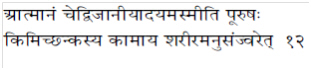
“If a man knows the Self as “I am This” then desiring what and for whose sake will he suffer in the wake of the body.”
(The entire Trupti Deepa chapter of Panchadasi is based on this shruti mantra)

Kutastha, the pure Consciousness, is asanga (without any association) and avikari (immutable). This Kutastha is also the adhisthana (substratum) of “bhrama” (illusions- not to be confused with Brahman) of indriya-sharira (body- mind complex). When it gets associated (the association is only vyavaharic/transactional and not real) with mind through anyonya-adhyasa (mutual superimposition) it is known as Jiva. Kutastha’s reflection in mind “chidabhasa” alone cannot be the Jiva since it has no existence of its own without Kutastha – image in a mirror is not possible unless there is a face behind it. The mixture/combination of chidabhasa and Kutastha is also referred to as purusha in the the shruti above. Continue reading

Revision of ‘Review of article on Shankara’ – part 3

RB: “Now the error in calling avidy¯a as something epistemic should be obvious. The following extract, from [SSS], is clearly putting the philosophical cart before the horse:

‘Avidy¯a is subjective and has been explained by ´ Sa ˙ nkara as the natural tendency of the mind to superimpose the self and the not-self on each other.’

When the conception of j¯ıva itself is due to avidy¯a, how can avidy¯a be the ‘natural tendency of the mind to superimpose the self and not-self’?” (*) Continue reading

Review of article on Shankara by Ramakrisnan Balasubramanian

(This is a slightly modified article published here one year ago, which was improperly and incompletely posted. Ramesam had asked me to review the following article, with which I complied after much hesitation. The article is over 40 p. long and quite dense and complicated in parts – in other words, ‘academic’: for specialists only; one could add: cutting the slices so thin, that the substance is practically lost, or forgotten).

Review of ‘A New Approach to Understanding Advaita as Taught by ´Sa ˙ nkara Bhagavadp¯ada’ – by Ramakrishnan Balasubrahmanian. Continue reading

Review of article titled ‘A New Approach to Understanding Advaita as Taught by Shankara Bhagavadpada’

(Ramesam asked me to review the following article, with which I complied after much  hesitation. The article is over 40 p. long and quite dense and complicated in parts – in other words, ‘academic’: for specialists only; one could add: cutting the slices so thin, that the substance is practically lost, or forgotten).

Review of  ‘A New Approach to Understanding Advaita as Taught by ´Sa ˙ nkara Bhagavadp¯ada’ – by Ramakrishnan Balasubrahmanian

The first impression, on a quick glance at the beginning of the article, is that the criticisms of the author contained in the article, and addressed to the writings of Swami Satchidanandendra Saraswati (SSS), a recognized sage and scholar, are extensive to the latter’s whole opus, as coming from an uncompromising position concerning the teachings and method of Shankaracharia. Some of the words and expressions used in the article are quasi-litigious (e.g., ‘intellectual arrogance’, ‘vociferously opposes’, ‘pointless’, ‘glaring inconsistency’, ‘making errors’, ‘misconstruing’, ‘twisting’, ‘has invented a new term’, etc.), reminiscent of the theological disputes and diatribes in the European Middle Ages. Evidently, SSS had his followers as well as his detractors, and the same can be said of the author of this article, who belongs to an opposite camp. Occasionally, he shows signs of (partial) approval of his adversary’s (if one can use this term) enunciates; for example: “No doubt SSS’s textual analysis skills are excellent, but the problem I see with SSS’s writings is his obsession with terminology, rather than philosophy. Indeed none of his works are about the philosophy of advaita [!], but are oriented almost exclusively towards contradicting previous commentators of ´Sa˙nkar¯ac¯arya”. And soon after that: “The difference between Padmapada and SSS is that the former is a philosopher, while the latter is a textual analyst”. Concerning these  pervading criticisms of the work of SSS by the author, Ramakrishna Balasubramanian (RB), the reader may judge whether they are excessive, unwarranted, or justified.

The main criticism by the author, in respect of the interpretation of avidya by SSS, is that this is not due to a double superimposition of the self and the non-self, as the latter maintains, but only to a superimposition of a subject, non-self, on the self: “[T]he fundamental error is a superimposition of an observer on the real… and by a reverse process the inner self, which is the witness of everything, is superimposed on the inner-organ”. He calls this reverse act (or process, as he calls it) ‘natural’, since “a superimposition of observer on the self naturally leads to the imagination of objects ‘outside’ and ‘inside’ the observer, just as described by Gaud.ap¯ad¯ac¯arya”. He adds: “The usage of the continuative ‘adhyasya’ in the above passage also clearly indicates that the superimposition of an observer is avidy¯a and is prior to the reverse superimposition”.

Logically prior?, prior in time? Or simultaneous, by mutual implication? Continue reading