
Q.494 Brahman and the World

Q: There is potential confusion between ‘knowing about it’ and actually ‘being it’; between ‘self-realization’ and ‘self-actualization’. ‘Knowing about it’ is in the mind, whereas ‘being it’ has nothing to do with the mind. Along these lines is why Nisargadatta always said that who-we-really are is prior to the body-mind and Consciousness and to leave them alone.

What are your thoughts about all this?

A: Basically, we are already Brahman. The problem is that we do not know it. Remove the ignorance and we realize the truth. You cannot ‘experience’ or ‘perceive’ Brahman. You can only realize that we are it. Hence, the term ‘anubhava’ is misunderstood and modern teachers have been propagating a misunderstanding of the teaching. The term ‘self-actualization’ is definitely a modern one, I think, and can mean nothing. How can you ‘make actual’ what is already the case? Continue reading
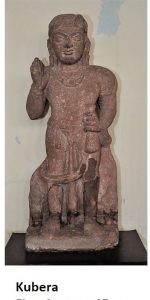
Kubera’s Search for The Self:

 [The world and everything in it are imaginary (mithya) ‘names and forms’! Therefore, tradition depicts Ishwara as a pauper because he does not possess any worldly wealth. However, he transcends the worldly objects and is said to be an embodiment of the Self. In contrast, Kubera possessed a lot of worldly treasures, a collection of mere names and forms, but lacked the real wealth of Self-knowledge. So, he sought guidance from Ishwara.]

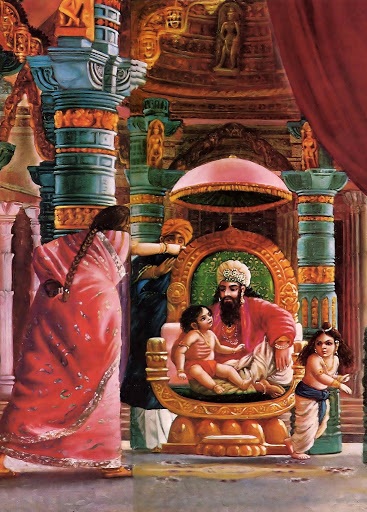
Lord Ishwara was holding court in Kailasha. His consort and both his sons were also seated with him. There were several nobles and other gods in attendance. The gurgling flow of the Ganges from the matted hair of the Lord and the chirping of the birds and other creatures around were sounding like a background drone reciting the name of Shiva-Shiva-Shiva. The God of Riches, Kubera, famous for his wealth, came to meet Ishwara. He bowed to the Lord and worshiped him as per the tradition. Kubera had a deep philosophical question and posed the same to Ishwara requesting the Lord to relieve him from the doubt. Continue reading

Ahamkara

Another story from Swami Vishudhananda’s book “Pakshpata-rahit Anubhavpraksh” in Hindi. The book is written in Yoga-Vashishtha style where various stories are narrated using Shrimad Bhagwat [and other] Pauranic characters to bring home Advaita concepts. Following is the translation of “ahamkara” (pages 514-516).

 Once upon a time, ahamkara (the ego) assumed human form and entered a gathering of sages. He introduced himself:“I am ahamkara! Avidya (ignorance) also known as maya is my mother and Sat-Chit-Anand (Existence-Knowledge-Bliss) Brahman, the witness of the entire prapancha (the appearing universe) is my father. Per the rules of scriptures pure is always different than the vishishtha (specific). Based on this rule pure Brahman is my father and this prapancha which is nothing but names & forms made up of panchbhutas – five elements (akasa-sky, vayu-air, agni-fire, jala-water & prithvi-earth) is my family. I the ahamkara and the ones in my family are caught in between the cycles of birth & death resulting in eternal pain & suffering. I stay with my mother. I never stay with my father even though I have desire to live with him. I do try to do so but no matter what I do my father is always apart from me – he is asanga (without any attachments), nirvikar (unchangeable), nirvikalpa (without any doubts). And by the way, I do not have any grandparents (my parents do not have any parents). My birth is a mystery as my father does not touch or even get closer to my mother. My death is another story – every time me and my family rest on my mother’s lap we enjoy blissful deep sleep where we lose ourselves and become one with her. And when we come out of this deep sleep it is like a rebirth for us. This goes on all the time like waves in an ocean.

Continue reading

Me, “The Seer” and World, “The Seen”

Dhruva was an adorable little boy. He saw his half-brother, Uttama, sitting and playing on the lap of their father, King Uttanapada. He too desired to climb on to the lap of Uttanapada. But his step-mother could hardly tolerate that. She gave a tight slap to him declaring that he was unfit to sit on the lap of the King as he was not born to her but to another queen. Crest-fallen and deeply hurt, the little kid, with his eyes full of tears, ran to his mother. His mother, a highly noble lady, consoled him and advised that he should achieve something so that people look at him with awe. The little Dhruva left the royal palace and went away to a distant forest. He met with a group of Sages in the forest and narrated to them his soulful story. They advised him to meditate on Vishnu. So, he embarked on a very austere and rigorous course of meditation. Regretting heavily the developments, the King and all his retinue, his mother, the queen and all his family implored that he should give up his askesis and return home. The King was even ready to abdicate the throne and promised to coronate him. But Dhruva was unrelenting. He did not succumb to the temptations and was uncompromising in his resolve. He pursued his meditation with greater vigor. He meditated on Vishnu, the Ultimate. Continue reading
Jadabharatha, Vamdeva & king Rahuganaka

Swami Vishudhananda, a contemporary [a little earlier) of Swami Sivananda, lived in Rishikesh around 1900 -20. He wrote the book “Pakshpata-rahit Anubhavpraksh” in Hindi. The book is written in Yoga-Vashishtha style where various stories are narrated using Shrimad Bhagwat [and other] Pauranic characters to bring home Advaita concepts.

Here is an excerpt – my translation from the Hindi text:

Story of Jadabharatha, Vamdeva & King Rahuganaka

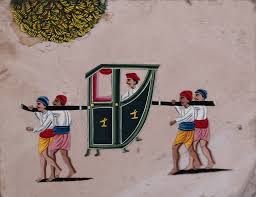
King Rahuganaka was travelling to his hilltop vacation destination along with his royal contingent. He was being carried in a luxurious palanquin (palki) by four palanquin bearers. During this journey two of the palanquin bearers got sick and king’s soldiers started looking for replacements. They found two weird looking goons wandering in the forest. King’s soldiers grabbed them and forced them to carry palanquin on their shoulders while the royal journey continued. But then everyone including the king noticed how weird these two men were. Both of them were not big or strong but the heavy load did not seem to bother them. They were not very aggressive but then they weren’t lethargic either. Their faces did not look bright and cheerful but they looked relaxed. They were often whipped by the soldiers to make them move faster but that did not perturb them. In fact, both of them were taking their steps as if they were in a trance. Continue reading

Q.493 Sanskrit expression

Q:Thank you for your website. It is a precious treasure.

I am a Transmission Acarya in Japanese Shingon Buddhism, I have studied and taught siddham for over 25 years. My Wife (also a Shingon Priest) and I have Temples and teach in Fresno, California and Nara, Japan.

In our tradition each vibration is separate and distinct although each letter is a thousand gates. Each letter has multiple levels of understanding as we move towards awakening. We have taught the role of advaya (JP: Funi -not two) and have spent several hundred hours in jñana (from the Buddhist Perspective). Our group is small with about 60 regular attendees at our seminars, This size gives us the depth of vibration to reach states that are beyond an individuals experience.

I have been a member of the advaitin group for many years but I was inactive. When it moved to the new site I began to receive the numerous treasures that were hidden within the messages and texts. I now look at each word from the perspective of siddham. This allows me to open to a larger perspective. Some of the discussions have led me to experience the advaita realm rather than the advaya realm. I especially benefitted from the effect of understanding the advaita explanation of the the burnout of the causal body after extended periods in the realm of jñana. The advaita explanation matched perfectly with not only my experience but the experience of many of my students. Continue reading

Q.492 Consciousness and consciousness

Q: Shankara often wrote the descriptor “pure Consciousness” to point to Brahman.
1. What does “pure Consciousness” have to do with conventional consciousness, as in “I’m conscious of this or that?” Does chidabhasa explain it?

A: chidAbhAsa is the best metaphor, I think, (it is pratibimba vAda and associated with vivaraNa). The other main one is avachCheda vAda, associated with bhAmatI, which uses the idea of upAdhi-s. Consciousness (big ‘C’) is typically used to refer to non-dual reality; ‘c’onsciousness is the manifestation of ‘C’onsciousness in the mind of man.

2. Is there a difference between Consciousness (as-if paramartha level) and existence?

A: As you know (!) you cannot define or say anything objective about Consciousness. Ideally  you should read the long Shankara commentary on satyam j~nAnam anantam brahma in Taittiriya Upanishad 2.1. That explains how such ‘descriptions’ work. The adjectives qualify-support-limit each other so that you do not take any single one as in any way a descriptive attribute. If you want, you could say that Brahman is limitless-existence-consciousness. But at the pAramArthika level, you cannot say anything at all about Brahman!

3. If there is a difference, which is more fundamental: Consciousness or existence? I.e. which gives rise to which? Why (not the other way)?

A: I cannot really add anything to the previous answer.