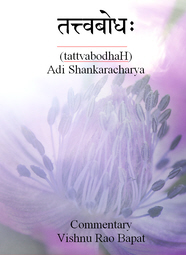
Tattvabodha – Part 7

OLYMPUS DIGITAL CAMERAPart 7 of the commentary by Dr. VIshnu Bapat on Shankara’s Tattvabodha.This is a key work which introduces all of the key concepts of Advaita in a systematic manner.
The commentary is based upon those by several other authors, together with the audio lectures of Swami Paramarthananda. It includes word-by-word breakdown of the Sanskrit shloka-s so should be of interest to everyone, from complete beginners to advanced students.

Part 7 begins the section on Atma vichAra – investigation into the nature of Atma – and in this part specifically asks the questions ‘What is true knowledge?’ and ‘Who is Self?’. There is also a hyperlinked Contents List, which is updated as each new part is published.

Swami Dayananda

dayanandaIn case anyone has not yet heard, Swami Dayananda passed away yesterday, the 23rd September, at 22.18 IST in Rishikesh. Unquestionably the greatest teacher of Advaita in our lifetimes, he must certainly rank as one of the most important ever. Fortunately the legacy of his own writings and transcriptions, and that of the institutions he founded and the teachers he taught, will live on to the benefit of future seekers.

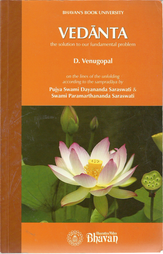
As a topical example of his teaching, I would like to reproduce the following pieces on the subject of manonAsha. These are extracted from the excellent book already recommended in these pages: ‘Pujya Swami Dayananda Saraswati – his uniqueness in the vedanta sampradaya’ by D. Venugopal.

manonaSha or Thought-free-mind Confusion

There is also a widespread contention among the adherents of aShTANga-yoga that the truth of the self is covered by vRRittis (thought-forms) and it has to be uncovered by stoppage of thoughts (citta-vRRitti-nirodha). Pujya Swamiji clarifies that thought is not the problem. He says:

“The confusion comes from the statement that AtmA is undivided (nirvikalpa). The vision of the ShAstra is that while the knower, known, and knowledge are not separate from AtmA, AtmA is independent of all of them. In MANDukya UpaniShad and in the kArikA, the dreamer is cited as proof that there is no real division (vikalpa) such as dreamer, dream and dreamt, even though during the dream, the division was taken to be real. Continue reading

Creation According to Reason

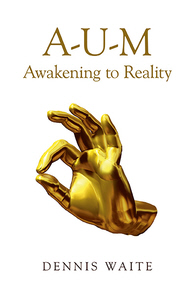
small_A-U-MAlthough not scheduled for publication until the 25th of this month, both Amazon UK and Amazon US claim to have only a few copies left! So, to remind you of the sort of content you can expect, here is another extract from the book on the topic of ‘Creation according to Reason’.

Having spent some time showing how key passages from the scriptures claim that there is no creation (and explaining how there can be apparently contradictory passages elesewhere), Gaudapada turns to reason – his principal tool in this work.

Read the extract here.

Q. 377 – Desire and suffering

(Also discusses Buddhism versus Advaita; analysis versus experience; need for practice)

Q: Your work is both beautiful and rigorous, and I’ve appreciated your continuous efforts to continue the much-beloved tradition of Advaita Vedanta.

As I consider devoting myself to the path of Advaita Vedanta, I find that I keep coming up against a few constant, nagging protests:

First, it seems that the tradition and methodology (although I also assume that there is quite a lot of variety of how Vedanta is taught and realized) is overly academic and scholastic, at least as I view it from the information that I’ve gleaned during my research.  The unfolding of the teaching of Vedanta seems to leave the student engaging in a lot of analysis, rather than a deep exploration of how they genuinely experience the world, which lacks transformative power because it remains something objective.

Second, according to some of the sources that I’ve gleaned, it seems to place Vedanta on an extremely high pedestal, as something engaged in only following years of other preparatory practices.  But modern practice appears to demonstrate that such preparation, while helpful, is not necessary.  I cite websites like “Liberation Unleashed” and Scott Kiloby’s excellent work which show that directly exploring and inquiring into the truth of statements like, “All there is is pure awareness,” etc., can still be highly transformative outside of the context of a more robust regime of spiritual purification and development.

My fear is that if I follow the traditional route, I will end up entangled in these preparatory practices.  I’ll just be getting the appetizer for years before getting the meal, in other words, but, in my opinion, why wait?

Is this perception true (given that there will be a lot of diversity)?  Do most AchArya-s make their disciples engage in such practices for prolonged periods of time before discussing Vedanta?

I have heard you and many other teachers in the traditional Advaita lineage say things like, “Unless you have a very pure mind…” or “Unless you are highly developed…”  etc., the practice of Vedanta will be fruitless.  But, if you read the logs, for example, of the website “Liberation Unleashed,” you will find some very impure people – depressed, addicted, desperate, you know, the usual seeker lot!, who come out transformed after only a few days of directly looking into their experience.

I appreciate your thoughts on this and your generosity in helping so many confused seekers. Continue reading

Tattvabodha – Part 6

OLYMPUS DIGITAL CAMERAPart 6 of the commentary by Dr. VIshnu Bapat on Shankara’s Tattvabodha.This is a key work which introduces all of the key concepts of Advaita in a systematic manner.

The commentary is based upon those by several other authors, together with the audio lectures of Swami Paramarthananda. It includes word-by-word breakdown of the Sanskrit shloka-s so should be of interest to everyone, from complete beginners to advanced students.

Part 6 concludes the look at the six sAdhanA-s (shamAdhi shakti sampatti), and in this part addresses samAdhAna (contemplation) and mumukShutva (desire for liberation). This also concludes the examination of sAdhana chatuShTAya, the fourfold spiritual path.There is also a hyperlinked Contents List, which will be updated as each new part is published.

Q. 376 – Is preparation necessary?

Q: As I consider devoting myself to the path of Advaita Vedanta, I find that I keep coming up against a few constant, nagging protests:

 First, it seems that the tradition and methodology (although I also assume that there is quite a lot of variety of how Vedanta is taught and realized) is overly academic and scholastic, at least as I view it from the information that I’ve gleaned during my research. The unfolding of the teaching of Vedanta seems to leave the student engaging in a lot of analysis, rather than a deep exploration of how they genuinely experience the world, which lacks transformative power because it remains something objective.

 Second, according to some of the sources that I’ve gleaned, it seems to place Vedanta on an extremely high pedestal, as something engaged in only following years of other preparatory practices. But modern practice appears to demonstrate that such preparation, while helpful, is not necessary. I cite websites like “Liberation Unleashed” and Scott Kiloby’s excellent work which show that directly exploring and inquiring into the truth of statements like, “All there is is pure awareness,” etc., can still be highly transformative outside of the context of a more robust regime of spiritual purification and development. Continue reading

Q. 375 – Conditions affecting next life

Q: I agree that Reincarnation, the next life, isn’t real. But it’s as real as this life…and, for most of us, this life seems pretty real, even if we know better.

And, as we all know, very, very few people are going to achieve Enlightenment (Liberation, Realization, Moksha) in this lifetime.

For the above 2 reasons, I suggest that Reincarnation is a reasonable thing to be concerned about and to ask a question about. That’s what this question is about. I’ll speak of Reincarnation as if it’s as real as this life seems.

 It’s been said that one’s next incarnation depends greatly on one’s thoughts and state in their last moments of this life. I hope that isn’t true, because no one can know what condition they’ll be in when they’re dying. I mean, we aren’t always in the best of condition when we die, are we.

 A person, at death, might be delirious, or heavily sedated at a hospital. What then? How does that affect that person’s next life?

 Has there been discussion, from theory, regarding how this life—and, in particular, a person’s condition in the last moments of this life–affect that person’s next life?

Responses from , Sitara, Venkat and Dennis Continue reading

Q. 374 – Ramesh

Here is a question and answer from several years ago, which addresses a topic that I avoided getting involved with publically at the time.

Q: I recently bought a book called “Final Truth” by Ramesh Balsekar. I read the book and now see it as one of the most “deep” and “philosophical” books on Advaita. But then I read Balsekar had some sex scandals and preached “do whatever you want you are not responsible” philosophy and I`m shocked. Anyway…

I saw an idea in the book and it resonated with me so much. In my opinion, It even explains (for some level) why there is Maya or why the appearances exists or why there is “creation” in the first place. (or Why there seems to be creation) The idea is this: The formless Consciousness can be experienced only through the multitude of sentient bodies with names and forms, just as light can be seen only through refracting agents. It is thus not that the multitude of names and forms exist independently of Consciousness but that Consciousness can express itself only through these forms.
 
So the other way of saying is the God or the Brahman or the Consciousness experiences himself through us. We and the universe are God looking into himself.
 
 Brihadarnyaka 2.5.19 has this verse
 
“He transformed Himself in accordance with each form; that form of His was for the sake of making Him known. The Lord on account of Maya (notions superimposed by ignorance) is perceived as manifold, for to Him are yoked ten organs, nay, hundreds of them. He is the organs; He is ten and thousands – many and infinite. That Brahman is without prior or posterior, without interior or exterior. This self, the perceiver of everything, is Brahman. This is the teaching.”
 
What do you think?  I  wanted to know if traditional Advaita accepts that idea or not.

A: As it seems with most questions I get these days, this one also revolves around the reality-appearance, paramArtha-vyavahAra question.

Who-you-really-are does not act, so cannot be ‘responsible’ in the sense that you mean here. The person, on the other hand, does act and is responsible, and gets puNya-papa as a result of those actions. It is especially the responsibility of the realized person to act in accordance with dharma – the awareness of right and wrong – since he is setting an example to others. However it is also possible that, because of insufficient prior mental preparation, an enlightened person is still attached to desires and fears. Even knowing that he is perfect and unlimited, he could still act in accordance with these feelings, which are called pratibandha-s (obstacles or impediments). These will go in time, with further nididhyAsana.

It has to be assumed that this was the position regarding Ramesh, as far as the ‘scandals’ are concerned. However, if it was the case that he was actually preaching “do whatever you want you are not responsible”, as you say, then this is not a clear presentation of the truth of the situation and should be condemned.

Regarding your second point about the ‘purpose’ for the seeming creation, this does not hold water either. There can be no meaningful attribution of purpose at all. Purpose implies some sort of deficiency in brahman, which is a contradiction. Experience of any sort is a limitation, so cannot be applied to brahman. Best just to think of everything as name and form, including the ignorance and the experience; the experienced and the experiencer. But, as an imaginative way of thinking about it, God looking into himself is fine, as long as you don’t take it literally.