Atma vichAra

The Self cannot be ‘known’ in any objective sense because it is the ultimate subject – there is no other subject that could know it. This is why science can never tell us anything about the Self. Science works by collecting data and analyzing it; formulating theories and then using them to predict what will happen when data are gathered in a different situation. This can never be applied to Self/brahman, because brahman has no data.

Strictly speaking, vichAra refers to investigation into ‘things’ so that Atma vichAra is effectively a contradiction in terms; the Self is not a thing. Spiritual investigation has to be done rather differently. The correct term is shAstra mImAMsA and it is really scriptural ‘investigation’ that we must conduct in order to find out about the Self. Monier-Williams translates mImAMsA as “profound thought or reflection or consideration; investigation, examination, discussion”. The philosophical branch that studies the Upanishads etc at the end of the Vedas (Vedanta) is called uttara mImAMsA. (uttara means “later, following, subsequent, concluding” but also “superior, chief, excellent, dominant”.)

We ‘discover’ the Self by removing ignorance. If someone holds up a screen in front of our face and then brings an object to show us, but keeps it behind the screen, we can say nothing at all about the object. However, as soon as the screen is taken away, the object is revealed to our senses and the perception takes place automatically. Similarly, knowledge of the Self is obscured by ignorance but as soon as that ignorance is removed, the Self is immediately self-evident; we do not have to do anything to ‘investigate’ it.

Scripture functions like a mirror. When we look into a mirror, we do not literally see our face and body, we only see an image of it. Yet this enables us directly to perform whatever actions are required on the body itself – combing the hair, shaving and so on. We do not shave the image but the actual hair on the face. Similarly, the scriptures do not directly represent the Self but the information therein, when explained by a qualified teacher, directly enables the ignorance in our mind to be removed, revealing the Self-knowledge which is as though hidden beneath.

Actions will never bring about Self-knowledge, since action is not opposed to ignorance. Nor will practices such as meditation or prayer. As Swami Paramarthananda puts it, meditation will only bring about quiet ignorance.

As Shankara puts it (if he was the author of vivekachUDAmaNi v.13): “It is through reflection over the words of a truly benevolent soul that one comes to a knowledge of reality, and not through bathing at sacred places, charity or hundreds of breathing practices”. [1] I.e. it is through shravaNa, manana and nididhyAsana and not through asking ‘Who am I?’ that one gains Self-knowledge.

[1] The Crest Jewel of Wisdom; viveka-chUDAmaNi, commentary by Hari Prasad Shastri, Shanti Sadan, 1997. ISBN 0-85421-047-0.


Perspectives

perspectivesEver since I began the site at advaita.org.uk, I have been using my own photographs (principally digitally enhanced flower photos) to illustrate the pages. Photography has been one of my main hobbies since early childhood and I have thousands archived. I recently started to build a portfolio of the best of these at 500px and I will be updating this on a regular basis, adding those that are voted for by the 500px community and removing the low-scoring ones. Please feel free to visit there to browse when you want a break from the mental struggle with Advaita! I have retained the Advaita VIsion logo and also advertize my books there! The portfolio is called Advaita Vision Perspectives. There is a new menu item at the top right to ‘Photos‘.

Should I stop enquiring???????

ripplesShould I stop enquiring???????

Vijay Pargaonkar

(मुञ्डकोपनिषत्) MundakaUpanishat 3-2-9

“Anyone who knows that supreme Brahman becomes Brahman indeed……….”


My search for Brahman started with aparokshAnubhUti (supposedly written by Shankaracharya) where it is stated that knowledge of liberation is obtained through enquiry. It then goes on to explain what constitutes enquiry:                                                               (अपरोक्षानुभूती) aparokshaAnubhUti (Shloka #11 & #12) (translation by Vimuktananda)

“Knowledge is not brought about by any other means than Vichara (Enquiry), just as an object is nowhere perceived (seen) without the help of light”.

“Who am I? How is this (world) created? Who is its creator? Of what material is this (world) made? This is the way of that Vichara (Enquiry)”. Continue reading

Vedanta the Solution – Part 17

venugopal_vedanta

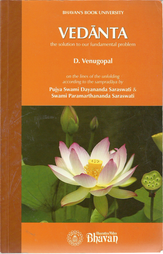
VEDĀNTA the solution to our fundamental problem by D. Venugopal

Part 17 addresses the changes in lifestyle needed to enable us to become successful seekers. These include fasting, silence, breath control, prayer, karma yoga and renunciation.

There is a complete Contents List, to which links are added as each new part appears.

Tattvabodha – Part 2

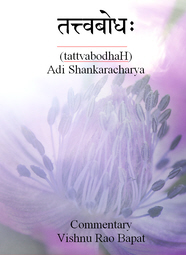
OLYMPUS DIGITAL CAMERAPart 2 of the commentary by Dr. VIshnu Bapat on Shankara’s Tattvabodha.This is a key work which introduces all of the key concepts of Advaita in a systematic manner.

The commentary is based upon those by several other authors, together with the audio lectures of Swami Paramarthananda. It includes word-by-word breakdown of the Sanskrit shloka-s so should be of interest to everyone, from complete beginners to advanced students.

Part 2 provides an introduction to the series and begins the discussion of sAdhana chatuShTAya sampatti. There is also a hyperlinked Contents List, which will be updated as each new part is published.

Q. 371 – Deep-sleep state

Q: In advaita, we use the recall of a “good deep sleep” as a very important argument for proving continued presence of awareness… the question is, how does this recall happen? We have a process in advaita by which ‘the presence of a pot is known’. How is deep sleep known? Or – How is the fact that one slept well, recalled?

Responses from DhanyaRamesam, Martin, Ted and Dennis

A (Dhanya): When I was a child, there was a TV show I liked to watch.  It was called ‘You Are There.’  As I recall, the show depicted a famous scene from history, and then ‘you’ (meaning in this case the narrator), magically showed up in the scene and got to ask the historical figures all sorts of questions.  (I guess I should Google it to make sure I recall the details of the show correctly).  Anyway, I do remember that I enjoyed the show, and often these days recall the title, because one could ask oneself the question, ‘How is anything known?’ and the answer would be because ‘You are There!’  The whole point of deep sleep in the teachings of Vedanta is to is highlight ‘You are There’  Your nature is consciousness, i.e. that by which anything is known.  The absence of any thing is also known.  Thus one can recall the fact that one slept well.  Why?  Because You are There. Continue reading

Q. 370 – nirvikalpa samAdhi

Q: Should a person have compulsorily experienced nirvikalpa-samādhi in order to know that he has a mind which is prepared for jñāna? In other words, is experience of nirvikalpa-samādhi a must as a sādhana?

Responses from VenkatMartinTed, Shuka and Dennis

A (Venkat): Nirvikalpa-samAdhi is an experience of the absence of objects, for a finite period of time, which the experiencer eventually exits to re-perceive the world.  As it is not permanent, it is not real.  Any temporary experience that is witnessed cannot be a pre-requisite for j~nAna – since j~nAna is the permanent dissolution of the illusory I-thought.

“Abiding permanently in any of these samadhis, either savikalpa or nirvikalpa, is sahaja. What is body consciousness? It is the insentient body plus consciousness. Both of these must lie in another consciousness which is absolute and unaffected and which remains as it always is, with or without the body consciousness. What does it matter whether the body consciousness is lost or retained, provided one is holding on to that pure consciousness? Total absence of body consciousness has the advantage of making the samadhi more intense, although it makes no difference to the knowledge of the supreme.” – Sri Ramana Maharshi Continue reading

Q. 369 – mokSha

Q: What is meant by mokSha as a puruShArtha? (The answer should incorporate a definition of mokSha.)

Responses from Ted, Venkat, Ramesam, Martin, Shuka and Dennis

A (Ted): Moksha literally means, “liberation.” It indicates freedom from dependence on objects (i.e., anything perceivable, conceivable, or in any way experienceable) for happiness, contentment, or a sense of wholeness and completeness. And since it is our vain pursuit of permanent fulfillment through impermanent objects that is the cause of suffering, moksha also implies freedom from all suffering.

 Moksha is the essential purushartha (i.e. goal or end) that we are seeking, though in most cases not consciously, through our pursuit of artha (security), kama (pleasure), and dharma (virtue). If we analyze the objects we chase in any of these categories, we invariably find that it is not actually the object itself that we want, but rather the sense of peace and/or happiness that it seemingly provides us. Admittedly, the objects we seek to obtain in these areas are either necessary for our survival or enhance our enjoyment of life, but all are limited. And no limited object can provide limitless fulfillment. Thus, if we depend on these objects for our happiness, we doom ourselves to inevitable disappointment and certain suffering. Continue reading

Tattvabodha – Part 1

OLYMPUS DIGITAL CAMERAI am pleased to announce that Dr. VIshnu Bapat has granted permission for us to host his unpublished commentary on Shankara’s Tattvabodha.This is a key work which introduces all of the key concepts of Advaita in a systematic manner.

The commentary is based upon those by several other authors, together with the audio lectures of Swami Paramarthananda. It includes word-by-word breakdown of the Sanskrit shloka-s so should be of interest to everyone, from complete beginners to advanced students.

Here is the link to Part 1. This provides an introduction to the series and covers the Invocation. There is also a hyperlinked Contents List, which will be updated as each new part is published.