Ego – Guardian

The ulterior agenda of the human ego is always one of control and the validation of separation and isolation. “I am alone, we (organization, community, race, etc.) are alone, and I or we will prove it to you.” The ego is not ‘bad’ for trying constantly to validate that it is alone and separate. That’s its job. It is a guardian that is meant to take care of the physical body by providing boundaries. That’s how it evolved long ago.

A Natural Awakening: Realizing the Self in Everyday Life, P. T. Mistlberger, TigerFyre Publishing, 2005. ISBN 0-9733419-0-4.

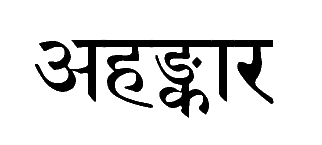
ahaMkAra – Killing the ego

However much you may try to kill the ego, it will only become stronger. So you have to approach it from the other end. Everybody understands in spite of the ego. The truth is that the ego automatically dies when you understand anything.

You will never succeed in bringing in light, if you insist upon removing all the darkness from your room before you do so. Therefore simply ignore the ego and try to understand, and the understanding itself will remove the ego. (Note 847)

Notes on Spiritual Discourses of Shri Atmananda, taken by Nitya Tripta, Vol. 2, Non-Duality Press, 2009. ISBN 978-0-9563091-3-6. Buy from Amazon US, Buy from Amazon UK

ahaMkAra – fixed quality

ahankaraWhen it comes to identity, we try to find something that we are, somewhere we can plant our flag and say: “This is me. ” The verb ‘to be’ implies a stationary, fixed quality. For instance, “I am a radio show host” has a very different quality from “I host a radio show.” The words ‘I am’ imply that whatever follows is a fixed quality of being, not something that comes and goes.

Nothing Personal: Seeing beyond the illusion of a separate self, Nirmala, Endless Satsang Foundation, 2001. ISBN 978-0-6151-8767-9. Buy from Amazon US, Buy from Amazon UK

Action – Enlightenment

Results of action are of four types:

1) utpAdya – a result in the form of a product, like a pot.
2) Apya – a result in the form of reaching, like going abroad or to heaven.
3) saMskArya – a result in the form of removal of impurity and imparting a good qualiity.
4) vikArya – a result in the form of modification, e.g. milk to yoghurt.

Making, reaching, purifying and modifying are the four results obtained by karma. mokSha (enlightenment) is not a product because it is nitya (eternal). It cannot be reached because it is you. It cannot be purified because it is free from blemish. It cannot be modified because it is one whole. Hence, nitya-mokSha is not a product or by-product of karma.

muNDakopaniShad (Vol. 1), Swam Dayananda Saraswati, Arsha Vidya Centre. ISBN 81-903636-3-8.

upadesha sAhasrI – part 15

upadesha15

Part 15 of the serialization of the  presentation (compiled by R. B. Athreya from the lectures given by Swami Paramarthananda) of upadesha sAhasrI. This is the prakaraNa grantha which is agreed by most experts to have been written by Shankara himself and is an elaborate unfoldment of the essence of Advaita.

Subscribers to Advaita Vision are also offered special rates on the journal and on books published by Tattvaloka. See the full introduction

Difference

differenceVive la difference!

I am still in the process of writing my next book on the Mandukya Upanishad and kArikA-s. I have just written the following section on the concept of ‘difference’. Since I posted a query to the Advaitin group, relating to what Swami Paramarthananda had said on the topic, I concluded by sending the completed section to the group. Accordingly, I am also posting this here.

In his commentary on this kArikA (2.34), Shankara touches on the logic of this concept of ‘difference’ and Swami Paramarthananda expands upon this. What, he asks provocatively, is the color of the difference between red and blue? Clearly, it is potentially a very important topic since, if it could be proven logically that the idea of ‘difference’ is incoherent on examination, it would effectively demonstrate the non-dual nature of reality. Numerous post-Shankara philosophers have looked into this and formulated involved arguments. There is extensive material in the post-Shankara texts of brahmasiddhi, iShTasiddhi, tattvashuddhi, khaNDanakhaNDakhAdya and chitsukhI/tattvadIpikA but, having looked at these, they seem too impenetrable to study in detail. (No references are given for these – you really don’t want to read them!) Continue reading

Action – Reaction

The mind… will re-act from the past (in any situation in life), because whenever it is faced with something in the moment, in the now, in rush all these memories, all these experiences. And whether one likes it or not, it is a purely mechanical process; we may think we are in control, but that is entirely illusory. Thus, there is no fresh response, no appropriate action; it is always the memories and the past experiences that dictate the action, which is therefore not really an action at all but a re-action.

from ‘Dialogues on Reality: An Exploration into the Nature of Our Ultimate Identity’, Robert Powell, Blue Dove Press, 1996. ISBN 1-884997-16-36. Buy from Amazon US; Buy from Amazon UK.