Action – Morality

“When you understand and are able to act from right action, morality is no longer necessary. It’s instantly obsolete and discarded. This is at the heart of the Bhagavad Gita. Arjuna, as a moral creature, throws down his weapon and refuses to launch a war. Krishna converts him to a creature of right action by freeing him from delusion and Arjuna takes up his weapon and launches the war. Right action has nothing to do with right or wrong, good or evil, naughty or nice. It is without altruism or compassion. Morality is the set of rules and regulations that you use to navigate through life when you’re still trying to steer your ship rather than let it follow the flow”

from ‘Spritual Enlightenment; The Damndest Thing’, Jed McKenna, Wisefool Press, 2002. ISBN 0971435235. Buy from Amazon US, Buy from Amazon UK
Action – Agency

An action should have an actor (kartA). That means there should be someone to claim: “I am doing this”. Only humankind has this sense of agency, though all living beings naturally are active. Man is born as part of nature and lives as part of nature. But he does not realize his being an integral part of nature, and therefore is oblivious of the fact that his ability to know, ability of volition, and ability to do works are merely part of the creative function of nature. Because of this obliviousness he thinks he is the doer of all these actions. Such a man is called vimUDhAtmA (the stupefied one or the stupid). Only such stupid ones have the sense of agency and they alone have karma.

From Karma and Reincarnation, Swami Muni Naryanana Prasad, D.K. Printworld (P) Ltd., 1993, ISBN 81-246-0022-8. Buy from Amazon US, Buy from Amazon UK
Topic of the month

New – Topic of the month

We are beginning a new series (or at least seeing how it goes!)

This will aim to present frequent, specially chosen, short quotations on a different topic each month. Each blogger will aim to post several quotations and will be principally responsible for answering any questions which may arise from his or her post. It is not required that the poster agree with the post!

The title of each post will be of the format ‘Topic name – Post subject’ and will be accompanied by details of the source (‘Book title, author, ISBN’ or ‘teacher who said this and where’). Length of post will be no more than 200 words and sometime only a single sentence. I have generated a new category called ‘Topic of the month’. Please feel free to post comments with further suggestions.

The first topic is ‘Action’ and the first post will follow immediately.

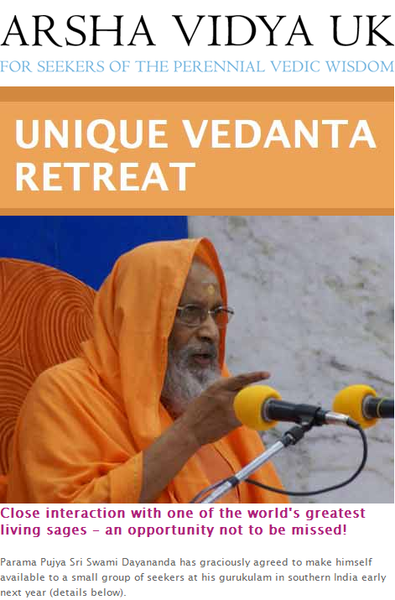
Swami Dayananda retreat

dayananda_retreatThis specially arranged 16–day retreat (15–30 January) offers the rare privilege of sitting at the feet of a master teacher. There will be several classes a day, each day ending with a question and answer satsang. The retreat will be followed, from the 31st, by a further 4–5 days of optional visits to sites of historic importance, including Sringeri Math.

The ashram is situated in beautiful, peaceful forest 45 minutes drive from Coimbatore.

See more details.

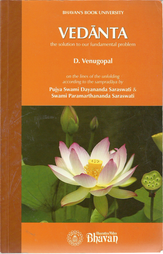
upadesha sAhasrI – Part 14

upadesha14

Part 14 of the serialization of the  presentation (compiled by R. B. Athreya from the lectures given by Swami Paramarthananda) of upadesha sAhasrI. This is the prakaraNa grantha which is agreed by most experts to have been written by Shankara himself and is an elaborate unfoldment of the essence of Advaita.

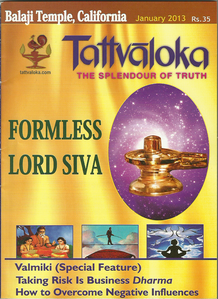
Subscribers to Advaita Vision are also offered special rates on the journal and on books published by Tattvaloka. See the full introduction

Q. 354 – Consciousness and reality

Q: I have an odd question, a question that I am not even sure how to formulate, it concerns consciousness. Why does Advaita philosophy insist on calling the ultimate reality consciousness? The word consciousness implies intelligence and thought – how do we know that anything outside of brains is in any way conscious?  Does this mean that physical reality amounts to the “thoughts” of this consciousness? Can the transcendent consciousness send messages to an embodied consciousness? 

 I know that an advaitin will say that there is only a non-dual reality but I mean this (however unreal or relative a reality my individual reality may be from an ‘ultimate’ perspective’) in much the same way that, until you received this e-mail from me, you were not aware of any ‘message’ or meaning from me.

  If I see a figure in clouds or a face in some wood-grain, should I see this as information with meaning? Does the consciousness ‘behind’ or ‘underneath’ everything communicate meaning with physical events (pictures, or ‘my thoughts’ , or even ambiguous hand-writing!) the way we normally communicate meaning with words and concepts? In other words–if the entire universe is consciousness, can anything be truly mindless or meaningless? Continue reading

Why Advaita Works

To explore the womb, or tomb, or dreams; all these are usual

Pastimes and drugs, and features of the press:

And always will be, some of them especially

When there is distress of nations and perplexity

Whether on the shores of Asia, or in the Edgware Road. (T. S. Eliot. Four Quartets, 3.5)

If you are reading this magazine*, I suggest that there is a high probability that you are not happy! It is an undeniable fact that the majority of people today are dissatisfied with what they perceive as being a mediocre existence. They may feel that they are limited by an unattractive and illness-prone body or by a mind that is imperfectly educated and unable to make intellectual leaps of understanding. There are very many things that we want – objects, partners, lifestyle, jobs etc – but few that we seem to be able to obtain. (And, even when we do obtain them, their rewards are invariably ephemeral.) Western society relies upon the media advertising all of these things, and thereby continually reinforcing the desires. Being repeatedly frustrated by this materialistic lifestyle, it should be hardly surprising that many turn towards the spiritual in the hope that this might bring about peace and a durable happiness. Continue reading

Q. 353 – Witness to the boredom

Q: I have a problem with the boredom of everyday life. Nothing seems to satisfy me. I just find it so difficult to be just here in the moment and be content with that. You say: go through life and work etc, but as a witness to it all.

Am I living in moment as I should? Should I give all my attention to each action, so that the ego is absent or should I just be the witness of everything every action on a moment to moment basis?

Maybe if I understand how to live in the moment better and had some clarification, that would help me stay present and focused on just living. My mind lives in the future.

(Note: I have reworded the question slightly but some of the replies quote from the original question. Apologies for any confusion!)

Answers are provided by: Sitara, Ted, Ramesam, Martin and Dennis. Continue reading