
Swami Haribrahmendrananda Tirtha on “The Theory of Uncreation”
Category Archives: Ramesam
The Lie of the Upanishads – 2/2:
Shankara leaves no scope for any doubt when he declares at the end of his commentary at 2.1.33, sUtra bhAShya, that “The shruti statement of creation does not relate to any reality, for it must not be forgotten that such a text is … meant for propounding the fact that everything has brahman as its Self.” (Translation by Swami Gambhirananda).
Shankara also asserts in his commentary on mantra 2.1.20, brihadAraNyaka: “Therefore the-mention in all Vedanta texts of the origin, continuity and dissolution of the universe is only to strengthen our idea of Brahman being a homogeneous unity, and not to make us believe in the origin etc. as an actuality.” (Trans: Swami Madhavananda).
He makes it abundantly clear in his commentary at 3.15, Gaudapada kArikA that “Therefore, we have reasonably to conclude that the scriptural statements regarding creation, etc., are for the purpose of helping the mind to realize the oneness of Atman, and for no other purpose whatsoever. Therefore, no multiplicity is brought about by creation, etc. (Translation by Swami Nikhilananda.)
The 35th Sringeri Acharya HH Sri Abhinava Vidyatirtha was unequivocal when he told a disciple that “To cater to the doubts of such people (i.e. less advanced aspirants) as regards creation, the scriptures speak variously of origination. Scriptures are actually not concerned with creation at all.” Continue reading
The Lie of the Upanishads – 1/2:
The uncompromising position of Advaita Vedanta is that “Nothing is ever born” as Gaudapada tells us in his mANDUkya kArikA (verse) at 3.48 and repeats it for emphasis at 4.71. As many as four Upanishads wrap up the Absolute Reality from the Advaita viewpoint in the following verse which appears also in Gaudapada’s kArikA and Shankara’s vivekaCUDAmaNi :
न निरोधो न चोत्पत्तिर्न बद्धो न च साधकः ।
न मुमुक्षुर्न वै मुक्त इत्येषा परमार्थता ॥ — 10, amRitabindu upanishad; 2.31, Atma upanishad, 11, avadhUta upanishad; 5.13, tripuratApini upanishad; 2.32, Gaudapada kArikA; 575,vivekaCUDAmaNi .
[Meaning: There is neither Dissolution nor Creation. There is neither bondage nor any seeker for freedom. There is neither any one wishing for salvation nor any one who achieved it. This is the absolute Truth.] Continue reading
The Great Indian Rope Trick:
The famous Indian Rope Trick is Shankara’s favorite to illustrate how the world or an individual separate ‘self’ originates. He says that it is like the mesmerizing show created by a Magician, himself being unaffected and uninvolved and standing unseen, “veiled magically,” on the ground. Here are three instances where Shankara refers to the Rope Trick in his Commentaries:
Shankara @ Verse 7, Ch 1, Gaudapada kArikA on mANDUkya:
The magician throws the rope up in the sky, climbs it with hands, disappears from sight (of the spectators), engages himself in a fight (in the sky) in which his limbs, having been severed, fall to the ground and he rises again. The onlooker, though witnessing the performance, does not evince any interest in the thought in regard to the reality of the magic show performed by the magician. Similarly, there is a real illusionist who is other than the rope and the one that climbs up the rope. Continue reading
The Ignorance that Isn’t – 8/8
15. jIva and jagat are Notional (Contd):
When Arjuna laments at the prospect of killing his loved ones in the war, Krishna tells him, “It was not that I was not existing before nor will I stop existing in the future.” That means there is no beginning or end, nor do the birth and death exist. Life is merely a transitional form that arises in between the unreal appearance of birth and death. Since birth and death are unreal, we (as the Self) are already liberated.
न त्वेवाहं जातु नासं न त्वं नेमे जनाधिपा |
न चैव न भविष्याम: सर्वे वयमत: परम् || — 2:12, Bhagavad-Gita.
[Never was there a time when I did not exist, nor you, nor all these kings; nor in the future shall any of us cease to be.]
In the very next verse, Krishna, however, says: Continue reading
The Ignorance that Isn’t – 7/8
13. The Logical Fallacy of Infinite Regress:
While explicating further on the question of “Whose is avidyA (Ignorance)?” Shankara points out that the contention “I am ignorant” is a logical fallacy which would lead one to an infinite regress.
Shankara says:
न च ज्ञातुः अविद्यायाश्च सम्बन्धस्य यः ग्रहीता, ज्ञानं च अन्यत् तद्विषयं सम्भवति ; अनवस्थाप्राप्तेः । न च ज्ञातुः अविद्यायाश्च सम्बन्धस्य यः ग्रहीता, ज्ञानं च अन्यत् तद्विषयं सम्भवति ; अनवस्थाप्राप्तेः । यदि ज्ञात्रापि ज्ञेयसम्बन्धो ज्ञायते, अन्यः ज्ञाता कल्प्यः स्यात् , तस्यापि अन्यः, तस्यापि अन्यः इति अनवस्था अपरिहार्या । यदि पुनः अविद्या ज्ञेया, अन्यद्वा ज्ञेयं ज्ञेयमेव । तथा ज्ञातापि ज्ञातैव, न ज्ञेयं भवति । यदा च एवम् , अविद्यादुःखित्वाद्यैः न ज्ञातुः क्षेत्रज्ञस्य किञ्चित् दुष्यति ॥
“How can you perceive the relation between the Self and avidyA? It is not indeed possible for you to perceive your Self as related to avidyA, at the same moment (that your Self cognizes avidyA); for, the cognizer (Self) acts at the moment as the percipient of avidyA. (The Self cannot be both the perceiver and the perceived at the same time). Continue reading
The Ignorance that Isn’t – 6/8
What we have are clearly two entities. They are the kShetra, the field comprising all that which is the knowable, and the kShetrjna, who is the Knower. If ignorance and misery were to be the inherent properties of the Self, it amounts to say that Self perceives Itself because the Self is able to know them (the misery and nescience). That obviously is an absurd position, “since one and the same thing cannot be both the agent and the object of an action.” Whatever is perceived, as for example form and color, cannot be a property of the perceiver.
Likewise, it is the Self that perceives joys and sorrows. They cannot perceive themselves. They are objects to the Self; they are not the Self. For the Self to perceive these, they must be different from the Self. Only then can they be experienced. If the object is totally identified with the Self (me), it cannot be perceived anymore. It itself becomes the Self.
Hence it is incorrect to say that “nescience and misery and the like are the attributes and specific properties of kShhetrajna.” Continue reading
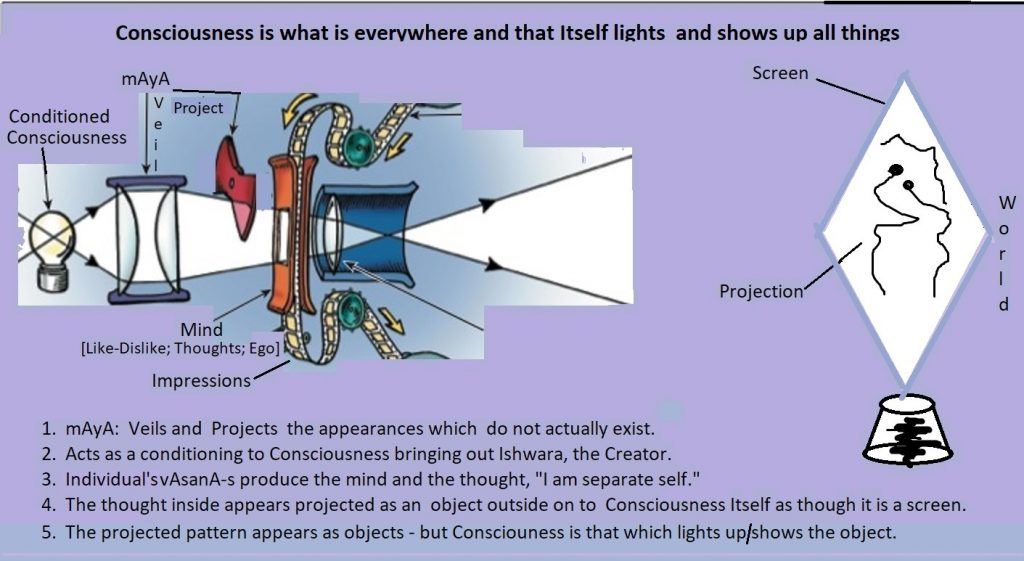
Projector Metaphor:
I tried to visualize the Advaita teaching using the Projector Metaphor. A slide is prepared based on that visualization.
Any corrections/suggestions for improvement will be gratefully appreciated.
The Ignorance that Isn’t – 5/8
8. Self is never in Bondage (Contd.):
Shankara is very categorical in his observation that “Very rare is the person who attains discriminating wisdom. The ignorant don’t follow the man of Wisdom, because of their attachments and evil passions which necessarily lead to action.” He regrets that such people resort to even black magic. He adds that “Therefore, samsAra is only based on avidyA and exists only for the ignorant man who sees the world as it appears to him. Neither avidyA nor its effect pertains to Kshetrajna, pure and simple.”
9. A Man of Erudition (paNDita) vs. A Scholar:
Shankara says that, not only many of the common people, even some of the scholars (Experts in shAstra-s) fail to understand the essential message of the scripture. Proud of their knowledge in the Vedic rituals, they think that they are the doers (with a strong sense of a “me”) and believe they will attain great merit (as “mine”) in this life-time so that they can reap the fruits of their meritorious actions in the next world. They perceive their body, life-force, senses, and mind, but are unable to grasp their innermost Self (pratyagAtmA) which is the actual witness to all that they perceive. If they are able to recognize their inner Self, they will easily cognize the Supreme Self (paramAtmA) that is present everywhere and in everything. They will come to realize that their inner Self is not different from the Supreme Self. As the Gita says,
विद्याविनयसम्पन्ने ब्राह्मणे गवि हस्तिनि |
शुनि चैव श्वपाके च पण्डिता: समदर्शिन: || — 5.18, Bhagavad-Gita. Continue reading
The Ignorance that Isn’t – 4/8
7. Self is The Knower of All Experiences:
Any feelings, like joys or sorrows, that we experience are not what we are. They are experienced by us. Everything is known by that one no-thing thing which is the Knower (Knowingness). It is we who experience even birth and death. After all, death does not experience its death, nor does birth experience its birth. Whatever experiences the birth and death cannot Itself be born. Nor can it die. Once we are able to clearly discriminate and understand this truth, we will stop identifying ourselves with the wrong entities like the body. Knowing clearly who we are, and abiding as that Knowledge is liberation from ignorance. Liberation is not something that we attain in some heavenly abode, a remote Vaikunta or Kailasha. Nor it is to be attained sometime in the future. It is right here and right now.
There is no separate self within us waiting to be liberated. Liberation is our very nature. Joys and sorrows are not our nature. That which comes (Agama) and goes (apAya) is not what we are. That which we perceive is not us. We perceive a thing only if it is different from us. What is inherent to us, what we are, namely the Self, cannot be perceived, nor is It something we can add on to nor can be gotten rid of. We are It, space-like, all-pervasive, formless, and blemishless. Continue reading