
Everyone must face the consequences of his/her actions. But who is it that ensures it? Who brings a guy back, once he is dead, and make him reap his just desserts?
The scripture only can provide an answer. And the answer is:
विज्ञानमानन्दं ब्रह्म … | — 3.9.28 (7), brihadAranyaka
Meaning: Knowledge, Bliss, brahman.
Shankara explains that It is Pure Intelligence and is also Bliss. It is a Bliss not smitten with pain. It is serene, beneficent, matchless, spontaneous, ever content and homogeneous, he amplifies.
Shankara, however, says, we cannot close the issue at that. We should explore and understand better what exactly the word “Bliss” would mean.
In our normal parlance, “the word ‘bliss’ is generally known to denote pleasure.” The shruti uses the word ‘bliss’ as an adjective to brahman. Can we infer from this that shruti says brahman is pleasurable?
Here are a few more examples where the Upanishads talk of brahman and Bliss: Continue reading

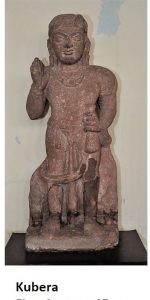 [The world and everything in it are imaginary (mithya) ‘names and forms’! Therefore, tradition depicts Ishwara as a pauper because he does not possess any worldly wealth. However, he transcends the worldly objects and is said to be an embodiment of the Self. In contrast, Kubera possessed a lot of worldly treasures, a collection of mere names and forms, but lacked the real wealth of Self-knowledge. So, he sought guidance from Ishwara.]
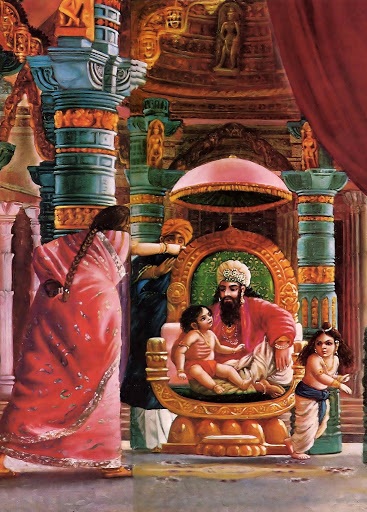 Dhruva was an adorable little boy. He saw his half-brother, Uttama, sitting and playing on the lap of their father, King Uttanapada. He too desired to climb on to the lap of Uttanapada. But his step-mother could hardly tolerate that. She gave a tight slap to him declaring that he was unfit to sit on the lap of the King as he was not born to her but to another queen. Crest-fallen and deeply hurt, the little kid, with his eyes full of tears, ran to his mother. His mother, a highly noble lady, consoled him and advised that he should achieve something so that people look at him with awe. The little Dhruva left the royal palace and went away to a distant forest. He met with a group of Sages in the forest and narrated to them his soulful story. They advised him to meditate on Vishnu. So, he embarked on a very austere and rigorous course of meditation. Regretting heavily the developments, the King and all his retinue, his mother, the queen and all his family implored that he should give up his askesis and return home. The King was even ready to abdicate the throne and promised to coronate him. But Dhruva was unrelenting. He did not succumb to the temptations and was uncompromising in his resolve. He pursued his meditation with greater vigor. He meditated on Vishnu, the Ultimate.