Mandukya Upanishad – part 1

Here is Part 1 of a new, short series (5 or 6 parts) on the Mandukya Upanishad, from James Swartz.

This first part talks about the means for obtaining knowledge and the meaning of the word ‘limitlessness’, using the snake and rope metaphor.

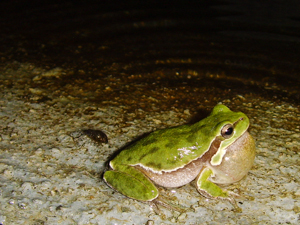
(In case you are wondering about the photo, the title of the Upanishad is sometimes claimed to be derived from the Sanskrit ‘maNDa’, meaning ‘a frog’.)

Prāptiḥ – Attainments – 2 types

Whether I seek artha – security, in the form of food, clothes or shelter, or kāma – pleasures, it is really happiness that I seek all the time; only that I think happiness comes from these external objects and hence my extroverted nature. Even when pursuing dharma, it is happiness in the other worlds that I seek. mokṣa is really being happy here and now, and hereinafter.

prāptiḥ the word means to gain, to attain. Let us analyze this extroverted pursuit for happiness. Everyone agrees that money is essential for a happy life. We see those who don’t have money suffer, and those who have money to be happy; hence we conclude that “money gives happiness”. Based on this conclusion, we orient our lives and that of our dependents, towards earning as much money as one possibly can, so that we can remain happy everafter!!! Continue reading

Panchadashi series

Some of you may remember that I was posting a series of posts, presenting a new translation and commentary by James Swartz on the Panchadasi. Apologies for the long delay since the last post.

James and I had begun this collaboration on turning his lecture notes into a new written commentary on the text. But we have realized that this would require long-term commitment and we are both too busy at present. Accordingly, this is being postponed indefinitely. Meanwhile, he has given his permission for us to serialize some of his other writing, beginning with his essay on the Mandukya Upanishad. So see the next post!

Discussion on chidAbhAsa

In the comments following the Question and Answer on the subject of mAyA and Ishvara – Q.325, Peter and I began the following exchange on the subject of ‘reflection of Consciousness’ (between the <<<  >>> marks below). We continued this discussion off-line. Now that this has been concluded, we are posting the discussion so that others may, perhaps, benefit from the clarification that ensued.

<<<

PB: 2. The easiest misunderstanding to resolve is the distinction between ‘original consciousness’ and ‘reflected consciousness’: there is NO difference. To explain this we are given the analogy of light. Any opaque object is seen because it reflects light. One can say that the light reaching our eyes from the object is ‘reflected light’. But what is the difference between ‘reflected light’ and ‘original light’? There is no difference: light is light. ‘Reflected light’ is merely the name given to ‘original light’ seen together with a reflecting medium (the object). In the same way, ‘reflected consciousness’ is the name given to ‘original consciousness’ seen together with the reflecting medium of the perceptible gross and subtle universe. ‘Original consciousness’ is given the name Brahman. Continue reading

Vision Of Truth (sad darshanam – 4)

sarvairnidAnam jagatohamashcha

vAchyaH prabhuH kashchidapAra shaktiH

chitretra lokyam cha vilokitA cha

paTaH prakAshopyabhavat sa ekaH—3

sarvaiH = by all; nidAnam = cause;  jagataH = of the world; ahamaH cha = and of ‘I’;

vAchyaH = is (popularly accepted); prabhuH kashchit = somemLord; apAra shaktiH =

limitless power; chitre = picture;  atra = here;  lokyam cha vilokitA cha = seen and the 

seer; paTaH = canvas; prakAshaH = light;  abhavat = became; saH ekaH = that one.


The cause of the world and the ‘I’ (individual) is popularly accepted by all to be some Lord of limitless power. Here, in this picture, that one has become the seer, seen, the canvas and the lights also.


Even as children, we have a curiosity to know how the universe began. If the big bang occurred in time, there would have been time and space already; even otherwise who created that dense matter that made a bang. Such curiosity to go to the root is natural to a thinking person.

Continue reading

Short questions and answers No. 2

Here are a few more short Q & A’s which do not merit a separate post of their own: (Dennis’ answers, so don’t blame any of the other bloggers!)

Q: Nisargadatta says : Delve deeply into the sense ‘I am’ and you surely discover that the perceiving centre is universal, as universal as the light that illumines the world. All that happens in the universe happens to you, the silent witness. On the other hand, whatever is done, is done by you, the universal and inexhaustible energy.

My question in two parts:

 1. If my awareness is the absolute one and there is no other – then yours does not exist?

 2. If they both exist as the Absolute but are separately perceived by two minds why am I not aware of your experience as well as my own?

 So far as I can see, without reliance on solipsism, non-duality/Vedanta must posit a reality where the Absolute is being “dipped into” by separate minds? Continue reading

Annihilation of Thought

Yogavaasishta is a remarkable Advaitic text in many ways. It is at once a theoretical text and a practical Manual. It combines the abstruse Vedantic concepts of Non-duality with simple doable tips and presents them in an engrossing manner.  Sage Vasishta often uses the technique of bringing home the most intricate philosophical point through a fictitious tale crafted on the spot with imaginary characters  representing with high fidelity the point to be illustrated in an unforgettable manner.  One such story is of Kadamba Daasura**. It tells us about the untenability of the perceived world. Daasura is shown to be living on the last tender leaf of the topmost branch of a Kadamba tree (Anthocephelus – Latin name: Adina cordifolia) where sustenance for any being, leave alone a human, is impossible. Sage Vasishta intends to impress on us that the sustenance of a world (which we take to be real and functioning) to be equally impossible.

Daasura teaches his son that the world is a creature of the ‘thought’  that thinks it. Intent on ending the world, the son who is hardly in his early teens enquires what is thought and how thought itself originates and what are the means of annihilating the thoughts. Daasura’s response to these questions is very profound and a summary is presented below. Continue reading

upadesha sAhasrI part 5

Part 5 of the serialization of the  presentation (compiled by R. B. Athreya from the lectures given by Swami Paramarthananda) of upadesha sAhasrI. This is the prakaraNa grantha which is agreed by most experts to have been written by Shankara himself and is an elaborate unfoldment of the essence of Advaita.

Subscribers to Advaita Vision are also offered special rates on the journal and on books published by Tattvaloka. See the full introduction and part 1 of the new series.

You are the witness—or are you

Today on the beach on Maui my friends and I met a man who had a debilitating stroke that had changed his life completely. He was only 49 years old. His wish was to swim in the ocean, but he and his wife had felt unable to bring that off, and so they had stayed on the shore merely looking at the water. My friends helped this man into the water thus fulfilling his wish.

Later he spoke to us about the stroke that had totally changed his life. He was sad. He was depressed. He said that he no longer liked himself. His story was very touching.

With compassion he was advised to understand that in reality he was not the body, but rather the witness of the body, not only the witness of the body, but the witness of the thoughts which passed through his mind, including those thoughts about himself which were negative. Continue reading

brahman and AkAsha – Q. 326

Q: My mind has this tendency of creating doubts every once in a while and I was able to find answers for every doubt I’ve had through contemplation, logic and reasoning. But not this one.

Before I begin, please understand that my mind simply will not accept anything that cannot be proven to it through logic and reasoning, which is why ‘Sruti says so’ has not satisfied my mind.

So, my question is, how can we say that Brahman is the cause of Akasha (I’m referring to the Vedic element which is the substratum of everything that exists) and not Akasha itself? How do we know that consciousness itself is simply not the Akasha our bodies are made of which happens to be a conscious entity?

I understand that reality is non-dual, but Akasha being omnipresent (basis of all things), omnipotent (since it is Akasha that takes all forms, it can be said to be the cause of everything), omniscient (if we cannot deduce that Akasha is an unconscious entity, it would become omniscient), infinite, eternal and able to take forms without changing its own nature makes it no different from what is described as Brahman. Continue reading