Tat Pada Vicāra – 1 – Sṛṣṭi – Creation

CreationIn the previous article, I had said that īśvara and jīva have to be understood in their entirety in order for us to understand the mahāvākya, tat tvaṁ asi. Over the next few articles, we will attempt to have a fuller understanding of who īśvara really is.

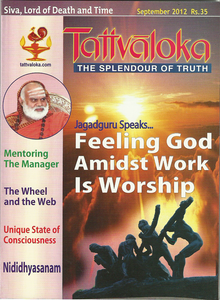

The most important understanding of īśvara is his dimension of being the abhinna nimmitta upādāna jagat kāraṇam. Its means the one who is the non-different intelligent and material cause of the jagat. Continue reading

Q.344 – Death of the small I

Q: While I’m drawn to the apparent peace that sages such as Ramana Maharshi seemed to enjoy, I feel I’m failing to grasp something.

 Advaita seems, sometimes, to be totally nihilistic and bleak (although I accept that this would not constitute an argument against its veracity).

It’s all very well to say that the ‘self’ can’t die but this seems (from my perhaps benighted viewpoint) to be playing with semantics.

 If, with ‘my’ death, comes only oblivion such as in deepest sleep /anaesthesia, where is the comfort or meaning in this knowledge? The end of my small ‘I’ would seem to be, in effect, the end of everything since, without my consciousness to perceive it, how can anything be said to exist?

 Does one take comfort from the fact that other apparent ‘I’s continue to experience within the one reality? It may be that my existence is only apparent and that, whether it is followed by oblivion is irrelevant – but it doesn’t feel like that from where I’m sitting! Continue reading

Logical enquiry into ‘Who I am’ (2/4)

who am I 2In the first part of this enquiry we saw how, by discriminating between the seer and what’s seen, we arrive at the understanding that ‘I’, the seer, am not the body, not the sense powers, not the thinking faculty, not even a combination of all of them. They are all objects of my perception and I am the perceiving subject. And I, the subject, cannot be what I can perceive as an object. In this logical way we arrived, step-by-step, at a final ‘knower’, which is given the name ‘pure consciousness’. This pure consciousness is what remains after thoughts, (which are the subtlest objects of perception), have been dismissed as the ultimate ‘I’. We know there’s something there but it is still a bit hazy. We now need to test the robustness of our new working conclusion that this ‘pure consciousness’ is the ‘I’ we are searching for and sharpen the understanding.

For this we need to understand the nature of consciousness and its relationship, if any, with ‘I’. A question might arise at this point: If ‘I’ is the pure consciousness that remains in the absence of vtti-s (thoughts), and no cognition is possible without vtti-s, then how can I ever know what I am? How do we go further with this enquiry if there are no thoughts? Continue reading

Eka jIva VAda – I Am Alone: Part V

Part – IV

This Post responds to the Comments of 18th April made by Suka.

(Suka’s Comment in blue and my response in black).

S:  Mithya is defined as sadasadbhyām vilakṣaṇam – meaning it cannot be categorically classified as truth or false. Mithya is vyāvahārika, experientially efficient, substantially unreal. 

R:   vyAvahArika and prAtibhAsika fall under mithya.  Both vyAvahArika and prAtibhAsika are experienced in their respective spheres, and both derive their reality based on the Reality of the immutable substratum. Dr. Mani Dravid Shastri also suggests in his lectures on adhyAsabhAshya that, “mithya can be divided into two categories, namely vyAvahArika or empirical and prAtibhAsika or illusory.”

S:  The argument tat pot is an illusion does not hold water, because pot does hold water.

R:  “Holding water” too is as much an illusion as pot or water!!

Continue reading

Eka jIva VAda – I Am Alone: Part IV

Part – III

This Post is once again in continuation to the discussions on my earlier Posts.

I shall try to answer the questions and clarify on some of the conceptual issues raised by our esteemed Colleague Suka in his Comments of the 15th of April.

That we have to necessarily use words to express ourselves is pretty obvious. But the words come with their own baggage especially when we use them in contexts that are non-quotidian and are hence liable to be understood or misunderstood in unintended terms. Therefore, it looks to me that I should begin with clarifying the meaning of some of the words, and many a time, this by itself, will have the potential to resolve some of the pending confusion.

Suka observed, inter alia, in his comments of the 15th April:

I)   “Traditionalists (do not) consider neither māṇḍūkya bhāṣya nor vivekacūḍāmaṇi as authentic works of śaṅkara for this very reason.” [I guess “do not” is a typo.] Continue reading

S&T Developments You may Like To Take Notice Of

If our valued Readers are interested, I propose to start a New Series of Posts on some of the latest Scientific advances that could be of interest to our Community of Advaita Thinkers and Philosophers. These Posts will be infrequent and in the form of simple “Alerts” on the current research findings. What gets reported by me will obviously be constrained by at least two of my own limitations:

(i)  The conscious and or unconscious ‘filtering mechanism’ exercised by my mind in selection of the topics; and

(ii) What research papers happen to come to my notice.

For the present, here is a sample Post to show how I propose to structure this venture taking selections from the works published during the last couple of weeks:

[If Dennis agrees and if there is sufficient interest, we may continue and improve upon this idea.  Readers may like to send their views to Dennis (in confidence, if desired).] Continue reading

upadesha sAhasrI part 10

upadesha10

Part 10 of the serialization of the  presentation (compiled by R. B. Athreya from the lectures given by Swami Paramarthananda) of upadesha sAhasrI. This is the prakaraNa grantha which is agreed by most experts to have been written by Shankara himself and is an elaborate unfoldment of the essence of Advaita.

Subscribers to Advaita Vision are also offered special rates on the journal and on books published by Tattvaloka. See the full introduction and part 1 of the new series.

Review of article on Shankara – part 3

Ramakrishnan Balasubrahmanian (RB): “Now the error in calling avidy¯a as something epistemic should be obvious. The following extract, from [SSS], is clearly putting the philosophical cart before the horse:

‘Avidy¯a is subjective and has been explained by ´ Sa ˙ nkara as the natural tendency of the mind to superimpose the self and the not-self oneach other.’

When the conception of j¯ıva itself is due to avidy¯a, how can avidy¯a be the ‘natural tendency of the mind to superimpose the self and not-self’?” (*)

Our reply: To repeat, it is not just avidya as a general concept, that is, ignorance, but avidya-adhyasa, which is a technical (double) concept whose consequences are far-reaching in empirical life, being responsible for all divisions and superimpositions. No reason why this should be considered a circular argument. Continue reading

Q.343 – Meaning of Ishopanishad mantra

Q : The second line in the first Shloka of Ishopanishad begins with ” Tena tyaktena Bhunjeeta”. The literal meaning appears to be ” therefore, enjoy with a sense of tyaga or renunciation (as everything created in this world is permeated by Ishwara) but Adi Shankaracharya has interpreted these words to mean ” protect ourselves”. Is there a satisfactory explanation for this interpretation? 

Also, the second word of first verse of Ishopanishad: is it vasam (is full) or vasyam (should be considered full). Shankara says vasyam. Vasam appears more logical to me.

A (Ramesam): In order to fully appreciate and admire the beauty and profundity hidden behind the simplicity of a cryptic statement, one ought to know the background and the context against which that expression gets developed.  It is as much true when we talk of an equation such as E = mc^2 or a routine proverb like ‘Still waters run deep.’ Continue reading