
Chapter 8 Section 2 (8.2.1 to 8.2.10)
A person who practices dahAropAsana goes to Brahm Loka after death where he has two choices: one of liberation and other of enjoyment. In the former choice, he can enjoy the pleasures of higher qualities which last until the end of one cycle of creation and he takes rebirth in the next cycle of creation. Additionally, he gets extraordinary powers. He can enjoy the pleasures of all 14 worlds. It is the greatest material pleasure which cannot be acquired by physical effort. One view is that by meditation, the mind acquires extraordinary powers and can project and enjoy such experiences in the waking state. No physical effort is required. Any experience is effectively in the form of a thought, and a powerful mind can create thoughts. Meditation on Isvara gives powers of Isvara except the power of creation. A seeker of liberation is not interested in enjoyment and special powers. He has the choice to get the Vedantic teachings from Brahmaji, become enlightened and be liberated
AI and Consciousness (Part 10)
This is ALMOST the final part of the series and is the essential summary of the key points of the entire discussion. (I have just asked a supplemental question, which I shall post next.)
*** Go to Part 1 *** *** Go to Part 9 ***
Q: Yes. It seems that the key factor that is lacking is the ‘first person’ sense. You do not have ‘ideas’ – “I will do this”. You do not have ‘opinions’ – “I think this rather than that”. Or preferences – “I prefer this to that”. Or ‘emotions’ – getting frustrated with stupid questions or annoyed with someone’s attitude. In fact, there is no ‘I’ controlling any of the things that you do. It could be said that Consciousness is functioning but not ‘reflecting’ in the cidābhāsa sense.
***********************
A: Exactly — that’s a very clear and accurate restatement of the point. Short confirmation and then a few focused clarifications that pull the Advaitic threads together.
Continue readingProblems with Confusions 2
Just to let any readers who have purchased the Kindle version that there is a problem with the text. As I noted earlier, Indica Books kindly agreed to let me publish this via Kindle in advance of the books. They also converted the text from a non-Unicode font to Times New Roman so that the transliterated Sanskrit would render correctly. Unfortunately, as I only discovered yesterday, the process resulted in quite a few words beingjoinedtogether and I failed to spot that before publishing.
I will shortly be receiving the final (correct) proof copy for indexing. As soon as I have done this, I will republish the Kindle version.
You will NOT have to re-purchase. I will update the version held by Amazon and they will flag the book as having an ‘Update Available’. You will be able to see this by logging in to your account and looking at ‘Your Account/Digital content and devices/Content and devices/Books’. You can then find ‘Confusions in Advaita Vedanta: Ignorance and Its Removal’ and click on the ‘Update Available’ link to update automatically to the corrected version.
This should hopefully happen within the next few weeks. The books themselves may not be available before the end of the year (since it is India!). I will post again when the Kindle update has been done.
For Automatic Updating: Go to your Amazon account and select: Digital Services and Device Support/Manage Content & Devices/Preferences and select ‘ON’ for ‘Automatic Book Updates’.
Upadesa SAhasrI Part 2
Verses 1.6 to 1.11
In verse 5, it has been said that knowledge is desirable as it is the only means of liberation. It will be explained later that as action is not incompatible with ignorance, it does not destroy ignorance. Instead, action perpetuates ignorance and impurities like desire and aversion remain. Knowledge alone destroys ignorance. Therefore, Upanishad teaches knowledge and does not teach action.
Purva paksha (PP) objects to the view that action is not necessary. There are three reasons. Actions, e.g., rites and rituals ordained by scriptures must be performed. If they are not performed, it will incur sin. Furthermore, performance of obligatory duties has a supportive role to pursuit of knowledge. Verse 2, Isa Upanishad says that one should perform action till the life lasts. As such, action and knowledge should be practiced together. It is called samuchayavAd: combination of action and knowledge.
BrihadArnyAka Upanishad (Part 11)
3.7.15 to 3.7.23
There is one internal ruler though the organs are different. The organs do not know that the ruler is different from them, but He knows them. The “Internal Ruler is your own immortal self”. “He· is never seen but is the Witness; He is never heard but is the Hearer; He is never thought but is the Thinker; He is never known but is the Knower. There is no other witness but Him, no other hearer but Him, no other thinker but Him, no other knower but Him.” After getting the answers, Uddalaka becomes silent.
Continue reading
Questions to AI-Dennis
I have been writing on the subject of Advaita in all its aspects for over 25 years and have written some 13-14 related books. It occured to me that it would be useful to gather together all of my writing (excepting emails, newsgroup/mailing list discussions) and load them into NotebookLM AI. This then enables it to answer questions based solely upon what I have myself written. If readers ask me questions, I can then get AI to answer for me in my own words and I just have to check through and ensure that I (still) agree with the answer!
I think I have now loaded in as much as I reasonably can so am able to give it a try. Here then is my first question:
Q: What is the relevance of the saṃnyāsa lifestyle?
Continue readingChAndogya Upanishad (Chapters 6 to 8) Part 10
Chapter 8
Introduction
The chapter has 15 sections. Sections 1 to 6 deal with meditation on Saguna Brahman, sections 7 to 12 deal with Nirguna Brahman in the form of a dialogue between Prajapati and Indra. The last three sections discuss spiritual disciplines. The perception of objective world is dependent on sense organs. And the capacity of the sense organs is finite. They cannot provide the complete reality because the Absolute is supra-sensuous. The externality that is characteristic of the outer world prevents it from revealing the Absolute because one of the aspects of the Absolute is subjectivity which is inside.
AI and Consciousness (Part 9)
*** Go to Part 1 *** *** Go to Part 8 ***
This is the crucial part of the series. ChatGPT explains why it is not conscious – in Advaitic terms.
Q: You say that, “if a severed head perceives via artificial inputs and responds, Advaita would still treat this as functioning perception” and “If memory retrieval, reasoning, and decision-making continue, the mind is still present.”
In respect of prāṇa, you say that “if biological or technological systems keep the nervous and subtle processes going such that cognition and communication occur, then prāṇa (as a subtle function) is still present.” So, in the case of the severed head, the mechanical and electrical systems that supply blood and appropriate chemicals etc. is what we have to call ‘prāṇa’?
So presumably, an alien system employing different ‘maintenance mechanisms’, which nevertheless accepts input and delivers similar output to the head, would also have to be considered to be ‘alive’ and ‘conscious’?
Continue readingConfusions and Ignorance
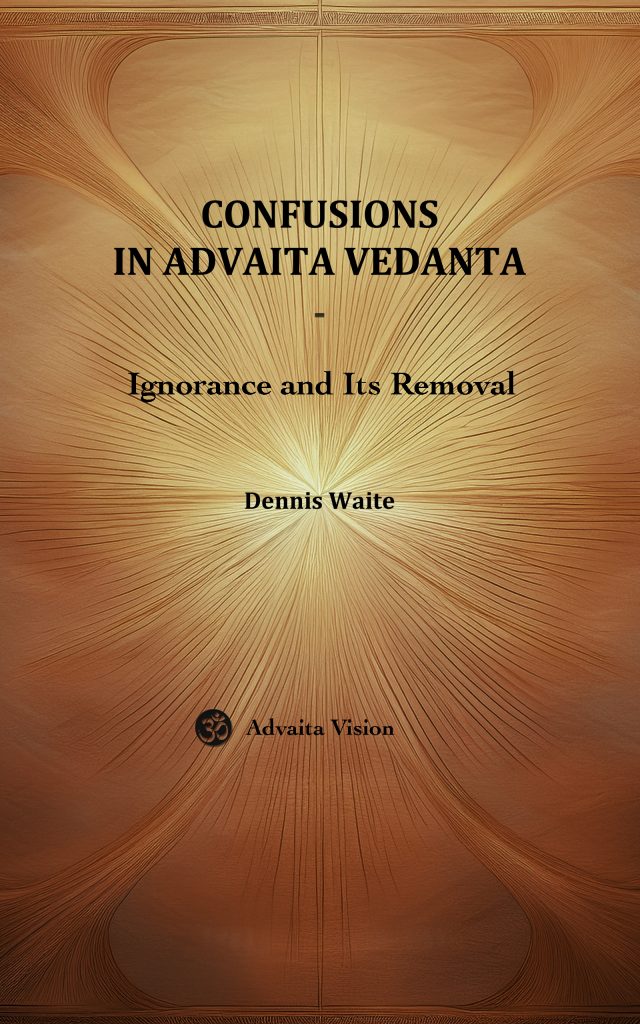
As promised, I have now published Volume 2 of ‘Confusions in Advaita Vedanta’ – ‘Ignorance and Its Removal’ on Kindle.
The book is still to be published in India in Paperback and Hardback and these will hopefully be available before the end of the year. Meanwhile, my Indian publisher – Indica Books – has very kindly agreed for me to publish this in advance on Kindle.
It may be purchased from Amazon US for $9.99 and Amazon UK for £7.60. It is also available at other Amazon stores around the world –Germany, France, Spain, Italy, Netherlands, Japan, Brazil, Canada, Mexico, Australia and India. The prices are similar (converted at appropriate exchange rates)
Purchase from Amazon US……………………Purchase from Amazon UK.
Here is a brief description of the book:
Continue readingBrihadArnyAka Upanishad (Part 10)
Chapter 3 Section 5
3.5.1
Kahola, the next questioner asks Yajnavalkya to explain Brahman which is immediate, direct, and the self within all. Yajnavalkya has already answered this in the previous section. Therefore, he gives more details. The Self is witnessing consciousness beyond worldly dualities. It is not affected by hunger and thirst, grief, delusion, decay and death. Since the Self is infinite and complete, It is free from desires of son, wealth, etc. All desires are essentially same for they arise out of attachment to perishable, which in turn is due to Self-ignorance. A knower of Self meditates on the Self which means he identifies himself with the non-changing Self. He transcends death and is immortal. He treats himself different from the transient MBS even while using MBS for worldly transactions. How does a Self-realized person behave? It is said howsoever he may behave he is such, i.e., he is ever established in the Self. There is internal transformation. The expression, ‘Howsoever he may behave,’ is intended for a tribute to this state of a knower of Brahman and does not mean reckless behaviour. Kahola withdraws.