Q.400 – Consciousness and the person

A few questions or clarifications please…

  1. As you’ve said to me before, to focus on this world and everything within it, is really the wrong focus, because it’s mithyA. And what we really are, is that in which all of it occurs?
  2. Am I correct in saying that Vedanta is truly a specific system or process to know who you really are as well as understanding the functioning of everything?
  3. So the elements or energy is not who we are since they are dependent on Consciousness. As Nisargadatta said, “without Consciousness nothing is”.
  4. To gain self-knowledge however, there must be a body with a nervous system. So the body does matter in relation to self-knowledge? But, consciousness doesn’t care whether it’s manifested or not?
  5. Words cause confusion, so what is the difference between Consciousness and Awareness from your understanding?
  6. The mind is discussed a lot, and many say that to have ‘no mind’ is the key to peace and freedom. Is the mind a part of the brain or something entirely different?
  7. Upon gaining self-knowledge, does the mind continue or fade away if you will, leaving the brain to function in its normal and natural way without the mind blocking it?

A (Dennis):

  1. You are not the body-mind; you are Consciousness. There is only Consciousness in reality; the ‘rest’ is just appearance and mistaken interpretation.
  2. Advaita is a teaching methodology to bring you to this realization.
  3. Elements, energy etc are only name and form of Consciousness.
  4. In reality, there is only Consciousness. From the perspective of the person, there is a body-mind. The realization that there is only Consciousness has to take place in the mind of the person in order for the person to realize that ‘All there is is Consciousness’.
  5. You can define words how you like. As long as you do this, there need not be any confusion. The way I use these terms is that Consciousness (capital ‘C’) is the reality (better called ‘Brahman’ to avoid confusion); and ‘awareness’ (capital or not) and ‘consciousness’ (small ‘c’) refer to the person’s perceiving/conceiving ability.
  6. The ‘person’ requires a mind in order to function in the world. This applies whether the person has Self-knowledge or not.
  7. It is likely (though not necessary) that the mind of someone with Self-knowledge will be less prone to disturbance by desire/fear etc.

Tattvabodha – Part 23

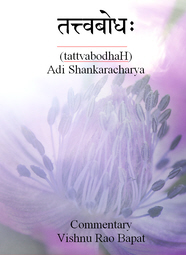
Part 23 of the commentary by Dr. VIshnu Bapat on Shankara’s Tattvabodha.This is a key work which introduces all of the key concepts of Advaita in a systematic manner.

The commentary is based upon those by several other authors, together with the audio lectures of Swami Paramarthananda. It includes word-by-word breakdown of the Sanskrit shloka-s so should be of interest to everyone, from complete beginners to advanced students.

Part 23 continues the enquiry into the statement ‘you are That’ (tat tvam asi) and looks at the meaning of ‘you’ and ‘That’.

There is a hyperlinked Contents List, which is updated as each new part is published.

Is the universe conscious?

www.quora.com/Can-you-disprove-the-fact-that-the-universe-is-conscious/answer/Lonny-Wortham-II 

Can you disprove the fact that the universe is conscious?

[“Universe” is defined as “all existing matter and space considered as a whole”.

There are conscious beings within this universe.

They are part of the universe.

Therefore, the universe is conscious (with its consciousness manifesting in specific places such as the brain of a conscious being).]


LW. No. You are essentially asking whether or not we can disprove the existence of a pantheistic god.

We can not disprove that possibility. However; we can take a look at the logic that underlies your supposition. Continue reading

Overview of Western Philosophy – Part 12

(Read Part 11 of the series.)

Marx and Nietzsche

Marxism

As noted earlier, Hegel’s philosophy was very influential with Marx, whose ideas are the basis of the intellectual foundation of Communism. In particular, he accepted Hegel’s concept of reality as an ongoing dialectic process, which could be monitored through a study of history, and which would continue to evolve until there were no further internal contradictions needing resolution. Not until this was achieved would true freedom and fulfilment be possible for man. He believed that the sort of society that would bring this about would be one in which individuals acted together rather than independently. Marx did not however agree with Hegel’s concept of a spiritual ‘Absolute’. Any form of religious belief or pursuit was seen as an attempt to escape from the meaninglessness that life had become.

He believed that matter, in the sense of man’s relation to it, was the driving force behind progress, and this meant that subjects such as the production and distribution of goods, and the economics of this, became extremely important. Thus he would have argued that socialism was simply the point that had been reached in the process of evolution, not something that he was specifically advocating, though his personal commitment to the ‘revolution’ is apparent in his writing. But all of this is a matter of politics and was advocated at the expense of ethical considerations. Continue reading

Q.399 – Self-evident Atma

Q: I want to ask about the following quotation from your series on upadesha sAhasrI – part 19 (upadesha sAhasrI compiled by R. B. Athreya from the lectures of Swami Paramarthananda):

Atma, though a knower of everything, is not a known object, because, if Atma were to be a known object it will need another Atma to know, leading to what is known as infinite regress (anavasta dosham)Atma cannot be known by itself, because, to be known by itself, it has to become both the subject and the object, which is not possible as one and the same entity cannot function as subject and object simultaneously.

We cannot also say that one part of Atma can be known by another part, as Atma is by definition partless.  Thus, Atma is ever the knower but not known by others or by itself. 

As Atma is self-evident, its existence needs no proof.  That I am conscious is evident to me.  The very search for proof is possible because of my being conscious.  Thus, Atma is revealed as self-evident Witness Consciousness which illumines everything and which cannot be objectified by anything.  This Atma is my real nature.  All the known attributes belong to the known objects and cannot belong to the knower, Atma (consciousness).” Continue reading

Q.398 – Use of metaphors

Q: There are two concepts, super-imposition and manifestation, in Advaita to  describe the ‘relationship’ between Brahaman and the empirical world. Super-imposition means that the world is super-imposed on Brahaman. Manifestation means that the world is a manifestation of Brahaman. My doubt is as to how a manifestation can be super-imposition also? My gut feeling is that there is a subtle link between the two concepts which I am unable to ‘see’ because of the proverbial ‘ignorance’. 

A (Dennis): They are each a metaphor to give the mind some insight into the nature of reality. The reality is non-dual so that all metaphors and all ‘explanations’ are ultimately untrue. The world and the jIva are mithyA. Brahman has no relationships. Use the metaphors and explanations of the scriptures and teachers to help guide the mind to realization of the truth but don’t ever take them as more than what they are. And do not worry if one ‘explanation’ disagrees with (or even contradicts) another. They all have to be dropped in the end!

Q.397 – Why are scriptures needed?

Q: From the blogs and articles on Advaita, it seems like Scriptures are the basis from which everything is derived. If Scriptures were also written by humans, why is it considered sacred? Why can’t we independently come to same conclusions completely discarding scriptures?

e.g. Why couildn’t Vivekananda or Ramana Maharishi state something original about Self without reference to scriptures? All we see is a definition of Self without knowing the process by which it has been arrived at. I feel I am no different from the guy who slaughters innocent people because something is stated in a Book.

A (Dennis): Upanishadic material was passed down by word of mouth long before it was written down. From teacher to disciple; from those who knew to those who did not. The disciple trusts that the teacher will explain things until such time as the disciple realizes the truth. The seeker is specifically asked to use reason and own experience to validate what is said. If what is initially taken on trust is found to be invalid, it is rejected. If it is contrary to reason, it is rejected.

How does this process differ from science? Should you re-prove/re-derive all of the scientific laws from first principle and own experiments before you accept them? And if something is true, and fully understood by those who have gone before, how can one state something ‘original’? Moreover, why should one try? If teacher-seeker tradition over thousands of years have established an optimal way of passing on knowledge, isn’t it the height of arrogance to think one could do better?

adhyAsa (part 1)

Notes on Shankara’s examination of the nature of ‘Error’ in the introduction to the brahmasUtra.

adhyAsa is possibly the most important concept in Advaita – certainly in Advaita as ‘formulated’ by Shankara, since he wrote an extended introduction to his commentary on the Brahmasutras on this topic. I wrote this article originally for Advaita Vision but (as far as I know) it is no longer available at that site so I am reproducing it here. It will be in 4 or 5 parts.

These notes are essentially a rewording, omitting most of the Sanskrit, of the notes provided by Achacrya Sadananda on the Advaitin List and I gratefully acknowledge his permission for this. In turn, he wishes that I acknowledge his own indebtedness to H.H. Swami Paramarthananda of Madras, himself a student of Swami Chinmayananda and Swami Dayananda. His lectures form the basis of these notes.

The brahmasUtra is the third of the so called ‘Three pillars of vedAnta‘, the first two being the upaniShad-s (shruti – the scriptures ‘revealed’ and not ‘authored’ by anyone) and the bhagavad gItA (smRRiti – the ‘heard’ scriptures passed down by memory). The brahmasUtra is a very terse and logical examination of the essential teaching of the upaniShad-s, seeking to show the nature of brahman and the superiority of the philosophy of vedAnta. It is usually studied with the help of a commentary or bhaShya, the best known being the one by Shankara. Continue reading

Tattvabodha – Part 22

Part 22 of the commentary by Dr. VIshnu Bapat on Shankara’s Tattvabodha.This is a key work which introduces all of the key concepts of Advaita in a systematic manner.

The commentary is based upon those by several other authors, together with the audio lectures of Swami Paramarthananda. It includes word-by-word breakdown of the Sanskrit shloka-s so should be of interest to everyone, from complete beginners to advanced students.

Part 22 begins the enquiry into the statement ‘That thou art’ (tat tvam asi) and looks at the differences between AtmA and jIva.

There is a hyperlinked Contents List, which is updated as each new part is published.