Tattvabodha – Part 7

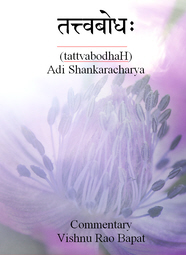
OLYMPUS DIGITAL CAMERAPart 7 of the commentary by Dr. VIshnu Bapat on Shankara’s Tattvabodha.This is a key work which introduces all of the key concepts of Advaita in a systematic manner.

The commentary is based upon those by several other authors, together with the audio lectures of Swami Paramarthananda. It includes word-by-word breakdown of the Sanskrit shloka-s so should be of interest to everyone, from complete beginners to advanced students.

Part 7 begins the section on Atma vichAra – investigation into the nature of Atma – and in this part specifically asks the questions ‘What is true knowledge?’ and ‘Who is Self?’. There is also a hyperlinked Contents List, which is updated as each new part is published.

How could we merge absurdist and Buddhist philosophies?

www.quora.com/How-could-we-merge-absurdist-and-Buddhist-philosophies

M. Provisionally we could put side by side ‘absurd’ (or illogical) and ‘unprovable’, even if they are not synonymous; and the main tenets of all religions are such. They are not ‘rational’. On the other hand, neither science, ‘common sense’, or rationality are the ‘end all’. There are many things that escape explanation with the current state of our knowledge and understanding.

Paradox is a term related, one way or another, to the above. Just consider the following:

i) “How wonderful that we have met with a paradox. Now we have some hope of making progress”. Niels Bohr (famous physicist)

ii) Is there anything more absurd to ordinary understanding of the world and us than the following (taken from my blog): “That truth, put into words, is paradoxical: you are all (as Consciousness) and ‘you’ (as perceived individual) are nothing, or a phantom; you are the final witness, but ‘you’ are not a witness; the world is illusory (as appearance), but in essence is reality itself. That revelatory, transcendental experience is non-transferable, not provable to another.”

GL. If by absurdism you mean acknowledging that there is no absolute truth, then zen buddhism when asked what is enlightenment, answers “6 pounds of flax”, which is, I believe, trying to point out that absolute truth is impossible.

M. You probably mean ‘impossible to demonstrate, or to know, with the ordinary mind’, but ask a zen buddhist if it (absolute reality or truth) is impossible to grasp, to grok.

GL. I think the point of the flax koan is that you can’t know satori with certainty.

M. Is it not rather that the experience cannot be explained – or transmitted – with words, being ineffable? Such is a transcendental experience, where there is no individual per se present.

GL. Isn’t “ineffable” the same as saying we can’t know with certainty?

M. No, it means ‘inexpressible’, the experience being overwhelming (rather than being too sacred – another meaning).

GL. If you can’t describe it, then it isn’t knowable.

If it is purely a matter of experience, then there is no way for me to know you are experiencing something the same way I am. Color is ineffable. You experience red and green the way you do, and I experience it the way I do. And unless we have an objective test for color blindness, there is no way to know if you see what I see. Some people see color when they hear sound. And as long as that experience is ineffable, there is no way to know if we see color the same way. Only when we establish some objective explanation and some objective testing can we know with certainty if we are experiencing similar things.

M. You refer to what are called qualia, but I am not sure how far you want to go (can nothing be known? In what sense?) Most empiricists/scientists tend to disregard this question or deny that it presents any problem for their physicalist stance. In non-duality, which is what interests me, there are not, cannot be, any objective tests referable to either external or internal experiences of what generally is understood as reality (the world and oneself) except, perhaps, in one’s facial expression and/or demeanor. That agrees with what you say about qualia but, aside from non-duality (or as a preliminary to it), it doesn’t mean that there cannot be agreement, concurrence, in the realm of thought, sensations, and feelings. Two people reading the same book or page – if they are on the same wave length (let’s say interest in non-duality, or in a particular modality of art, like Baroque or modern) – will have similar thoughts and feelings. Language is for communication – even about the understanding of non-duality (like zen) – but certain experiences cannot be communicated, such as particular intuitions or epiphanies, regardless of what we understand as qualia, though related to it.

Q. 377 – Desire and suffering

(Also discusses Buddhism versus Advaita; analysis versus experience; need for practice)

Q: Your work is both beautiful and rigorous, and I’ve appreciated your continuous efforts to continue the much-beloved tradition of Advaita Vedanta.

As I consider devoting myself to the path of Advaita Vedanta, I find that I keep coming up against a few constant, nagging protests:

First, it seems that the tradition and methodology (although I also assume that there is quite a lot of variety of how Vedanta is taught and realized) is overly academic and scholastic, at least as I view it from the information that I’ve gleaned during my research.  The unfolding of the teaching of Vedanta seems to leave the student engaging in a lot of analysis, rather than a deep exploration of how they genuinely experience the world, which lacks transformative power because it remains something objective.

Second, according to some of the sources that I’ve gleaned, it seems to place Vedanta on an extremely high pedestal, as something engaged in only following years of other preparatory practices.  But modern practice appears to demonstrate that such preparation, while helpful, is not necessary.  I cite websites like “Liberation Unleashed” and Scott Kiloby’s excellent work which show that directly exploring and inquiring into the truth of statements like, “All there is is pure awareness,” etc., can still be highly transformative outside of the context of a more robust regime of spiritual purification and development.

My fear is that if I follow the traditional route, I will end up entangled in these preparatory practices.  I’ll just be getting the appetizer for years before getting the meal, in other words, but, in my opinion, why wait?

Is this perception true (given that there will be a lot of diversity)?  Do most AchArya-s make their disciples engage in such practices for prolonged periods of time before discussing Vedanta?

I have heard you and many other teachers in the traditional Advaita lineage say things like, “Unless you have a very pure mind…” or “Unless you are highly developed…”  etc., the practice of Vedanta will be fruitless.  But, if you read the logs, for example, of the website “Liberation Unleashed,” you will find some very impure people – depressed, addicted, desperate, you know, the usual seeker lot!, who come out transformed after only a few days of directly looking into their experience.

I appreciate your thoughts on this and your generosity in helping so many confused seekers. Continue reading

Q. 372 – Superimposition and Memory

Q: What is the relationship between memory and superimposition (adhyAsa)? In the metaphor of rope and snake, we say that we fail to see the snake clearly, because of inadequate light – there is partial knowledge and partial ignorance. When we superimpose a snake on the rope, we are drawing on fear and memory. We must have seen a snake (or image of one in a film or book) before in order to be able to mistake the rope for one. Similarly, we mistake brahman for the body and the world etc.

 But what about a baby or someone who has no memory as a result of brain damage? Is there still superimposition in this case?

Responses from Ted, Venkat, Ramesam, Martin, Sitara and Dennis

A (Ted): We have to bear in mind that the example of a rope being mistaken for a snake is an analogy, and as is the case with any analogy, the example is imperfect. In the example, the snake image is based on a previous experience of the mistaken perceiver.

 In terms of mistaking the body-mind-sense complex as well as the innumerable other objects that constitute the manifest universe for Brahman, however, we are dealing with something a little bit different. Whereas in order to mistake the rope for a snake, one must have previously seen a snake, the projection of the apparent reality (i.e., the manifest universe in both its subtle and gross aspects) is not based on experiential memory, but rather results from the mind’s ability to recognize the “cosmic blueprints” that abide in dormant form in the Macrocosmic Causal Body, which is personified as Isvara, and are made manifest through the conditioning that maya upadhi, the limiting adjunct of causal matter, puts upon Brahman. That is, the mind is an instrument that is designed or a mechanism that is “programmed” to recognize these forms and, thus, is able to discern their apparent existence within the cosmic soup of pure potentiality (i.e., the unmanifest realm or “mind of God,” if you will) from the data it receives via the perceptive instruments/organs. Continue reading

Atma vichAra

The Self cannot be ‘known’ in any objective sense because it is the ultimate subject – there is no other subject that could know it. This is why science can never tell us anything about the Self. Science works by collecting data and analyzing it; formulating theories and then using them to predict what will happen when data are gathered in a different situation. This can never be applied to Self/brahman, because brahman has no data.

Strictly speaking, vichAra refers to investigation into ‘things’ so that Atma vichAra is effectively a contradiction in terms; the Self is not a thing. Spiritual investigation has to be done rather differently. The correct term is shAstra mImAMsA and it is really scriptural ‘investigation’ that we must conduct in order to find out about the Self. Monier-Williams translates mImAMsA as “profound thought or reflection or consideration; investigation, examination, discussion”. The philosophical branch that studies the Upanishads etc at the end of the Vedas (Vedanta) is called uttara mImAMsA. (uttara means “later, following, subsequent, concluding” but also “superior, chief, excellent, dominant”.)

We ‘discover’ the Self by removing ignorance. If someone holds up a screen in front of our face and then brings an object to show us, but keeps it behind the screen, we can say nothing at all about the object. However, as soon as the screen is taken away, the object is revealed to our senses and the perception takes place automatically. Similarly, knowledge of the Self is obscured by ignorance but as soon as that ignorance is removed, the Self is immediately self-evident; we do not have to do anything to ‘investigate’ it.

Scripture functions like a mirror. When we look into a mirror, we do not literally see our face and body, we only see an image of it. Yet this enables us directly to perform whatever actions are required on the body itself – combing the hair, shaving and so on. We do not shave the image but the actual hair on the face. Similarly, the scriptures do not directly represent the Self but the information therein, when explained by a qualified teacher, directly enables the ignorance in our mind to be removed, revealing the Self-knowledge which is as though hidden beneath.

Actions will never bring about Self-knowledge, since action is not opposed to ignorance. Nor will practices such as meditation or prayer. As Swami Paramarthananda puts it, meditation will only bring about quiet ignorance.

As Shankara puts it (if he was the author of vivekachUDAmaNi v.13): “It is through reflection over the words of a truly benevolent soul that one comes to a knowledge of reality, and not through bathing at sacred places, charity or hundreds of breathing practices”. [1] I.e. it is through shravaNa, manana and nididhyAsana and not through asking ‘Who am I?’ that one gains Self-knowledge.

[1] The Crest Jewel of Wisdom; viveka-chUDAmaNi, commentary by Hari Prasad Shastri, Shanti Sadan, 1997. ISBN 0-85421-047-0.

Should I stop enquiring???????

ripplesShould I stop enquiring???????

Vijay Pargaonkar

(मुञ्डकोपनिषत्) MundakaUpanishat 3-2-9

“Anyone who knows that supreme Brahman becomes Brahman indeed……….”


My search for Brahman started with aparokshAnubhUti (supposedly written by Shankaracharya) where it is stated that knowledge of liberation is obtained through enquiry. It then goes on to explain what constitutes enquiry:                                                               (अपरोक्षानुभूती) aparokshaAnubhUti (Shloka #11 & #12) (translation by Vimuktananda)

“Knowledge is not brought about by any other means than Vichara (Enquiry), just as an object is nowhere perceived (seen) without the help of light”.

“Who am I? How is this (world) created? Who is its creator? Of what material is this (world) made? This is the way of that Vichara (Enquiry)”. Continue reading

Q. 371 – Deep-sleep state

Q: In advaita, we use the recall of a “good deep sleep” as a very important argument for proving continued presence of awareness… the question is, how does this recall happen? We have a process in advaita by which ‘the presence of a pot is known’. How is deep sleep known? Or – How is the fact that one slept well, recalled?

Responses from DhanyaRamesam, Martin, Ted and Dennis

A (Dhanya): When I was a child, there was a TV show I liked to watch.  It was called ‘You Are There.’  As I recall, the show depicted a famous scene from history, and then ‘you’ (meaning in this case the narrator), magically showed up in the scene and got to ask the historical figures all sorts of questions.  (I guess I should Google it to make sure I recall the details of the show correctly).  Anyway, I do remember that I enjoyed the show, and often these days recall the title, because one could ask oneself the question, ‘How is anything known?’ and the answer would be because ‘You are There!’  The whole point of deep sleep in the teachings of Vedanta is to is highlight ‘You are There’  Your nature is consciousness, i.e. that by which anything is known.  The absence of any thing is also known.  Thus one can recall the fact that one slept well.  Why?  Because You are There. Continue reading

Modern knowledge and the Vedas

Do the Vedas really contain any advanced knowledge as so many people claim they do?    QUORA

15.3.15 – I’d say the Vedas contain the most fundamental and ‘advanced’ knowledge there is, though mostly portrayed  in the form of paradox (analogy, metaphor, story, etc.), so that one has to crack the code in order to find the wealth hidden in them. That knowledge is not like empirical science, which is cumulative and provisional, and which could be said to be somehow contained in it, even if in embryonic or potential form. That knowledge or perspective is metaphysical rather than mystical. According to the Vedas there is one and only one reality: consciousness (brahman, the Absolute, etc.), which pervades the whole universe; it is immanent in it as well as transcendent… “the smallest of the small, the largest of the large”. It cannot be measured out or understood by the mind, for which it is ineffable, but it is that by which the mind comprehends… it cannot be expressed in words but by which the tongue speaks… it is eye of the eye, ear of the ear, mind of the mind, as expressed in the Upanishads.

Modern physics is having a hard time trying to explain away what consciousness is in terms of physical phenomena (neuronal activity in the brain), but consciousness is not just an irreducible phenomenon or datum; it is reality itself, everything being comprehended in it (theories, doubts, projections, emotions, things, thoughts, intelligence, observer and observed, you and I). The part (for instance, an ‘external’ observer) cannot understand the whole into which he/she is enclosed. For the Vedas, to repeat, reality is one, and contemporary physics is trying to find out in which way it is so (‘theory of everything’, ‘unified field’…). Not all physicists are reductionist, some of them having seemingly mutated into philosophers with a workable understanding of the core of Vedic teachings.


Q. 370 – nirvikalpa samAdhi

Q: Should a person have compulsorily experienced nirvikalpa-samādhi in order to know that he has a mind which is prepared for jñāna? In other words, is experience of nirvikalpa-samādhi a must as a sādhana?

Responses from VenkatMartinTed, Shuka and Dennis

A (Venkat): Nirvikalpa-samAdhi is an experience of the absence of objects, for a finite period of time, which the experiencer eventually exits to re-perceive the world.  As it is not permanent, it is not real.  Any temporary experience that is witnessed cannot be a pre-requisite for j~nAna – since j~nAna is the permanent dissolution of the illusory I-thought.

“Abiding permanently in any of these samadhis, either savikalpa or nirvikalpa, is sahaja. What is body consciousness? It is the insentient body plus consciousness. Both of these must lie in another consciousness which is absolute and unaffected and which remains as it always is, with or without the body consciousness. What does it matter whether the body consciousness is lost or retained, provided one is holding on to that pure consciousness? Total absence of body consciousness has the advantage of making the samadhi more intense, although it makes no difference to the knowledge of the supreme.” – Sri Ramana Maharshi Continue reading