Q. 372 – Superimposition and Memory

Q: What is the relationship between memory and superimposition (adhyAsa)? In the metaphor of rope and snake, we say that we fail to see the snake clearly, because of inadequate light – there is partial knowledge and partial ignorance. When we superimpose a snake on the rope, we are drawing on fear and memory. We must have seen a snake (or image of one in a film or book) before in order to be able to mistake the rope for one. Similarly, we mistake brahman for the body and the world etc.

 But what about a baby or someone who has no memory as a result of brain damage? Is there still superimposition in this case?

Responses from Ted, Venkat, Ramesam, Martin, Sitara and Dennis

A (Ted): We have to bear in mind that the example of a rope being mistaken for a snake is an analogy, and as is the case with any analogy, the example is imperfect. In the example, the snake image is based on a previous experience of the mistaken perceiver.

 In terms of mistaking the body-mind-sense complex as well as the innumerable other objects that constitute the manifest universe for Brahman, however, we are dealing with something a little bit different. Whereas in order to mistake the rope for a snake, one must have previously seen a snake, the projection of the apparent reality (i.e., the manifest universe in both its subtle and gross aspects) is not based on experiential memory, but rather results from the mind’s ability to recognize the “cosmic blueprints” that abide in dormant form in the Macrocosmic Causal Body, which is personified as Isvara, and are made manifest through the conditioning that maya upadhi, the limiting adjunct of causal matter, puts upon Brahman. That is, the mind is an instrument that is designed or a mechanism that is “programmed” to recognize these forms and, thus, is able to discern their apparent existence within the cosmic soup of pure potentiality (i.e., the unmanifest realm or “mind of God,” if you will) from the data it receives via the perceptive instruments/organs. Continue reading

Who Slept Well?

OLYMPUS DIGITAL CAMERAThis is the first of a four-part article by Acharya Sadananda of Chinmaya Mission Washington (edited by myself) clarifying the nature of the deep-sleep state and addressing a number of problems which frequently cause confusion in seekers.

I wish to express my appreciation to Pujya Sastriji and Shree Subbuji for directing me to the Panchadashi Ch.11, where the deep-sleep aspects are discussed extensively by Shree Vidyaranya.  This article is in response to a question posed by a sincere seeker in a private mail. His question focused on the following:  Who is the experiencer, knower, and the recollector of the deep-sleep state, when the mind is not there? In essence, who slept well and knows that he slept well and is now recollecting that information when he is awake.  This response to the question is based on my understanding of the 11th Chapter, together with a private communication from Shree Sastriji the post to Advaitin by Shree Subbuji.

In searching for answers, I came across the article by Shree Ananda Wood on the topic of Shree Atmananda Krishna Menon’s understanding of the deep sleep state. Given the fact that all descriptions of the deep-sleep state are necessarily from the vantage point of the waking state, we can only rely for analysis on 1) shaastra pramANa and 2) those experiences that are universally common.  The problems with Shree Atmanandaji’s interpretation of the deep–sleep state are noted at the end, since there are many people that I see on Facebook, as well as elsewhere, who follow Atmanandaji writings relating to deep sleep state. Continue reading

Action – Reaction

The mind… will re-act from the past (in any situation in life), because whenever it is faced with something in the moment, in the now, in rush all these memories, all these experiences. And whether one likes it or not, it is a purely mechanical process; we may think we are in control, but that is entirely illusory. Thus, there is no fresh response, no appropriate action; it is always the memories and the past experiences that dictate the action, which is therefore not really an action at all but a re-action.

from ‘Dialogues on Reality: An Exploration into the Nature of Our Ultimate Identity’, Robert Powell, Blue Dove Press, 1996. ISBN 1-884997-16-36. Buy from Amazon US; Buy from Amazon UK.

Living In The Moment Eternally – 1

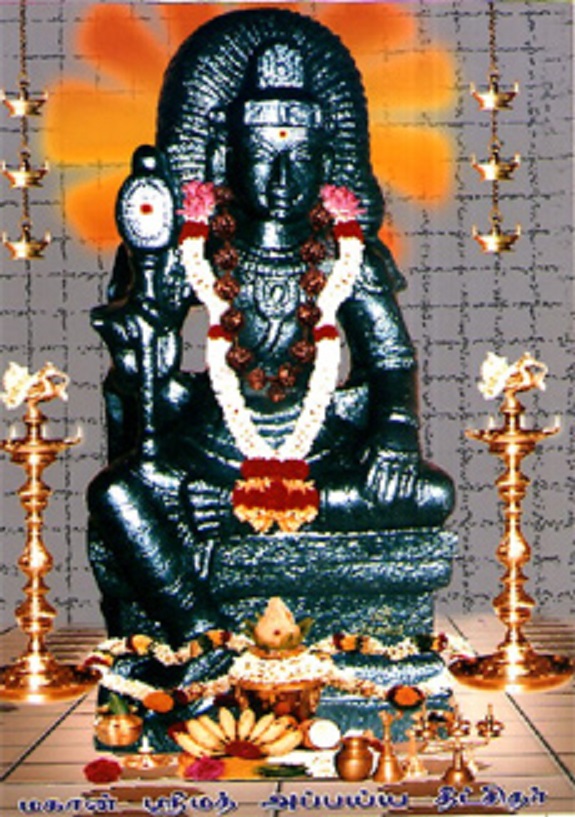
Appayya Dikshitar - (1520-93)

Appayya Dikshitar – (1520-93)

We, the traditional Advaitins, are a prejudicial lot – aren’t we?  Appayya Dikshitar’s words uttered in delirium when his brain was under the influence of the hallucinogenic Datura seeds are for us a beautiful AtmArpaNastuti in praise of Lord Shiva. But the mutterings of some other ordinary mortal with a differently affected brain is mere meaningless chatter unworthy of any notice. Let us not forget that both are actions done under conditions of an altered brain. And in both cases, an external agency is responsible for causing the change in the brain.

It was UG who famously said once that whether it was Beethoven’s 9th Symphony or pulling the chain in the WC sounded the same to him.  Some of the Zen Masters used to respond to the simple questions like “What is the time now?” with an answer that the mountain was running or some such response – totally frivolous and meaningless on the face of it. But their effort was to draw our attention to the way our mind functions in assigning ‘meaning and significance’ (which are actually not there) ever caught up in a habituated pattern which we  normally fail to detect.

Over six years ago, I prepared a comparative statement of the characteristics of an ordinary person and a ‘Self-realized’ man. I used the information  collated from many sources  that I could lay my hands on in preparing this tabulated compilation — almost like what a Purchase Officer does with the quotations (s)he obtains. There were several reasons behind this exercise of mine. Continue reading