
 The mind in Sanskrit is antaHkaraNa. It is the seat of both thought and feeling. It derives from antar – within, interior – and karaNa, which means “instrument” or sense-organ. The mind consists of a number of separate functions – manas, buddhi, chitta and ahaMkAra. The buddhi is responsible for discrimination and judgement, perhaps nearest equated to the intellect in Western usage. It differentiates between pairs of opposites, particularly between transient and eternal. In terms of the ‘spiritual development’ of a man, it is the most important function of the mind, since it is able effectively to exercise control over all of the rest of the body-mind instrument. Without it, we are no better than animals, driven by primitive instincts and selfish, acquisitive urges. Continue reading
Tag Archives: mind
Becoming, Being and the Brain
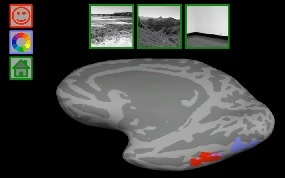 Can one day the brain science tell us “Who we truly are?”
And show the difference between ‘becoming’ and ‘Being’ in a brain scan?
Can a scan possibly differentiate a “Knower of Truth” vs an “Expert on Truth”?
Please watch this Talk (17:40 min) of Nancy Kanwisher, a Professor of Cognitive Neuroscience at MIT. Nancy’s Talk is supported by excellent graphics.
Bhakti in Advaita
“Bhakti” in common parlance is generally taken to mean a sort of Master – slave relationship of a seeker towards a superior Guru/Master/Lord/God, an attitude that in a way does reinforce duality.
Historically speaking, Bhakti as a cult took root in India after the Muslim invasions. The Abrahamic monotheistic religions with their proselytizing spirit attracted the masses offering the promises of a personal God who would fulfill their wants. Perhaps to counter this, indigenous Bhakti cults developed and continue to do so today.
The Advaita scriptural texts, strictly speaking, do say that devotional approach to a personal deity is an inferior path for Enlightenment. Further, some of them explicitly state that the devotee has to be a “Shiva” himself in order to worship Shiva. Yogavaasishta says a Vishnu only can truly worship a Vishnu. The implication in these statements is that the devotee should lose the sense of being a separate individual from what is being worshiped – it insists on a total identity, Oneness, of the subject-object.
I feel that the techniques like meditation, Bhakti, rituals, pilgrimages etc. are useful at two levels to a seeker:
- Bhakti etc. will work as a sort of aid to train the mind in its ability to stay focused (instead of wavering) and unbiased (being aware of one’s own hidden prejudices). These two aspects sharpen the mind and make it ready to take up Self-inquiry on one’s own.
- Bhakti and other such techniques are useful once again at a later stage after the Advaitic message is completely ingested without any doubt but a seeker experiences some difficulty to abide constantly in Brahman. The mind out of its sheer old habit pulls him/her back to the lures of the world from unceasing abidance as Brahman. Using Bhakti and other such things as little crutches, it will be easy for the seeker then to come back to rest as Awareness instead of being driven by the vagaries of the mind.
From: Place of Bhakti in Advaita – The Reply to the Question, Jul 27, 2012
Reality, appearance, and mind
Quote:
“Sage Vasishta: Please listen to me carefully as I shall now teach you the most supreme of all topics — ways to calm down the mind. Just like pillars bear the weight of a building, raajasic and taamasic people carry on their shoulders the unlimited illusion of a world. But saatvic natured persons like you can leave this burden as easily as a snake sheds its skin. The only way to do it is through an understanding of the essence of Truth (tatva vichaaraNa).
Whatever is not existent at the beginning and also at the end, but appears only in-between cannot be Real. Whatever stays permanently at all times (past, present and future) only can be True. How does a thing that has no existence at the beginning and at the end appear to be born and to exist in-between? The fact of the matter is neither anything is born nor anything has grown. All of this is entirely a play of the mind!
जायते मन एवेह मन एव विवर्धते ।
सम्यग्दर्शन दृष्ट्या तु मन एवहि मुच्यते ॥ — shloka 11, sarga 5
What is born here is mind, what develops is also mind. If you consider properly, what is liberated also is mind.”
Extracted from p:7 of the book: Yogavaasishta Part IV: The Calm Down by K.V. Krishna Murthy, (English rendering by Dr. Vemuri Ramesam), Avadhoota Datta Peetham, Mysore 570025, India, 2008, pp: 194.
Revision of ‘Review of article on Shankara’ – Part 5
A tarka (reasoning, argumentation) is required for the analysis of anubhava, as both SSS and RB (the author) agree – consistent with Shankara’s position. That is, language and thought, needless to say, have a role to play, chiefly for exposition and analysis.
However, after two long, dense paragraphs RB contends: “If the tarka required to examine anubhava is itself completely dependent on ´sruti, then by no means is anubhava the ‘kingpin’ of pram¯an.as.”
Prior to this, SSS was quoted as maintaining that “for this unique tarka all universal anubhavas or experiences (intuitive experiences) themselves are the support.” The author states that this affirmation involves circular argumentation, and that to say that Shankara interprets the Vedas as being consistent with anubhava is wrong, the truth being the other way around, anubhava is consistent with the Vedas: “it should be clear that according to Sure´svar¯ac¯arya, the direct realization is directly from just ´sruti itself, thus satisfying the criteria for it to be a pram¯an.a…. The direct realization of the self is from ´sruti alone.” Continue reading
Three neo-Advaitin Quotes
Three quotes from neo-Advaitin teachers on the value of seeking, and finding the truth (or not):
Spiritual seeking is the art of walking in very small circles. This does two things: it creates the illusion of motion, of getting somewhere; and it prevents one from stopping, from becoming still, which is where one would look around and see the futility of it all. David Carse
We all have a deep longing and a deep fear of the discovery of what we are, and the mind devises any way it can to avoid this discovery. The most effective way it avoids awakening is to seek it. Tony Parsons
Spiritual seekers do not become finders. Nathan Gill
Who Slept Well – part 3
 Experiencer of the Deep-Sleep-State
As noted in Part 2, we have three experiences in the deep-sleep state: 1. I exist, since I say I slept well; 2. I have the knowledge of homogeneous ignorance, since I say I did not know anything; 3. I was happy or I did not experience the pains of BMI, since I am not conscious of the BMI or any duality. The question remains: if the mind is not there, then who experiences these and who recollects these experiences on waking up, since the experiencer and the recollector have to be one and the same? These appear to be puzzling questions that need to be addressed. Who is going to provide the answer to this – a sleeper or a waker? For this, scripture alone becomes a pramAna, or means of knowledge, since the mind that uses logic cannot provide the answers. No objective tools can be used or would be valid to analyze the deep sleep state, since all objective entities (apart from ignorance) are absent in that state. Hence, objective scientists also have no tools available for investigation. These aspects have to be clear even when we are studying the opinions of other philosophers such as Shree Atmananda-ji , unless these opinions are shruti based. Continue reading
Vedanta the Solution – Part 6
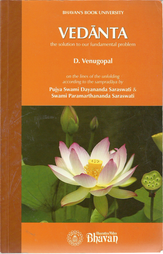 VEDĀNTA the solution to our fundamental problem by D. Venugopal
Part 6 examines who we think we are and explains how this dictates our degree of happiness.
There is a complete Contents List, to which links are added as each new part appears.
Who Slept Well?
 This is the first of a four-part article by Acharya Sadananda of Chinmaya Mission Washington (edited by myself) clarifying the nature of the deep-sleep state and addressing a number of problems which frequently cause confusion in seekers.
I wish to express my appreciation to Pujya Sastriji and Shree Subbuji for directing me to the Panchadashi Ch.11, where the deep-sleep aspects are discussed extensively by Shree Vidyaranya. This article is in response to a question posed by a sincere seeker in a private mail. His question focused on the following: Who is the experiencer, knower, and the recollector of the deep-sleep state, when the mind is not there? In essence, who slept well and knows that he slept well and is now recollecting that information when he is awake. This response to the question is based on my understanding of the 11th Chapter, together with a private communication from Shree Sastriji the post to Advaitin by Shree Subbuji.
In searching for answers, I came across the article by Shree Ananda Wood on the topic of Shree Atmananda Krishna Menon’s understanding of the deep sleep state. Given the fact that all descriptions of the deep-sleep state are necessarily from the vantage point of the waking state, we can only rely for analysis on 1) shaastra pramANa and 2) those experiences that are universally common. The problems with Shree Atmanandaji’s interpretation of the deep–sleep state are noted at the end, since there are many people that I see on Facebook, as well as elsewhere, who follow Atmanandaji writings relating to deep sleep state. Continue reading
Review of article on Shankara by Ramakrisnan Balasubramanian
(This is a slightly modified article published here one year ago, which was improperly and incompletely posted. Ramesam had asked me to review the following article, with which I complied after much hesitation. The article is over 40 p. long and quite dense and complicated in parts – in other words, ‘academic’: for specialists only; one could add: cutting the slices so thin, that the substance is practically lost, or forgotten).
Review of ‘A New Approach to Understanding Advaita as Taught by ´Sa ˙ nkara Bhagavadp¯ada’ – by Ramakrishnan Balasubrahmanian. Continue reading