Discussion on chidAbhAsa

In the comments following the Question and Answer on the subject of mAyA and Ishvara – Q.325, Peter and I began the following exchange on the subject of ‘reflection of Consciousness’ (between the <<<  >>> marks below). We continued this discussion off-line. Now that this has been concluded, we are posting the discussion so that others may, perhaps, benefit from the clarification that ensued.

<<<

PB: 2. The easiest misunderstanding to resolve is the distinction between ‘original consciousness’ and ‘reflected consciousness’: there is NO difference. To explain this we are given the analogy of light. Any opaque object is seen because it reflects light. One can say that the light reaching our eyes from the object is ‘reflected light’. But what is the difference between ‘reflected light’ and ‘original light’? There is no difference: light is light. ‘Reflected light’ is merely the name given to ‘original light’ seen together with a reflecting medium (the object). In the same way, ‘reflected consciousness’ is the name given to ‘original consciousness’ seen together with the reflecting medium of the perceptible gross and subtle universe. ‘Original consciousness’ is given the name Brahman. Continue reading

Puruṣārtha Niścaya – Determining the Purpose of Life

Almost every one of us mostly live our lives mechanically. Having been born, we go through the mill of studies, higher studies, romance, marriage, kids, money, power, old age, disease and death. People who are in positions of power, rich people, and erudite people are looked up to by the society, regardless of how they achieved their ends or by what values they lead their lives. The paradox is that it appears both the classes of people, the ones who lookup and the ones who are looked up to, are satisfied with this pathetic state of affairs.

For some, the immediate unfolding future becomes the purpose; for some others, money and power becomes the driving force. Only a very few, stop to think about what is real purpose of this life? Why was I born? In a particular family? Into a given status? Endowed with a given intellect? Why did our lives take a certain turn?

Continue reading

Can you accept that the world is mithyā? – 1/2

As long as I believe in the absolute reality of the things around me, as long as I believe in the absolute reality of the body-mind amalgam, and further, as long as I believe that the body-mind amalgam is Me, I will be insecure and unhappy. Why? Because, if the world is real and this body-mind amalgam is real then threat and danger surround me: the treat may be to my life and wellbeing but, more often than not, my fragile ego is vulnerable to outside events and circumstances.

There is always someone richer or cleverer or wiser or more beautiful or more influential than me. In their presence I am unworthy and powerless. Poor unworthy me could lose all my friends to more attractive people, to cleverer people or to richer or more powerful people. I live my life dreading the moment that I will be found out to be a fraud or lose my job. Deep down I believe I am unlovable and that I will end my days sad and lonely. My fragile body-mind amalgam is not really up to the onslaught from the more powerful forces of the universe. I am not good enough to gain all the security I need to cushion myself from ‘the slings and arrows of outrageous fortune’ (as Shakespeare’s Hamlet puts it). My life (or the life of loved ones) can be wiped out in an instant by a monster wave or powerful wind or fire or earthquake, or a drunk behind the wheel of a car or a mugger or a mentally deranged person or by a tiny bug invisible to the naked eye. And even if the threat doesn’t come from outside, my very own biology can suddenly conspire to pack up: cancer, dementia, palsy, blindness, deafness, a blockage in the artery, stroke. Continue reading

Seeking – giving up pleasures? (Q. 322)

Q: I can see I need to live more austerely, and I am prepared to sacrifice much to bring about a more lucid and disciplined spiritual practice, but if I am honest, sacrificing those pleasures will have their cost and I will miss them. I would give up nearly anything to find a way forward, but I have heard that unless giving up pleasures is seen as so necessary it isn’t actually a sacrifice, it won’t produce any progress, making it pointless. I am confused. Living austerely definitely means sacrifice, and I could do it, but what’s the point in doing it if it won’t work? I hope I have been clear. If you could tell me what you think, I would be most grateful.

A (Sitara): Your emphasis on austerities and sacrifice indicates that you are influenced by a tradition other than Advaita Vedanta. While following dharma (an ethical lifestyle) has its place in Advaita Vedanta, it does not require austerities. It just means “be fair”, i.e. treat others the way you yourself would like to be treated. Also following a spiritual practice of meditation and prayer is thought of as beneficial for the seeker; but there is no need for much sacrifice here either, except for remaining with it even if sometimes inconvenient – having to get up a little earlier for example. Continue reading

Experience and Knowledge (Q. 321)

Q: ‘Experiential’, seemingly, is becoming a stumbling block in current discussions within spirituality and non-duality. There are the ‘experiential’, usually ‘anti-intellectual’ types (who deprecate ‘merely intellectual’, or ‘conceptual’ approaches), and those who defend the proper use of mind and the intellect, without denying the validity of experience.

 Would it be possible, though, to dispense with either of the two concepts: ‘knowledge’ and ‘experience’?; they appear to overlap, practically being synonyms and, indeed, one can say “I know pain in the belly”, or, “I know such and such emotion”, “I know (I am acquainted with) life”, etc., without resorting to the word ‘experience’ – the word ‘acquaint’, conveniently, is derived from the Latin via old French: cognoscere, gnoscere. The other alternative would be to dispense with the word ‘knowledge’ and use instead ‘real’/’unreal’, ‘reality’, which is, precisely, sat/asat in sanskrit – and expressions using these terms are quite frequent, as everybody… realizes (‘is cognizant with’, then, would have to be ruled out). Just today I wrote in a comment that true understanding is an experience, but now I have my doubts. Ultimately, certainly, the only Experiencer/Knower is brahman/atman (though he remains ever unmoved). Continue reading

What is Moksha and what does Science say?

[A few friends asked me about Moksha to be explained in simple words without any mystifying scriptural references, quotations and citations. This is what I wrote to them.

The points are made accordingly with no hyperbole, no mystique but merely as barebones facts without any frills – bibliographic references, supporting evidence etc. for the sake of brevity. I thought of sharing it here so that it can be corrected / sharpened in expression and  improved in an overall way. ]

1. Moksha:

There is nothing mysterious about it. It goads the spirit of inquiry in us.

Our ancients’ inquiry was on:

i) Who am I? and ii) What is this world around?

Continue reading

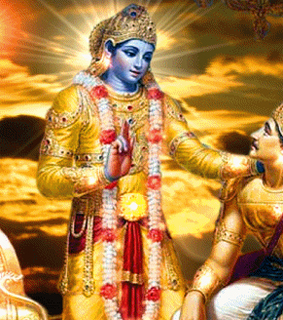
Interview with the Gita

We are very fortunate to have access to Bhagavad Gita ­– described as Mother, Goddess, Shower of the Nectar of Advaita and the Release from the Endless Cycle of Rebirth – to answers the many questions that relate to our day to day living. The advice relates to every person who, like Arjuna, find that, when the minds alone is involved, it is clear what’s needed, but when feelings become engaged they are no longer convinced they know what’s the right thing to do. And, at the end of each chapter, Gita is described as Brahma vidya [Knowledge of Reality] and yoga shAstra [scripture that prepares the mind for Brahma vidya]. So the questions start from this point: Enlightenment is the unshakable knowledge ‘Aham BrahmAsi’ [I am Brahman]…

Q: What stops us from knowing this truth of oneself 24/7?
Gita: Mind has three basic defects:
1. it is impure (i.e. it is ruled by appetites and aversions)
2. it is unsteady (i.e. it is unable to hold one thought for any prolonged period of time, let alone forever – i.e. it is NOT capable of being ‘unshakable’)
3. what it holds to be true is erroneous.
Krishna describes this sort of mind of the irresolute as ‘bahu shAkAh anantAh’ – many branched and endless. Continue reading