There is a very evolved state of realization that can easily be mistaken for the final realization brought about by akhaNDAkAra vRRitti. I do not mean the often mentioned state of samAdhi that also tends to be mistaken for enlightenment. What I am talking about is less spectacular than samAdhi. In my experience with Western students and friends, there is one moment in which an almost complete recognition of the true nature of oneness takes place. From that moment onwards, the general outlook of the person will change: suffering is going to diminish considerably and the person knows what it is that is actually sought by people asking the question “Who am I?”. He/she recognizes what is talked of in the scriptures as Truth. Continue reading
Tag Archives: moksha
upadesha sAhasrI – Part 19
Part 19 of the serialization of the presentation (compiled by R. B. Athreya from the lectures given by Swami Paramarthananda) of upadesha sAhasrI. This is the prakaraNa grantha which is agreed by most experts to have been written by Shankara himself and is an elaborate unfoldment of the essence of Advaita.
Subscribers to Advaita Vision are also offered special rates on the journal and on books published by Tattvaloka. See the full introduction
More on ekajIva vAda
Rather than add more comments to the ‘mokSha for All’ thread, I thought it better to make this a separate post. It is the same topic but here I posed a question to AchArya Dr. Sadananda of Chinmaya Mission, Washington, whom I have known for a long time. I have interposed comments in his response and his follow-up comments have been added in green.
Dennis:
Obviously any statement about the ‘nature’ of absolute reality can only be made from the jIva’s standpoint; i.e. an ‘as though’ pAramArthika statement made in vyavahAra. Thus, any talk about a world is clearly a vyAvahArika statement; aham brahmAsmi is an ‘as though’ pAramArthika statement.
Sada:
Dennis – aham brahmaasmi is statement of understanding of the truth – it is recognition of that paaramaarthika state but expressed using the instruments available in vyavhaaha that is the BMI. It is not just vyaavahaarika statement about paramaarthika state. It is like when I say sugar is sweet – it is statement which may not mean much to a listener who may not know what sweetness means, but it means a lot to one who knows and is the statement born of direct experiential understanding – or aparoxaanubhuti. Continue reading
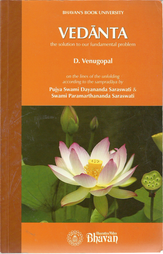
Vedanta: the Solution – Part 4
VEDĀNTA the solution to our fundamental problem by D. Venugopal
Part 4 looks at the ways in which we strive to overcome our sense of limitation but only succeed in propagating this.
There is a complete Contents List, to which links are added as each new part appears.
Action – Enlightenment
Results of action are of four types:
1) utpAdya – a result in the form of a product, like a pot.
2) Apya – a result in the form of reaching, like going abroad or to heaven.
3) saMskArya – a result in the form of removal of impurity and imparting a good qualiity.
4) vikArya – a result in the form of modification, e.g. milk to yoghurt.
Making, reaching, purifying and modifying are the four results obtained by karma. mokSha (enlightenment) is not a product because it is nitya (eternal). It cannot be reached because it is you. It cannot be purified because it is free from blemish. It cannot be modified because it is one whole. Hence, nitya-mokSha is not a product or by-product of karma.
muNDakopaniShad (Vol. 1), Swam Dayananda Saraswati, Arsha Vidya Centre. ISBN 81-903636-3-8.
upadesha sAhasrI part 12
Part 12 of the serialization of the presentation (compiled by R. B. Athreya from the lectures given by Swami Paramarthananda) of upadesha sAhasrI. This is the prakaraNa grantha which is agreed by most experts to have been written by Shankara himself and is an elaborate unfoldment of the essence of Advaita.
Subscribers to Advaita Vision are also offered special rates on the journal and on books published by Tattvaloka. See the full introduction
Review of article on Shankara – Part 6, and final
Maya
A tarka (reasoning, argumentation) is required for the analysis of anubhava, as both SSS and RB agree – consistent with Shankara’s position. That is, language and thought, needless to say, have a role to play, chiefly for exposition and analysis.
However, after two long, dense paragraphs RB contends: “If the tarka required to examine anubhava is itself completely dependent on ´sruti, then by no means is anubhava the ‘kingpin’ of pram¯an.as.”
Prior to this, SSS was quoted as maintaining that “for this unique tarka all universal anubhavas or experiences (intuitive experiences) themselves are the support.” The author states that this affirmation involves circular argumentation, and that to say that Shankara interprets the Vedas as being consistent with anubhava is wrong, the truth being the opposite: anubhava is consistent with the Vedas: “it should be clear that according to Sure´svar¯ac¯arya, the direct realization is directly from just ´sruti itself, thus satisfying the criteria for it to be a pram¯an.a…. The direct realization of the self is from ´sruti alone.” Continue reading
Why two lifestyles don’t mean two paths (1/2)
One enduring misconception about enlightenment is that there are different ‘paths’ for different temperaments. This is not supported by Śaṅkara’s vision. Below the argument for the single ‘path’ is presented.
1. All problems of life are due to an erroneous assumption about who one is. The solution to the problems of life, therefore, lies in correcting this erroneous assumption. Advaitins in the Śaṅkara tradition would agree with this.
2. Common observation supported by scripture shows that, when one’s aim is split, the goal is unlikely to be reached. So for seekers who are split between an avowed desire for self-knowledge and ‘compelling’ ties to the world in the form of emotional entanglements to people and places, unfulfilled duties, ambitions and the like, attaining the goal of self-knowledge is unlikely – their minds being impure (i.e. distorted by subjective likes and dislikes) or unsteady (unable to remain single-pointed for any length of time). The compelling pull of likes and dislikes that arise from duties and entanglements and ambitions is known as mala. And the flickering of the mind from one worldly demand to the other is called vikshepa. Continue reading
The Dream Problem – Part 11
Part 11 of the New Book Serialization!
The second dialog between the sage Vasishta and the Dreamer begins.
The dreamer asks about the difference between an avatar and a lunatic and Vasishta explains that the Absolute never assumes name and form.
Puruṣārtha-niścaya, the beginning of the beginning
What is puruṣārtha-niścaya? Of the two words, niścaya has a close English equivalent: certainty, conviction, unshakable clarity. So puruṣārtha-niścaya mean ‘doubt-free clarity and unshakable certainty’ about puruṣārtha. So what is this thing one has no doubt about?
Puruṣārtha is a compound made up of two words: puruṣa and artha. Puruṣa also has a close English equivalent: ‘person’, ‘human being’ (albeit with a lot behind it that reminds us of the true scale of what is indicated by the word – see footnote at the end).
Thus, so far, we have arrived at this meaning: ‘unshakable certainty about human artha’.
Artha is the last word that needs unpacking. Normally translated as ‘wealth’ or ‘meaning’, here it should be read as ‘aim or purpose’.
Puruṣārtha is the purpose of the human life. And puruṣārtha-niścaya is total clarity about what this purpose is – about what defines human life and drives human activity. Continue reading