Beyond Stillness – Q. 331

Q : I am a “solo practitioner” of the advice of Ramana Maharshi, as I understand what I absorb of it. My enquiries move between an apophatic and cataphatic flavor.

 When I do this, I am moved to an absolute stillness. Upon ‘coming back’, there is a sensation of still not passing the barrier of stillness. I am not sure how to continue. Should I continue to practice just like this? Until I have destroyed differentiation? Should this be a lesson on what the real really is?

[Note (Dennis): Here are the meanings of those terms from my Oxford dictionary –

apophatic /ap’fatk/ – adjective Theology (of knowledge of God) obtained through negating concepts that might be applied to him. The opposite of cataphatic.

cataphatic /kat’fatk/ – adjective Theology (of knowledge of God) obtained through defining God with positive statements. The opposite of apophatic.] Continue reading

Vision Of Truth (sad darshanam – 5)


Arbhyate jIva jagat parAtma

tattvAbhidhAnena matam samastam

idam trayam yAvadahamatiH syAt

sarvottamASham mati shUnya niShThA—4


Arbhyate = begins;  jIva jagat parAtma = divisions of individual, world and Ishvara; 

tattvAbhidhAnena = principles of the three tattvAs;  matam samastam = all philosophies; 

idam = this; trayam = three;  yAvat = as long as; ahamatiH = ‘I’ notion; syAt = is there;

sarvottamA = the greatest of all; aham mati shUnya = devoid of ego; niShThA = 

abidance; 


All philosophies begin based on the principles of the three divisions of individual, world and Ishvara. The abidance in self, devoid of the ego is the greatest abidance of all.


All religions are based on the three divisions of individual, total and world. These religions culminate in some philosophy which again is based on this triad only. Theology sticks to these divisions and does not attempt to go beyond. Continue reading

Depression – Q.330

Depression – Q. 330

 Q: For years now I’ve been severely depressed and it doesn’t seem to be changing. What led me to Advaita, I think, was the intense desire to know what I guess I can only meaningly refer to as God.

I read a lot about how we are not our bodies and how if we can be aware of something, then that ‘something’ cannot be us. I understand all this. There is a formless awareness that appears to be prior to everything, prior to my body, my mind and the suffering of depression, I can see that.

One book I’ve read, not specifically about depression, advises that we remain with that awareness, as that awareness that is prior to both body and mind. However, I find this difficult. The body and mind come out of the Self and thus must be the Self. Beyond this the reasoning and experience of it gets quite subtle, but I’ll give it my best shot. Yes, there is an awareness that is before the mind and body, something that you might call the Ultimate subject, but It is only apparent because of the body and mind – without the body and mind, the Self wouldn’t know itself. Continue reading

Vision Of Truth (sad darshanam – 4)

sarvairnidAnam jagatohamashcha

vAchyaH prabhuH kashchidapAra shaktiH

chitretra lokyam cha vilokitA cha

paTaH prakAshopyabhavat sa ekaH—3

sarvaiH = by all; nidAnam = cause;  jagataH = of the world; ahamaH cha = and of ‘I’;

vAchyaH = is (popularly accepted); prabhuH kashchit = somemLord; apAra shaktiH =

limitless power; chitre = picture;  atra = here;  lokyam cha vilokitA cha = seen and the 

seer; paTaH = canvas; prakAshaH = light;  abhavat = became; saH ekaH = that one.


The cause of the world and the ‘I’ (individual) is popularly accepted by all to be some Lord of limitless power. Here, in this picture, that one has become the seer, seen, the canvas and the lights also.


Even as children, we have a curiosity to know how the universe began. If the big bang occurred in time, there would have been time and space already; even otherwise who created that dense matter that made a bang. Such curiosity to go to the root is natural to a thinking person.

Continue reading

Book Review: THE SELF ILLUSION

The Self Illusion: How the Social Brain Creates Identity, Bruce Hood, OUP, 2012, pp: 349. ISBN 978-019-989759-9
Prof. Bruce Hood is the Chair in Developmental Psychology at the University of Bristol, UK. He started off his graduate work in Psychology  a couple of decades ago studying the gaze of new born infants, tracking their eye movements and what excites them to take in the world they look at. From then on grew his curiosity to know how a ‘self’ gets ensconced in the innocent minds of the babies and grows to the Himalayan proportions in the grownup egos — some turning out to be Osama Bins or Hitlers and others, well, a you and a me. Bruce presents lucidly a captivating and absorbing narrative of not only his research findings but also that of a plethora of Psychologists and Neuroscientists from different parts of the world.  He does not, however, preach sitting on a high pedestal condescendingly giving the reader exercises for self-improvement as we usually find in the books authored by Psychologists. (In fact that was my peeve about the excellently written work of Gary Marcus, “Kluge: The Haphazard Evolution of the Human Mind”, 2009).

Fig 2. Kanisza Square

But how could he? As so well argued by him, rather to the consternation of many Westerners unaccustomed to this kind of thinking, there is no entity, a ‘self’, present in you waiting to be improved. “Most of us believe that we have an independent, coherent self – an individual inside our head who thinks, watches, wonders, dreams, and makes plans for the future. This sense of our self may seem incredibly real, but a wealth of recent scientific evidence reveals that it is not what it seems — it is all an illusion.”  He illustrates the point using the Kanisza square (see Fig 2). Yes, you see a square alright. But remove the four Pac-Men in the corners. Where is the square? Continue reading

Where lies the “Person” of our personality?

A queer accident happened about four years ago in 2008.

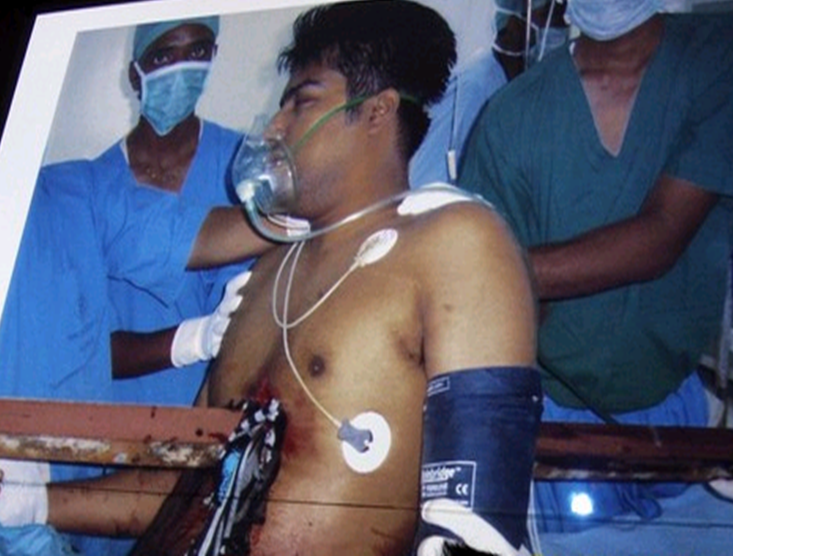
A long iron rod pierced through the chest of a 25 year old young man in a driving mishap.  Fortunately, the person had access to one of the top hospitals in New Delhi, India. Thanks to the developments in the surgical techniques, he survived the accident, was out of the hospital in a couple of weeks with a sound body and mind. He was Mr. S. Dutta, a software engineer. Neither his expertise nor his personality was affected by the accident. He retained his memories, his knowledge and skills and his temperament also did not change. In effect he continued to be the same person as before the gruesome accident.

S. Dutta, 18 July 2008

Wind backward 160 years. Continue reading