
 The mind in Sanskrit is antaHkaraNa. It is the seat of both thought and feeling. It derives from antar – within, interior – and karaNa, which means “instrument” or sense-organ. The mind consists of a number of separate functions – manas, buddhi, chitta and ahaMkAra. The buddhi is responsible for discrimination and judgement, perhaps nearest equated to the intellect in Western usage. It differentiates between pairs of opposites, particularly between transient and eternal. In terms of the ‘spiritual development’ of a man, it is the most important function of the mind, since it is able effectively to exercise control over all of the rest of the body-mind instrument. Without it, we are no better than animals, driven by primitive instincts and selfish, acquisitive urges. Continue reading
Author Archives: Dennis
Swami Dayananda on Twitter
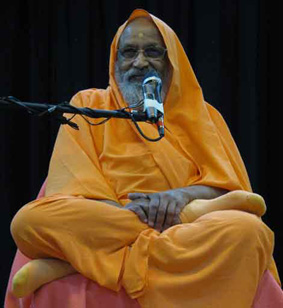
I have just been informed that Swami Dayananda has given permission to open a Twitter account for posting his sayings. For those who indulge in such things, the ‘Twitter handle’ is @swamijisays. I guess that they are likely to provide more worthwhile reading than most tweets…
Q. 363 – Divine Grace
Q: Over the past eight years I have developed a personal relationship with a God of my understanding – or should I say with a God of my non understanding and I know that the term God is loaded and perhaps not word enough. I love God and naturally want to be with God.
I have some experience of Hinduism and spent time studying Buddhism, I even spent time living at a Buddhist center while going about my ordinary business of work, life and family. I couldn’t continue with Buddhism even though they were wonderful people because in my heart I knew it was not the right path for me and I felt conflicted. I returned to my love of Hindu practices because it felt more right for me and over the past two years I have tried to find my way. I have deepened my understanding through reading books, internet teachings on you tube and meditation.
More recently I have ventured upon Advaita Vedanta and it feels right for me. However, I have no teacher and no one to ask when I have questions. Sometimes it all gets a bit too non dual for me and I feel disconnected from the love part with all the philosophy and intellectual explanations. I experienced the grace of God eight years ago when I was in a desperate plight and Divine Grace is an absolute for me. What I want to know is how does Grace happen, is it Brahman or Divine consciousnesses. Thank you for any time and consideration you might give to answer my question. Continue reading
Traditional Path
- Once self-ignorance is admitted as the problem, then it follows necessarily that self-knowledge is required to remove it. In turn this implies the need for a teacher or material to impart that knowledge and consequently, effectively a path and a seeker etc. We do not have any sense organ for ‘self-knowledge’. All of the usual pramANa-s only provide information about the world of facts, observations and information (which includes our body and the subtle aspects of thoughts and emotions).
- The seeker might well ask why it is that a sampradAya teacher should be better or more worthy of listening to than the independent teacher. The answer is simple – authority (in the sense of proven to work) and training. Why should one pay more attention to the claims of one ‘ordinary person’ than another? If a totally unqualified teacher says ‘This is it’ and my own experience tells me that “no it isn’t”, who is right? Should I not give more credence to first-hand experience? On the other hand, if a teacher is able to say “this is what my teacher told me” and so on, back down a noble line of sages to the shruti itself, then that is worthy of attending to.It might be said that the traditional path is a well-worn one and we are therefore far less likely to stray, whereas the neo-advaitin path is, by its own admission, no path at all.
Enlightenment: The Path through the Jungle, Dennis Waite, O-Books. ISBN: 978-1-84694-118-4. Extract Link
Buy from Amazon US, Buy from Amazon UK
Vedanta the Solution – Part 11
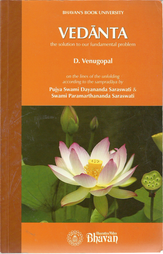
VEDĀNTA the solution to our fundamental problem by D. Venugopal
Part 11 discusses the qualifications required for commencing Self-inquiry.
There is a complete Contents List, to which links are added as each new part appears.
upadesha sAhasrI – Part 22
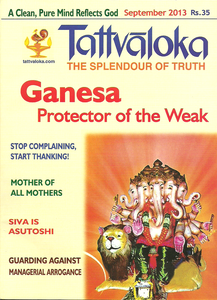 Part 22 of the serialization of the presentation (compiled by R. B. Athreya from the lectures given by Swami Paramarthananda) of upadesha sAhasrI. This is the prakaraNa grantha which is agreed by most experts to have been written by Shankara himself and is an elaborate unfoldment of the essence of Advaita. Note that this is the concluding part of the series.
Subscribers to Advaita Vision are also offered special rates on the journal and on books published by Tattvaloka. See the full introduction
Being is Reality
All things exist. We cannot conceive of non-existence as different from existence, for even non-existence, in order that it may convey any sense, must become a content of consciousness. And consciousness must be.
Existence is the minimum to which things can be reduced, without which even thought is impossible. Everything relates to existence of some kind, and there is no thought of non-existence. To argue along the lines of Parmenides, existence is that which does not admit of any change. We cannot think what is not, for what is not cannot come into being, either from what is or from what is not.
If what is comes from what is, we would be stating something which we ourselves do not understand, for what is includes all things, and there is no such thing as the production of what is from what is. What is, again, cannot come from what is not, for what is not has no meaningful value. To posit the relation of what is to what is by way of causation involves a tautology, and to conceive of the coming into being of what is from what is not, is absurd.
There cannot be something other than what is, for what is, is the all. Even supposing that there is such a thing as the coming into being of one thing from another thing, we would have to admit that nothing other than what is can come into being, for we cannot add anything to what is, and anything added must itself be a part of what is.
There cannot be anything exceeding what is, and what is not, again, cannot come into being. That which is cannot increase, and cannot also decrease, for it is always. If something is to be removed from what is, so that the latter may be lessened, what is removed should be either what is or what is not. What is cannot be removed from what is, and what is not cannot, again, be removed from what is, for it means nothing at all.
The concept of dimension, again, is possible only when there is spatial separation of one thing from another. But even space is included in what is. So what is cannot be diminished in any way. And it cannot be increased, because we cannot add anything to it other than itself.
Existence is the whole reality. It does not admit of either addition or subtraction, production or change of any kind. In order that it may move or change, there should be space; but space is not outside it. True being has no origination, no change, and so no end. This being must be equally present everywhere, with no less or more of it anywhere. It is that which is.
As being is indivisible, it cannot conceive of a real distinction of things in it. All things are being. If there are things other than being, they must be non-being. Even becoming has meaning only when it has being. If being is to be divided, we may have to introduce some other distinguishable and distinguishing element in it, which would be nothing but non-being.
Being is reality.
from The Philosophy of Life by Swami Krishnananda, The Divine Life Society.
What is Brahman? (Part 4)
Leo Hartong also uses the metaphor of clouds, as thoughts, in the blue sky of ‘I am’ awareness:
“Ramana Maharshi recommended that one investigates by asking the question ‘ Who am I?’ When asked who you are, there might be a hesitation as to what to answer; but when asked if you exist, there is no such doubt. The answer is a resounding, ‘ Yes, of course I exist.’ When the answer to the first question is as clear as the answer to the second question, there is understanding.
“The realization is that both questions have in fact the same answer. That which is sure of its existence –the innermost certainty of I Am- is what you essentially are. In other words: I Am this knowing that knows that I Am. The Hindus say Tat Tvam Asi (Thou Art That). In the Old Testament, God says, ‘ I Am that I Am.’ This undeniable ‘ I Am’ is not you in the personal sense, but the universal Self. Ramana Maharshi called the fundamental oneness of ‘ I Am’ and the universal Self ‘ I-I.’ Continue reading
A Comparison of Bhagavad Gita Versions
 There are very many versions of the Bhagavad Gita in print, although you will have to look to Indian bookstores to obtain most of these. This can be very worthwhile. Not only are they a lot cheaper there but it is not necessarily the case that the best versions are those which are most popular and are therefore available through Amazon.
You really need to look at each of them yourself to decide which ones appeal most. I can make a few general observations but only you know what your priorities are. (It goes without saying, of course, that the Bhagavad Gita is a ‘must read’ for anyone seriously interested in Advaita!) If you want to see original Devanagari, you are restricted in choice. If you want Romanised transliteration, again not all will provide this.
If you want word-by-word translations, only a few give this (see Refs. 1 – 3 below). If you are interested in the Sanskrit – parts of speech and which verses contain which words, you want Ref. 16 (but this contains neither the text nor a commentary).
If you want the most comprehensive, understandable commentary and expense and time are no hindrance, then Ref. 15 is a no-brainer!
Finally, there is the all-Devanagari version with Shankara’s bhAshya (Ref. 18). This is a huge, hardback book, beautifully produced but, of course, totally useless unless you can read Sanskrit very well indeed. I have a spare copy of this and hereby offer to send it to anyone in the UK free of charge (or anyone elsewhere in the world if they pay the postage) in exchange for the following: you agree to be available to provide a literal translation of any (short) text by email from time to time if I need this for my writing. Email me if you are interested in this offer. Continue reading
What is Brahman? (Part 3)
The superficially contradictory ‘descriptions’ of Brahman as ‘neti, neti’ and ‘sarvaM khalvidaM brahma’ [all this is verily Brahman] are brought out in adjacent verses of the Atma bodha, attributed to Shankara (Swami Chinmayananda translation):
- Brahman is other than this, the universe. There exists nothing that is not Brahman. If any object other than Brahman appears to exist, it is unreal like the mirage.
- All that is perceived, or heard, is Brahman and nothing else. Attaining the knowledge of the Reality, one sees the Universe as the non-dual Brahman, Existence-Knowledge-Bliss-Absolute.
Here, it is first stated that the universe is not Brahman. But it is also said that any other appearance will be unreal, like a mirage. The mirage is a powerful metaphor because the water that appears is in reality only the sand upon which the appearance takes place. I.e. sand is the substratum of the water appearance, just as Brahman is the substratum of the world appearance. It is then stated that all appearances are, in fact, nothing other than Brahman. But this is realized, of course only upon enlightenment. Until then, the world remains very real. Similarly, to the seeker after water in the desert, the mirage is very real. Continue reading