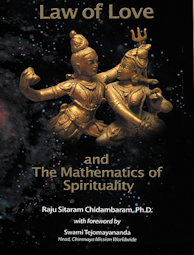
 New extract added to this section of the site:
Law of Love and The Mathematics of Spirituality by Raju Chidambaram, Ph.D.

New extract added to this section of the site:
Law of Love and The Mathematics of Spirituality by Raju Chidambaram, Ph.D.
 Back in the early days of my spiritual seeking, I used to think that there were three main approaches to enlightenment: karma yoga, bhakti yoga and j~nAna yoga and that any could be used successfully, according to the particular personality and capabilities of the seeker. (I later found out about rAja yoga but let’s not complicate things!) The fact that j~nAna and bhakti effectively and inevitably ‘go together’ to some degree has been written about elsewhere by people such as Dhanya and Peter. Swami Dayananda also often writes about the need to understand the place of Ishvara in one’s spiritual pursuits if they are to be fruitful. So I will not mention bhakti again. I am looking in this article specifically about where karma yoga fits in the scheme of things. Continue reading
 New extract added to this section of the site:
Beyond the Separate Self: The End of Anxiety and Mental Suffering by Colin Drake
Q: I am allowing life to teach me as I go through it, but I’m not finding it easy. Most of the time I feel I don’t want to even speak because I feel nothing I say is ‘correct’. At the same time, however, I feel that even if I do speak, whatever I say would not be ‘wrong’ because ‘right’ and ‘wrong’, ‘correct’ and ‘incorrect’ do not exist. Words and concepts are a massive hindrance to my understanding, yet I cannot overcome them.
I want to say that I know that everything is Brahman, but then something says, ‘you can’t ‘know’ that everything is Brahman because that cannot be known with the mind’, so I’m always hitting a wall. Continue reading
Other experiments carried out more recently have confirmed that having a relevant thought prior to an action also gives us the feeling that we ‘caused’ the action, even when this is not the case. One experiment involved an arrangement of mirrors whereby the subject sees himself but with another person’s arms in place of his own. Instructions to move the arms in various ways are given and the arms subsequently move accordingly. Although the arms actually belong to an unseen person, the subject nevertheless feels that he has moved them. Continue reading
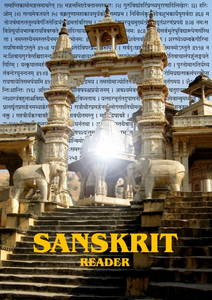 This Reader introduces India’s Sanskrit literature. The selection of more than 1600 verses covers subjects essential for the understanding of ancient Indian culture and modern Hinduism.
It consists of 300 pages A4, and is available for 25 Euro plus postage. You can order from: kontakt@vedischer-kulturverein.de. Alternatively, the best price (£12.24) is from the publisher.
You can view the first 18 pages here.
Even more amazing, however, is that you can download an 800 page Sanskrit Reader Course for free. This utilizes verses from the scriptures to illustrate the introduction of the alphabet and grammar, declensions and conjugations. There is also a list of dhatu-s and all of the words in the Bhagavad Gita, together with an indication of their derivation.
Heiko Kretschmer from Germany is to be congratulated on what has clearly been a labor of love in providing this wonderful resource. Download here (nearly 4MB).

New extract added to this section of the website:
Anatomy of Desire: How to Be Happy Even When You Don’t Get What You Want by Gina Lake
“The experience of willing an act arises from interpreting one’s thoughts as the cause of the act.” Daniel Wegner, quoted in the excellent book: Consciousness: an Introduction, Susan Blackmore, Oxford University Press, 2004. ISBN 0-19-515343-X. Buy from Amazon US or UK.
The scientific views that are often cited in respect of these discussions stem from experiments conducted by Benjamin Libet in the late 1970’s and by Daniel Wegner in the 1990’s. I described these in my books ‘How to Meet Yourself’ and ‘Back to the Truth’. Since very few people have actually read the former, I will quote at length from that: Continue reading
Q: In Sanskrit, a word’s meaning is determined by the meaning of the dhatu at the heart of the word, modified by the meanings of prefixes and suffixes. So according to Monier-Williams:
Flautist Upahar performs the poetry of Saint Kabir, translated by Rabindranath Tagore, in Papaji’s Cave, Mount Arunachala, Tamil Nadu, India. Watch this beautiful video paying homage to some wonderful poetry and haunting music.