Tattvabodha – Part 6

OLYMPUS DIGITAL CAMERAPart 6 of the commentary by Dr. VIshnu Bapat on Shankara’s Tattvabodha.This is a key work which introduces all of the key concepts of Advaita in a systematic manner.

The commentary is based upon those by several other authors, together with the audio lectures of Swami Paramarthananda. It includes word-by-word breakdown of the Sanskrit shloka-s so should be of interest to everyone, from complete beginners to advanced students.

Part 6 concludes the look at the six sAdhanA-s (shamAdhi shakti sampatti), and in this part addresses samAdhAna (contemplation) and mumukShutva (desire for liberation). This also concludes the examination of sAdhana chatuShTAya, the fourfold spiritual path.There is also a hyperlinked Contents List, which will be updated as each new part is published.

Q. 376 – Is preparation necessary?

Q: As I consider devoting myself to the path of Advaita Vedanta, I find that I keep coming up against a few constant, nagging protests:

 First, it seems that the tradition and methodology (although I also assume that there is quite a lot of variety of how Vedanta is taught and realized) is overly academic and scholastic, at least as I view it from the information that I’ve gleaned during my research. The unfolding of the teaching of Vedanta seems to leave the student engaging in a lot of analysis, rather than a deep exploration of how they genuinely experience the world, which lacks transformative power because it remains something objective.

 Second, according to some of the sources that I’ve gleaned, it seems to place Vedanta on an extremely high pedestal, as something engaged in only following years of other preparatory practices. But modern practice appears to demonstrate that such preparation, while helpful, is not necessary. I cite websites like “Liberation Unleashed” and Scott Kiloby’s excellent work which show that directly exploring and inquiring into the truth of statements like, “All there is is pure awareness,” etc., can still be highly transformative outside of the context of a more robust regime of spiritual purification and development. Continue reading

The importance of being earnest

Mumuksutva, the fourth of the fourfold means of moksha, is defined as the earnest desire for liberation.  In Vivekachudamani, Sankara says of it:

30: “It is only in the case of one who is determined in his detachment and yearns for liberation that sama [calmness of mind] etc become meaningful and fruitful”

And of vairagya and sama he further says:

21: “Vairagya (detachment) is revulsion from all things seen, heard, etc from all transient objects of enjoyment, beginning with the body and up to Brahman”

22: “Detaching the mind from manifold sense-pleasures again and again, perceiving their pernicious character, resting it permanently on one’s objective is said to be sama.”

Continue reading

Q. 375 – Conditions affecting next life

Q: I agree that Reincarnation, the next life, isn’t real. But it’s as real as this life…and, for most of us, this life seems pretty real, even if we know better.

And, as we all know, very, very few people are going to achieve Enlightenment (Liberation, Realization, Moksha) in this lifetime.

For the above 2 reasons, I suggest that Reincarnation is a reasonable thing to be concerned about and to ask a question about. That’s what this question is about. I’ll speak of Reincarnation as if it’s as real as this life seems.

 It’s been said that one’s next incarnation depends greatly on one’s thoughts and state in their last moments of this life. I hope that isn’t true, because no one can know what condition they’ll be in when they’re dying. I mean, we aren’t always in the best of condition when we die, are we.

 A person, at death, might be delirious, or heavily sedated at a hospital. What then? How does that affect that person’s next life?

 Has there been discussion, from theory, regarding how this life—and, in particular, a person’s condition in the last moments of this life–affect that person’s next life?

Responses from , Sitara, Venkat and Dennis Continue reading

Life’s Goals

I flirted with Fame. After a couple of dates
 we called it off.

I courted Wealth. She told me, 
”Better luck next time.”

Progeny left before we even got started.

Finally I found my true love, Satchitananda.

And we can never be parted.

Ignorance is Also Brahman

Rama:  Maharishi Vasishta!  Revered Teacher!  Kundadanta whom I met  on that day is here in this assembly.  He has been listening to your instructions for all these days.  That is why I have asked you if he has attained Self-Knowledge and if all his doubts have been clarified.

Sage Vasishta:  Where is the need for me to say anything?  Let us ask him directly.

(Addressing now Kundadanta):  What do you say, Kundadanta?  Could you understand the essence of Truth? Have you gained Self-Knowledge?  Have your doubts been cleared? 

Kundadanta:  Oh, Greatest of the Sages!  Maharishi!  My Salutations.  Yes, now I am totally free of doubt.  I have learnt what all has to be learnt.  I understood fully the nature of Consciousness.  I realize that even a tiny mustard seed can contain infinite universes within it.  I could also understand experientially that there are no worlds at all from an Absolute point of view.  I can see clearly that a question on how a large earth can fit into a small room has no locus.

What every creature experiences in the world is only The Supreme Brahman.  The ignorance they experience is also Brahman.  There is nothing whatsoever anywhere anytime beyond Supreme Brahman.  That is the last word!

Vasishta:  He is a Great Man Indeed!  Congratulations to you, Kundadanta!   Continue reading

The ‘ego’, the soul, and metaphysics – 3

2. And here we come to a necessary distinction: ego and ‘ego’, or self and ‘self’; the necessary, real or true ego, and the contingent ‘ego’, the ‘false ego’. Based on the previous considerations, it might seem that the latter is what is meant by the empirical, worldly ego, or ‘outer man’ of philosophical discourse (as in Frithjof Schuon), but that would be an error, since that ‘ego’ does nothing, being merely an impostor, or a mask, thus ultimately as unreal as the son of a sterile woman. What is real – though ambivalent, as will be shown just below in this same paragraph – is the soul (jiva in non-dualistic advaita philosophy), that is, the subject, one of his sides, as it were, facing the higher, spiritual domain and the other facing the outer world. This last, outer or ‘empirical man’, is the doer and the sufferer – this is the way he sees him/herself (cf. ‘Explanation’, p. 9, et passim).

Similar remarks can be made for now about individual and ‘individual’, the second term referring to a limited, narrow view, actually an ideology, that is, viewing the individual, and the individual viewing himself, as ‘self-sufficient’, ‘self-motivated’, independent and autonomous –in other words, the product or result of individualism (about which there would be much to say in psychological and sociological terms). The first (individual or jiva) is a metaphysical entity, rooted in being… but why ‘ambivalent’? The answer is that while the second, ‘individual’, stands for a psychological construct (as the ‘ego’, its equivalent term, is such, obviously), what can be said of it – namely, that this deluded ‘individual’, rootless, ‘for himself’ alone, happy may be at times, but mostly forlorn, and subject to all sorts of dis-ease if not despair(1)- is by and large the actual description of the ‘normal ego or individual’! And so a clarification is in place: Continue reading

Q. 374 – Ramesh

Here is a question and answer from several years ago, which addresses a topic that I avoided getting involved with publically at the time.

Q: I recently bought a book called “Final Truth” by Ramesh Balsekar. I read the book and now see it as one of the most “deep” and “philosophical” books on Advaita. But then I read Balsekar had some sex scandals and preached “do whatever you want you are not responsible” philosophy and I`m shocked. Anyway…

I saw an idea in the book and it resonated with me so much. In my opinion, It even explains (for some level) why there is Maya or why the appearances exists or why there is “creation” in the first place. (or Why there seems to be creation) The idea is this: The formless Consciousness can be experienced only through the multitude of sentient bodies with names and forms, just as light can be seen only through refracting agents. It is thus not that the multitude of names and forms exist independently of Consciousness but that Consciousness can express itself only through these forms.
 
So the other way of saying is the God or the Brahman or the Consciousness experiences himself through us. We and the universe are God looking into himself.
 
 Brihadarnyaka 2.5.19 has this verse
 
“He transformed Himself in accordance with each form; that form of His was for the sake of making Him known. The Lord on account of Maya (notions superimposed by ignorance) is perceived as manifold, for to Him are yoked ten organs, nay, hundreds of them. He is the organs; He is ten and thousands – many and infinite. That Brahman is without prior or posterior, without interior or exterior. This self, the perceiver of everything, is Brahman. This is the teaching.”
 
What do you think?  I  wanted to know if traditional Advaita accepts that idea or not.

A: As it seems with most questions I get these days, this one also revolves around the reality-appearance, paramArtha-vyavahAra question.

Who-you-really-are does not act, so cannot be ‘responsible’ in the sense that you mean here. The person, on the other hand, does act and is responsible, and gets puNya-papa as a result of those actions. It is especially the responsibility of the realized person to act in accordance with dharma – the awareness of right and wrong – since he is setting an example to others. However it is also possible that, because of insufficient prior mental preparation, an enlightened person is still attached to desires and fears. Even knowing that he is perfect and unlimited, he could still act in accordance with these feelings, which are called pratibandha-s (obstacles or impediments). These will go in time, with further nididhyAsana.

It has to be assumed that this was the position regarding Ramesh, as far as the ‘scandals’ are concerned. However, if it was the case that he was actually preaching “do whatever you want you are not responsible”, as you say, then this is not a clear presentation of the truth of the situation and should be condemned.

Regarding your second point about the ‘purpose’ for the seeming creation, this does not hold water either. There can be no meaningful attribution of purpose at all. Purpose implies some sort of deficiency in brahman, which is a contradiction. Experience of any sort is a limitation, so cannot be applied to brahman. Best just to think of everything as name and form, including the ignorance and the experience; the experienced and the experiencer. But, as an imaginative way of thinking about it, God looking into himself is fine, as long as you don’t take it literally.

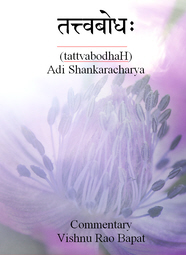
Tattvabodha – Part 5

OLYMPUS DIGITAL CAMERAPart 5 of the commentary by Dr. VIshnu Bapat on Shankara’s Tattvabodha.This is a key work which introduces all of the key concepts of Advaita in a systematic manner.
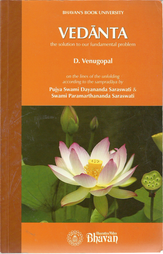
The commentary is based upon those by several other authors, together with the audio lectures of Swami Paramarthananda. It includes word-by-word breakdown of the Sanskrit shloka-s so should be of interest to everyone, from complete beginners to advanced students.

Part 5 continues to look at the six sAdhanA-s (shamAdhi shakti sampatti), and in this part addresses uparama (observance of duty), titikshA (forbearance) and shraddhA (faith). There is also a hyperlinked Contents List, which will be updated as each new part is published.