
Realization is beyond words and, ultimately, beyond the mind, though it (and what is referred to by its equivalent terms, awakening and enlightenment) first occurs in the mind, an apparently individual mind. Mystery of the timeless descending, as it were, into time, of the unmanifest becoming manifested, of the limitless appearing to be limited. Words, concepts, are unavoidable and, in this context, ‘experience’ and ‘knowledge’, are irreplaceable (experience-knowledge as one description of the ‘event’ – chit?). Consciousness, being the ultimate witness, sums it all up and, in itself, is not a concept. It does not admit of a description and is not relational.
Vision Of Truth (sad darshanam) – Part 18
क्वभातिदिक्कालकथाविनाऽस्मान्
दिक्काललीलेहवपुर्वयम्चेत्।
नक्वापिभामोनकदापिभामो
वयम्तुसर्वत्रसदाचभामः॥१८
Kva bhAti dikkAla kathA vinAsmAn
dikkAla lIleha vapurvayam chet
na kvApi bhAmaH na kadApi bhamaH
vayam tu sarvatra sadA cha bhAmaH —18
asmAn vinA dikkAla kathA Kva bhAti = without us where does the saga of space-time shine?edikkAla lIleha vapuH vayam chet = when we identify with the body, the play of space-time begins; na kvApi bhAmaH na kadApi bhamaH = we do not exist in a place; we do not exist at a time; vayam tu sarvatra sadA cha bhAmaH = we exist everywhere at all times.
Where does the saga of space-time shine without us? When we identify with the body, the play of space-time begins. We do not exist in a place, we do not exist at a time. We exist everywhere at all times.
Atma is not localized at a place or time. Space and time are appearances in the self. Yet, due to ignorance we find ourselves localized in the space time framework. On gaining knowledge we know that it is only the body which is limited by space and time. The self is limitless spatially and temporally. Continue reading
akhaNDAkAra vRRitti – Some Questions
I have a few questions on the concept and origin of the term akhaNDAkAra vRRitti. Will be grateful for any contribution and thoughts on my dobuts.
1. Does the term “akhaNDAkAra vRRitti” appear in any major upanishads or Bhagavad-Gita? If so, where (citation)?
2. Where and by whom was the term “akhaNDAkAra vRRitti” introduced for the first time in Advaita?
3. Is the concept “akhaNDAkAra vRRitti” an attempt to extend the process of ‘Object cognition’ by the mind as explained in Vedanta Paribhasha to the stage of Self-realization?
4. Does it occur prior to (and hence causal to) Self-realization or is the term “akhaNDAkAra vRRitti” a post hoc explanation of a presumed process that might have occurred in the mind on Self-realization?
5. Does the term have a practical utility for a seeker as a sAdhana tool? If so how?
Thanks and regards,
akhaNDAkAra vRRitti – The End of Suffering
 There is a very evolved state of realization that can easily be mistaken for the final realization brought about by akhaNDAkAra vRRitti. I do not mean the often mentioned state of samAdhi that also tends to be mistaken for enlightenment. What I am talking about is less spectacular than samAdhi. In my experience with Western students and friends, there is one moment in which an almost complete recognition of the true nature of oneness takes place. From that moment onwards, the general outlook of the person will change: suffering is going to diminish considerably and the person knows what it is that is actually sought by people asking the question “Who am I?”. He/she recognizes what is talked of in the scriptures as Truth. Continue reading
Vedanta the Solution – Part 8
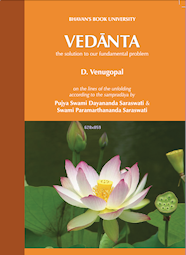
VEDĀNTA the solution to our fundamental problem by D. Venugopal
Part 8 looks at the role of the Vedas in providing knowledge of the Self.
There is a complete Contents List, to which links are added as each new part appears.
Akhandakara writti
Akhandakara vritti is, in psychological terms, the certainty that ends all doubts, the moment of realization which happens in timeless time. Ontologically, reality irrupts, as it were, into unreality, whereby the mind is transformed, or re absorbed, into consciousness unalloyed. Prior to that atemporal moment there may have been momentary sparks or instances of awakening or clear vision, anubhavas. But the realization that akhandakara writti consists of is definitive, irrecusable. Three aspects of reality combine in that ‘moment’: power-will-fearlessness (sat), Knowledge (chit), and liberation, freedom (ananda). A symbol of it would be spacelessness (or wide space).
upadesha sAhasrI – Part 19
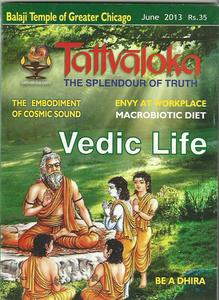
Part 19 of the serialization of the presentation (compiled by R. B. Athreya from the lectures given by Swami Paramarthananda) of upadesha sAhasrI. This is the prakaraNa grantha which is agreed by most experts to have been written by Shankara himself and is an elaborate unfoldment of the essence of Advaita.
Subscribers to Advaita Vision are also offered special rates on the journal and on books published by Tattvaloka. See the full introduction
akhaNDAkAra vRRitti – Tension
Quote
In some characters there is perhaps a sudden recognition of the true nature as oneness, and then – maybe, but not invariably – there might be a blissfullness associated with that, a kind of exaggerated relief at the release of tension. More commonly, because the seeing through of the ‘someone’ in the play has been gradual, there has been a gradual release of the tension associated with being a ‘someone’. And so there isn’t much tension hanging around anyway – therefore there isn’t necessarily any kind of great blissful release.
Already Awake, Nathan Gill, Non-Duality Press, 2004, ISBN: 0954779223. Buy from Amazon US, Buy from Amazon UK. Read Extract.
Topic of the Month – akhaNDAkAra vRRitti
 The topic for May is akhaNDAkAra vRRitti.
This is the mental ‘occurrence’ which supposedly causes enlightenment. It is the vRRitti (thought modification) in the form of (AkAra) the formless or undivided (akhaNDa). (Personally, I no longer favor this view and will endeavor to find some quotations which show that it is not quite like this for most people!)
Please submit your quotes, short extracts or personal blogs on this topic!
Revision of ‘Review of article on Shankara’ – Part 5
A tarka (reasoning, argumentation) is required for the analysis of anubhava, as both SSS and RB (the author) agree – consistent with Shankara’s position. That is, language and thought, needless to say, have a role to play, chiefly for exposition and analysis.
However, after two long, dense paragraphs RB contends: “If the tarka required to examine anubhava is itself completely dependent on ´sruti, then by no means is anubhava the ‘kingpin’ of pram¯an.as.”
Prior to this, SSS was quoted as maintaining that “for this unique tarka all universal anubhavas or experiences (intuitive experiences) themselves are the support.” The author states that this affirmation involves circular argumentation, and that to say that Shankara interprets the Vedas as being consistent with anubhava is wrong, the truth being the other way around, anubhava is consistent with the Vedas: “it should be clear that according to Sure´svar¯ac¯arya, the direct realization is directly from just ´sruti itself, thus satisfying the criteria for it to be a pram¯an.a…. The direct realization of the self is from ´sruti alone.” Continue reading