Q. 350 – Heaven and Hell

Q: In Advaita, it is said that the heaven and the hell are mithya. They are just ideas for bhakti-natured people. But Advaita says this world is mithya too. So even though heaven and the hell are mithya, we are still gonna go there just as this world is mithya but it is still real enough for us? I mean the idea of heaven and hell is mithya but it is still as real as this world. So they indeed exist just as this world. Is that the correct interpretation?

A (Ramesam): Firstly the simple and straightforward answer: Yes, you are right, heaven and hell are mithya and are ideas for bhakti-natured people, in the sense that they are experienced by the people who believe in them but these loka-s (worlds) lack a substantive reality by themselves. However, we have to note that they are the second degree imaginations – imaginations of the already imaginary worldly people! By this logic, perhaps they will be strictly comparable to dreams in their order of reality. (The word mithya includes both the empirical (vyavaharika) reality and the dream world (prAtibhAsika) reality). Continue reading

The Purpose of Life, Part 3

The Purpose of Life, Part 3

Inquiry 3:  For What Purpose Would the Self Want to Play?

Question:  How can we believe in lila? What could be its purpose? There is no convincing answer – I am sure you will concur.

Our initial inquiry concerning the purpose of life is, of course, valid only from the perspective of the apparent individual entity questioning life’s purpose and making inquiry into the nature of reality.

But what about the self?

What possible reason could the self have for assuming the appearance of the universe and seemingly enacting its continuous and seemingly interminable cycle of pleasure and pain, joy and sorrow, success and failure, triumph and tragedy, birth and death?

Continue reading

upadesha sAhasrI – Part 13

upadesha13

Part 13 of the serialization of the  presentation (compiled by R. B. Athreya from the lectures given by Swami Paramarthananda) of upadesha sAhasrI. This is the prakaraNa grantha which is agreed by most experts to have been written by Shankara himself and is an elaborate unfoldment of the essence of Advaita.

Subscribers to Advaita Vision are also offered special rates on the journal and on books published by Tattvaloka. See the full introduction

Experience

111472_web_R_by_Dieter Wendelken_pixelio.de

For most advaitins, traditional as well as Western, the term ‘experience’ seems to be a red rag. I would like to open our minds to a more comprehensive understanding of the word.

What exactly is an experience? It is a mind phenomenon, possibly following a sense perception or an action. Tasting food  is a sense perception. But to evaluate it as enjoyable or as disgusting makes for a pleasant or unpleasant experience. Similar with activities: just to be active – walking, talking, gesticulating etc. – is not an experience yet. Experiencing comes about when the mind gets involved, usually with an evaluation of the activity. An experience can also come about without a sense perception or activity: understanding a joke or having a nightmare can make for purely mental experiences, the first usually pleasant the latter unpleasant.

The whole world of non-advaita is ruled by the hunt for experiences of various kinds. Continue reading

Q.349 – Guru’s grace

Q: Do you have any comments on the concept of “guru’s grace” or ‘shaktipat guru’; the idea that some teachers are able to ‘induce’ experience in seekers or ‘transmit’ knowledge or ‘spiritual power’? Numerous reports of this sort of thing abound in the literature, and I myself have experienced something along these lines many years ago from a “mystical teacher” I followed for a couple of years in 1978-1980. I wonder what is actually going on in this sort of incident. Is it just 100% psychology at work, pure self-deception? Such “transmission” experiences can often be the seed or catalyst which spurs further effort on the path. There are so many examples of an aspirant “feeling something” in the presence of a teacher or guru that it seems inappropriate to just dismiss such claims outright.

A (Ted): It is true that some teachers can “induce” experiences in seekers.  The teacher’s ability to do this might be called a “spiritual” power in the sense that is seems both extraordinary – i.e. something most people can’t do – and mystical – i.e. beyond the normal range of mundane or worldly occurrences. The qualitative effect of this energy transmission on the seeker might, as well, be referred to as “spiritual power” in the sense that it powers up one’s mind-body-sense complex – most specifically the subtle body – in the same way that an influx of warm air heats up a room or the blare of dance music livens up a party. Continue reading

What is Death – part 6 and final (metaphysics or spirituality – non- duality)

Image


Meditation

‘There is doubt concerning a man who has departed. Some say, “He is”, and others say, “He is not”. Taught by you [Yama, god of death], I would know this. This is the third of my boons’.

‘Do not, do not insist: release me from this’…. Choose a hundred years, sons and grand sons… elephants, gold, horses… Naciketas, enter a great realm of desires: I will make you the enjoyer of your desires… but do not ask me about dying’.

Naciketas, the young seeker, will have none of that.

‘Since you, Death, tell me it is not easily understood, and no one else can be found who can teach this as you can, there is no boon to equal this’.

…………………………………..

‘Yama continues: ‘The wise one [inner self] is not born, nor does it die. [Hidden in all beings] it is not from anywhere, nor was it anyone. Unborn, everlasting, eternal, primeval, it is not slain when the body is slain.’  Continue reading

Living In The Moment Eternally – 1

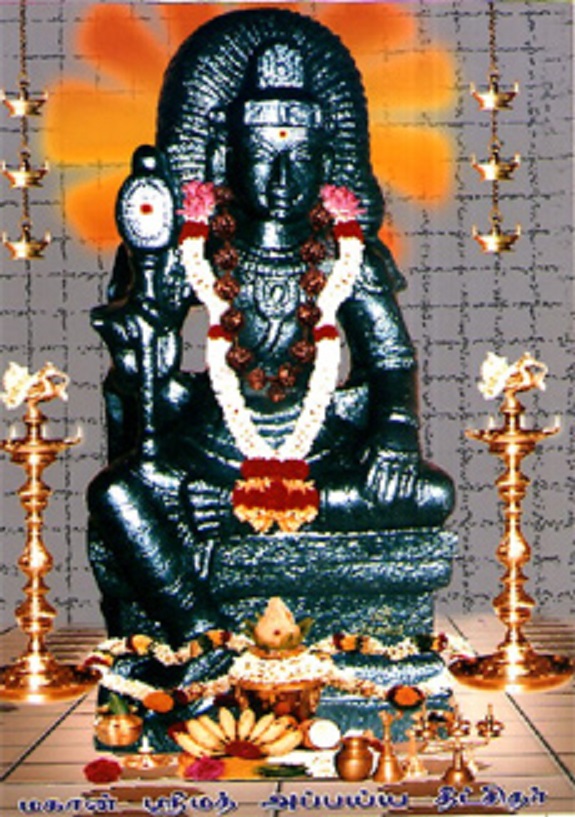
Appayya Dikshitar - (1520-93)

Appayya Dikshitar – (1520-93)

We, the traditional Advaitins, are a prejudicial lot – aren’t we?  Appayya Dikshitar’s words uttered in delirium when his brain was under the influence of the hallucinogenic Datura seeds are for us a beautiful AtmArpaNastuti in praise of Lord Shiva. But the mutterings of some other ordinary mortal with a differently affected brain is mere meaningless chatter unworthy of any notice. Let us not forget that both are actions done under conditions of an altered brain. And in both cases, an external agency is responsible for causing the change in the brain.

It was UG who famously said once that whether it was Beethoven’s 9th Symphony or pulling the chain in the WC sounded the same to him.  Some of the Zen Masters used to respond to the simple questions like “What is the time now?” with an answer that the mountain was running or some such response – totally frivolous and meaningless on the face of it. But their effort was to draw our attention to the way our mind functions in assigning ‘meaning and significance’ (which are actually not there) ever caught up in a habituated pattern which we  normally fail to detect.

Over six years ago, I prepared a comparative statement of the characteristics of an ordinary person and a ‘Self-realized’ man. I used the information  collated from many sources  that I could lay my hands on in preparing this tabulated compilation — almost like what a Purchase Officer does with the quotations (s)he obtains. There were several reasons behind this exercise of mine. Continue reading

Q.347 – Stone Consciousness

Q: Can you explain how it is possible that anything lifeless, for example a stone, a corpse or space,  does not have consciousness. Yet all of this is consciousness.

A (Shuka): The svarūpa (intrinsic nature) of fire is both heat and light. However, when it expresses through water (when water is heated), only the heat principle is expressed (water does not glow, but becomes hot); however when it expresses through an iron ball (when an iron ball is heated), both heat and light principles are expressed (the iron ball both glows and is hot). This is the limitation of the upādhī (medium) through which fire expresses, and is not reflective of the true nature of fire. So also, Brahman whose svarūpa is existence, consciousness and limitlessness, expresses only its existential principle when reflected through the upādhi-s such as stone, whereas it expresses both existential and conscious principles when expressed through a living being, and as īśvara (God), it expresses in all dimensions of its svarūpa.   Continue reading