Does practice make any difference? (Q. 315)

Q. Dennis–I have read your books( and appreciate them) and many books and tapes from many teachers on advaita and “neoadvaita” .  There have been glimpses and experiencing here in the last 15 years  resulting in much lightness in this life. The real freedom came when it was realized there was no more need to “decide” “who to listen to or follow” and “I” have followed them all.   I have one question which seems to separate your views from Parsons yet he, you and the others all state that “the bottom line is “nothing matters”  and whether or not an apparent person “gains” self knowledge makes not the slightest difference to reality-oneness.  The question is this: 

If the truth is ultimately only oneness always present, what difference does it make whether “I” as a separate individual meditates or doesn’t, “prepares myself for awakening or doesn’t etc, etc or does whatever “I” thinks it is doing??.  If I rob a store which seems to be out of the nature of this ‘I’,  why do you( or the traditional Advaita scriptures) say this is “dangerous” if not prepared??.  Whatever apparently  happens is going to apparently happen anyway with no “doing” by “me”  The freedom here has come from having intuitive trust and let life guide. Continue reading

ANESTHESIA, DEEP SLEEP, DEATH AND CONSCIOUSNESS – Part 3/3

[Part 1/3         Part 2/3]

To eff the ineffable:

We travelled the depths of Non-duality in Part 2/3.

As Jeff would put it, “I am realized, you are not” is a silly game. There’s no one – none – that’s not Brahman. You are already realized! So relax.

And let’s know what the brainy brain-scientists say consciousness is.

What consciousness is and how the brain produces it (if it does), is still one of the great challenges to science. Until a few decades ago, science was averse to dabble into this subject for lack of adequate investigative tools (both conceptual and instrumental). “Today consciousness research has become a passion for many scientists.”

But what is consciousness? It’s like asking what life is or what energy is. You know it when you see it. We say that “a brain that is fully awake and constructing experiences is fully conscious.” The thalamus, a sort of hub located deep in the brain for information flows from the senses to the upper reaches of the brain is crucial for consciousness. A person turns into a vegetative state if the thalamus is damaged or the information flows are inhibited. This does not mean that thalamus produces consciousness; it may just show that one is conscious – much like a thermometer which doesn’t actually make the heat, but tells you how hot it is.

Dr.Giulio Tononi of the University of Wisconsin–Madison and his colleagues are studying

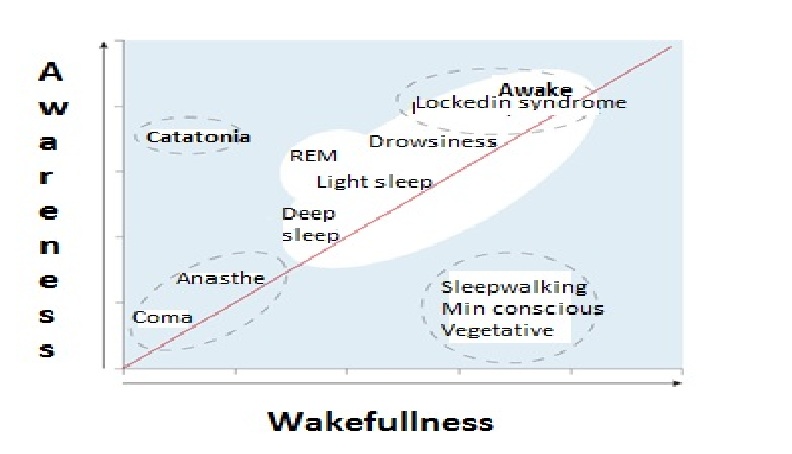
States of consciousness (After L. Saunders, 2012)

brains that are deeply asleep, under anesthesia or in comas to understand consciousness. As shown in the figure at the right, “awareness typically tracks with wakefulness — especially in normal states of consciousness. People in coma or under general anesthesia score low on both measures, appearing asleep with no signs of awareness. Sometimes, wakefulness and awareness become uncoupled, Continue reading

ANESTHESIA, DEEP SLEEP, DEATH AND CONSCIOUSNESS – Part 2/3

[Part 1/3      Part 3/3]

Before going into a consideration of Deep Sleep, once again a small detour.

Dennis raised in an e-mail the question of Sleepwalking. Where would it fit in the Model?

Some people amble around in sleep and even hurt themselves.  A few persons could commit heinous crimes in the state of somnambulism.  A well-known case is that of Kenneth Park in 1987 when he strangulated his father-in-law and killed his mother-in-law. However, he was let out by the court on the ground that he was sleepwalking when he harmed and killed people.  A similar case of acquittal also occurred in 1846. Apparently the body of the sleepwalkers is active but the mind seems to be asleep.

Neuroscientifically speaking, in the case of sleepwalking, the motor cortex of the brain is functional whereas the frontal lobe vested with executive functions is at rest. This means that a part of the mind (that propels the body to act) is active while the part responsible for reasoning and self-control is asleep. Continue reading

What is traditional advaita?

My teacher is a teacher of traditional advaita. I believe she is the only such teacher in the UK, if not in Europe. Some might look at what she teaches – Gita, Upaniṣads, Prakaraṇa Granthas (philosophical treatise) and stotras (devotional hymns) – and believe that they too, not only follow traditional advaita (because they too read these texts), but also have an additional, and arguably more powerful, key in the form of meditation or yoga or other such practice. Despite the surface similarity, however, I stick to my opening claim and will attempt to open up clear blue water between the teacher of traditional advaita simply by making clear what is mean by ‘traditional advaita’.

Two words set apart the traditional approach to teaching advaita from all others: sampradāya and pramāna.

Sampradāya is the established approach to unfolding the vision of Vedanta transmitted from one teacher to another. It is the traditional interpretation with a traceable lineage of teachers. Continue reading

What is Moksha and what does Science say?

[A few friends asked me about Moksha to be explained in simple words without any mystifying scriptural references, quotations and citations. This is what I wrote to them.

The points are made accordingly with no hyperbole, no mystique but merely as barebones facts without any frills – bibliographic references, supporting evidence etc. for the sake of brevity. I thought of sharing it here so that it can be corrected / sharpened in expression and  improved in an overall way. ]

1. Moksha:

There is nothing mysterious about it. It goads the spirit of inquiry in us.

Our ancients’ inquiry was on:

i) Who am I? and ii) What is this world around?

Continue reading

Ecosystems

If you enjoy wildlife television programs, and you live in the UK, then you’re probably watching ‘Secrets of our living planet’ presented by Chris Packham. If, on the other hand, you’re not particularly interested in wildlife programs, you really ought to give this one a look because it is not the run-of-the-mill type. (And if you live outside the UK, watch out for it because it is almost certain to be in your area soon.) In fact, it is actually about ecosystems and some novel connections are highlighted, which you will almost certainly not have heard of. These have something of the ‘wow’ factor of those books by Lyall Watson, such as ‘Supernature’, although this series seems to be grounded in genuine scientific observation. Continue reading

Being a bhakta (Q. 314)

Q: I take no great pleasure in what the Buddhists call samsaric existence, and, over a long number of years, by intellectual hard work, have extricated myself from sectarian Christianity. However, I have come to realise that my progress has been not so much spiritual as intellectual. In practice, I find that I seem to be incapable of devotion, or any emotional attitude to any avatar or guru. For me, Bhakti seems to be impossible even though I really try to avoid obvious “sins”, and try to be altruistic in my outlook. It seems as if I am damned to be merely a seeking, learning intellect, with very little emotion in what I do, except in times of crisis. For instance, in desperation at what I see as my condition, I have prayed to Ramana Maharshi, asking him to open my heart, and to allow me to feel more emotion/devotion than I do. Sometimes, on such occasions I have shed tears, but they pass, and soon, I am back to my usual practical self, doing  the usual, practical things, and taking an “intelligent interest” in things.

 Years ago, I used to attend a Buddhist meditation group under a very able teacher who, it was obvious, had seen through the ego and was beyond it. (It would be too complex a matter, and would take too long, to tell you how I knew this, but know it I did. He was a very powerful being, and his aura could be felt even after leaving him.) After a number of years’ attendance, this teacher made it clear to me (I must say, very skilfully, by implication and not directly) that I was not a suitable attendee. This was even though there had been many of what I would call transcendental experiences, and insights (all, I think, thanks to the darshan of this teacher) that have now been lost. For many years, since leaving the group, I have been a loner, living a very quiet and studious life, mainly. I try to do all the good for others that I can, by being helpful to others, and as generous as I can afford to be (I think) with money. Yet, I feel as if I am damned, having lost my chance to practice with a realised teacher. And all because (it seems) I was not able to forswear sex within marriage at that time of life. Even now, in old age, when such an obstacle cannot exist, there is still the problem of a lack of a capacity for devotion — only a capacity for intellectual understanding.

 What can be done? I am afraid of being re-born in unpropitious states because of my condition. Continue reading

ANESTHESIA, DEEP SLEEP, DEATH AND CONSCIOUSNESS – Part 1/3

Recently there was an interesting question about the disappearance of ‘me’ when a patient is administered anesthesia in preparation for a major surgery.  It is quite intriguing where the missing ‘self’ has gone and when under anesthesia (Q. 313).

Peter, Sitara and Dennis answered the question very ably explaining the Vedantic philosophy behind the various states of consciousness (as we usually understand the term).  The false concept of the sense of a separate ‘self’ we think we possess and the reality of an eternal Self; the misunderstanding that arises if we take the word Consciousness to mean the same in psychology (& medicine) and Advaita;  the possible existence of multiple ‘minds’ which derive their illumination from an unchanging, everlasting, self-effulgent One Brahman were dealt with by them. Hardly can anything be added to their clear exposition made from the stance of Non-duality beyond saying a word of our appreciation and gratefulness to them.

I would like to use this opportunity, if I may, to bring to the notice of a wider audience an approach I developed in 2004 relating the state of our alertness to our body-mind system in order to understand who we really are. We shall also in the process examine what are Deep Sleep and Death and what is the condition of the brain under different states, including awake, dream, deep sleep, death, coma, anesthesia etc.

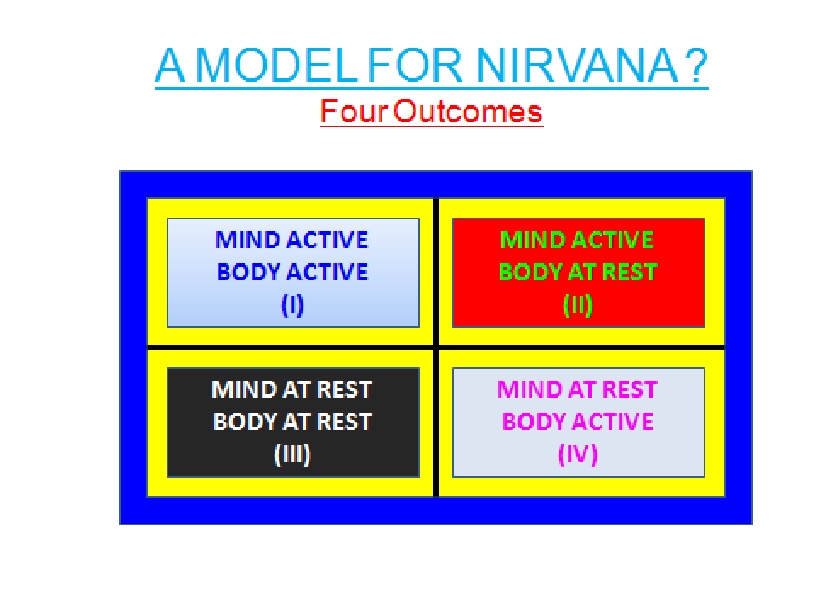
Let me call this as “A Model for Nirvana.”

Four Outcomes

Four Outcomes


Continue reading