Kaṭha Upaniṣad Review

The Kaṭhopaniṣad with Śaṅkarabhāṣyam
Based on Swami Paramārthānanda’s lecture
Compiled by Divyajñāna Sarojini Varadarājan
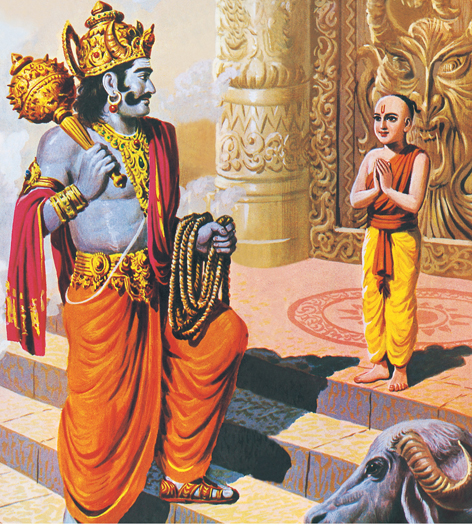
The main teaching of the Kaṭha Upaniṣad is Death’s response to the request by a young seeker, Naciketas, for Self-knowledge. Any serious student of advaita will want to know the answer as this is our own question too: using logic we may well be able to arrive at what we are not, but we still need to know clearly what we are. For this reason this book by Smt. Sarojini Varadarajan, based on Swami Paramarthananda’s traditional unfoldment of the Upaniṣad and Śaṅkara’s commentary theron, is a valuable addition to any seeker’s library.

One way of approaching this Upaniṣad is to note that Naciketas standing at Death’s door (literally) remained steady-minded enough to press his request for Self-knowledge – in spite of Death’s initial resistance to answer. And, by the end of the Upaniṣad, after Death finally gave in to the young man’s request, Naciketas ‘became pure and immortal’. Is it really possible that we can also reach the same point by closely following the teaching that Naciketas hears, especially as we are living lives grounded in fear? Continue reading

Beyond Stillness – Q. 331

Q : I am a “solo practitioner” of the advice of Ramana Maharshi, as I understand what I absorb of it. My enquiries move between an apophatic and cataphatic flavor.

 When I do this, I am moved to an absolute stillness. Upon ‘coming back’, there is a sensation of still not passing the barrier of stillness. I am not sure how to continue. Should I continue to practice just like this? Until I have destroyed differentiation? Should this be a lesson on what the real really is?

[Note (Dennis): Here are the meanings of those terms from my Oxford dictionary –

apophatic /ap’fatk/ – adjective Theology (of knowledge of God) obtained through negating concepts that might be applied to him. The opposite of cataphatic.

cataphatic /kat’fatk/ – adjective Theology (of knowledge of God) obtained through defining God with positive statements. The opposite of apophatic.] Continue reading

Vision Of Truth (sad darshanam – 5)


Arbhyate jIva jagat parAtma

tattvAbhidhAnena matam samastam

idam trayam yAvadahamatiH syAt

sarvottamASham mati shUnya niShThA—4


Arbhyate = begins;  jIva jagat parAtma = divisions of individual, world and Ishvara; 

tattvAbhidhAnena = principles of the three tattvAs;  matam samastam = all philosophies; 

idam = this; trayam = three;  yAvat = as long as; ahamatiH = ‘I’ notion; syAt = is there;

sarvottamA = the greatest of all; aham mati shUnya = devoid of ego; niShThA = 

abidance; 


All philosophies begin based on the principles of the three divisions of individual, world and Ishvara. The abidance in self, devoid of the ego is the greatest abidance of all.


All religions are based on the three divisions of individual, total and world. These religions culminate in some philosophy which again is based on this triad only. Theology sticks to these divisions and does not attempt to go beyond. Continue reading

Ānanda – our Svarūpam

When I went to a school, I asked the Children what are they in the school for? Someone said “to study”. I asked “Study for what?” “So that we can pass the examination with good marks” pat came the reply. “Why should you score good marks in the exams?” “So that we can get a good job?” “Why do we need a good job?” “So that we can earn a lot.” “Why do we need to earn a lot?” “So that we can buy things that we want.” “Why do we need to buy things that we want?” “So that I can be happy.”

What if you are Happiness here and now? What if Happiness is your Svarūpam? Please pause to think about the profundity of this possibility…..

Svarūpam, the word means one’s intrinsic nature. Like even heat and light are the intrinsic nature of fire.

Ānanda – it is a nuetral state; it is neither Happiness nor Sadness. It is neither bliss, for ignorance can be bliss. Ānanda is a state of equilibrium when one is at peace with oneself and the world.

We can logically arrive at Ānanda as our Svarūpam. How? Let’s analyze.

Continue reading

Morality in the Brain

Year 2012 is coming to a close and we are getting ready for one more end-of-the-year celebrations. People are already in a festive mood – remembering friends, recalling  favors received and planning for reciprocation with gifts. As you shop and bring home the packets, you plan to embellish them with a hand-crafted insignia to show your extra care and love. So you take a pair of scissors in hand and begin to cut a piece of paper molding it into an attractive shape. Your child suddenly comments: “Why do you purse your lips when you are cutting the paper?”

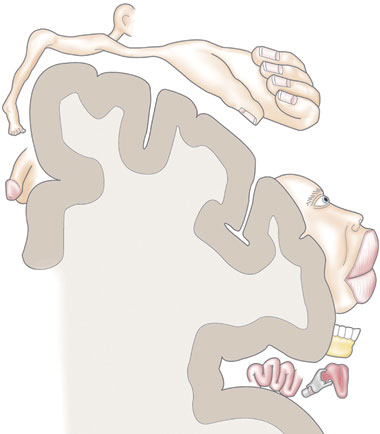
Fig. 1: Homunculus – Brain Real Estate Devoted to Touch in the Primary Somatosensory Cortex

What? Pursed the lips? You were not even conscious of the face, forget the lips.You were so much lost in the job with all your attention focused on the fingers and the scissors, you were unaware of the tightness in your face. Why should the lips tense up? And you  don’t even know about it!

You may be a six footer weighing 60 – 70 Kg having seen half a century or more of summers (and winters); or may be a short and smart young man of  20.  The wetware weighing less than a Kg and half (about 3 pounds) sitting between your ears contains an encrypted miniature model of who you are. It has all the maps representing your past, your knowledge, your expertise, tastes, likes, dislikes – everything that describes what you call as your ‘personality.’ Continue reading

Depression – Q.330

Depression – Q. 330

 Q: For years now I’ve been severely depressed and it doesn’t seem to be changing. What led me to Advaita, I think, was the intense desire to know what I guess I can only meaningly refer to as God.

I read a lot about how we are not our bodies and how if we can be aware of something, then that ‘something’ cannot be us. I understand all this. There is a formless awareness that appears to be prior to everything, prior to my body, my mind and the suffering of depression, I can see that.

One book I’ve read, not specifically about depression, advises that we remain with that awareness, as that awareness that is prior to both body and mind. However, I find this difficult. The body and mind come out of the Self and thus must be the Self. Beyond this the reasoning and experience of it gets quite subtle, but I’ll give it my best shot. Yes, there is an awareness that is before the mind and body, something that you might call the Ultimate subject, but It is only apparent because of the body and mind – without the body and mind, the Self wouldn’t know itself. Continue reading

Subscription Deletions

We have recently been receiving large numbers of what appear to be spurious subscriptions to the site, presumably for the purpose of spamming.

Accordingly, new subscriptions have temporarily been suspended and a number of existing subscribers have been deleted. The criteria for deleting these were as follows:


. Username unnecessarily long, with random alpha characters or numbers.
. No Name field entered.
. Email address suspect in a similar way, or closely resembling those of other subscribers.
. No posting activity since subscribing.

(If there had been posts or if a name had been entered, then the subscriber was not deleted.)

My sincere apologies if any valid subscriber has been deleted but I am sure you will understand and accept the error. Please re-subscribe and ensure that you enter your name and preferably use a Username that does not look as though generated by a computer!

If I have inadvertently deleted anyone who was not guilty of the above misdemeanours, then I doubly apologize!

I will reinstate the subscription facility in a few days.

upadesha sAhasrI part 6

Part 6 of the serialization of the  presentation (compiled by R. B. Athreya from the lectures given by Swami Paramarthananda) of upadesha sAhasrI. This is the prakaraNa grantha which is agreed by most experts to have been written by Shankara himself and is an elaborate unfoldment of the essence of Advaita.

Subscribers to Advaita Vision are also offered special rates on the journal and on books published by Tattvaloka. See the full introduction and part 1 of the new series.