Pleasure of Sex vs. Bliss of Self in Brain Scans

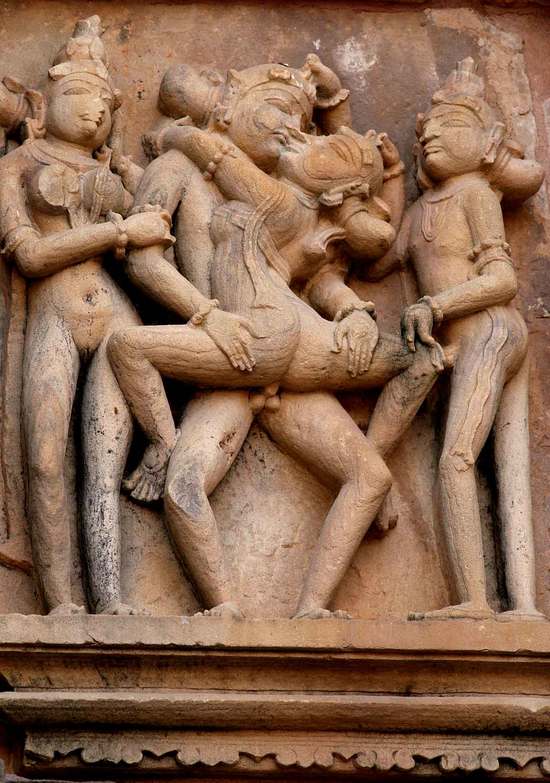
Khajuraho Temple Sculpture – 10th – 12th Century

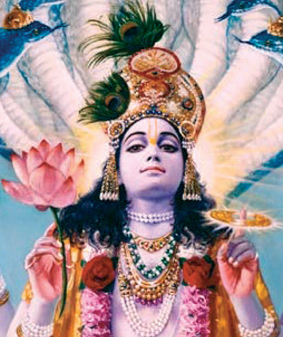
Khajuraho and Kamasutra fire the fancy of any foreign tourist to India.  Add Spirituality and the heady mix becomes a killer app for seekers of quick-fix salvation for paying a visit to India!  Biologically sex evolved as a reproductive mechanism to possibly capture the advantageous heritable genetic traits from a partner.  Only humans and a few animals like bonobos and dolphins indulge in recreational sex.  Sex is closely tied to sensory perceptions and lies within the realms of the mind. Salvation transcends both senses and mind. “Rajneesh, the ‘horse’s mouth’ concerning the topic of enlightenment for Westerners for many years,” regrets James Swartz, “wedded two largely incompatible concepts, sense enjoyment and enlightenment.” One may lose ‘self identity’ and get enwrapped in an inexplicable joy in either of them as Brihadaranyaka Upanishad says. But the bliss of enlightenment and the pleasure of sensual gratification are totally different. Our brains can show it all very clearly!

Human brain is a mass of interlinked neurons piled up in three layers. At the bottom is the most primitive brain common to all animals. Continue reading

Prayer for Advaitins?

In most Western Advaita circles prayer is an absolute anathema because it seems necessarily to imply duality. So with most seekers I have waited years until I introduced the topic. (As up to now I have only worked with people on a one on one basis, no-one has been exposed to something that he was not yet ready to digest.)

When finally I do introduce prayer people respond in a very similar way to it: with a mixture of scepticism („This certainly is something we are beyond, aren’t we?“), bad conscience (“Is not this a regressive step?”) and longing to allow themselves to pray.

 God

The biggest obstacle to prayer is the Western notion of God. The God they know of is an entity different from them, meaning this God definitely is part of duality. No Western Advaitin wants to turn to that. Moreover – even though there is much talk about His benevolence – many people have developed a healthy kind of a mistrust concerning His expression of love and care. They associate God with shame, guilt and punishment and much rather live without Him. Continue reading

How can we know Advaita is right? (Q. 312)

Q: One thing that has been troubling me is how I can know that Advaita is not just another interpretation of the world and self. For example, and to put it simply, a psychologist might explain the world using concepts and ideas in the field of psychology; a physicist might explain the world using ideas and laws found in physics etc. How do we know that Advaita is essentially ‘right’? Yes, a psychologists interpretation of the world and a physicists interpretation of the world are both ‘right’ in their own context, but *ultimately* they are wrong because, if Advaita is right, Brahman cannot be conceptualised?? But how do I *know* that Advaita is correct and not just another interpretation, another ‘way’ of seeing the world? Continue reading

Clearing the mind (Q. 311)

Q: I come across a lot about clearing the mind….but if there is no person, no-one that can have a will of his/her own, surely a desire or will to clear the mind is a nonsense? The mind cannot be tamed because there is not a person to whom it belongs, someone with their own free will? Is that at all right? Surely a clear mind would only arise because it is the will of Brahman?

 A: It’s only nonsense once you know that you are not a person!

 Also, you have to be very clear when you are talking about Brahman. Strictly speaking, the term ‘brahman’ refers to the non-dual reality and, if you are using it in this sense, it is not meaningful to speak of ‘the will of brahman’ – brahman does not have any will; there are no ‘parts’ to brahman and there is nothing other than brahman.

 If you are talking about the person (appearance) within the world (appearance), then you have to refer to Ishvara as the ‘creator’ and the dispenser of body-minds in accordance with accumulated karma from past lives.

 You have to be clear in your own mind about this distinction because, for example, the Brahma Sutras uses the word ‘brahman’ in both senses and expects you to know which one is being referred to in any given instance!

Science and the nature of absolute reality (Part 4)

Read Part 3

Science is not a pramANa (means of knowledge)

While philosophy may remain satisfied with the conceptual comprehension of the absolute and science with the never-ending search for it, religion points out the way to its immediate apprehension. Swami Satprakashananda (Methods of Knowledge according to Advaita Vedanta, Swami Satprakashananda, Advaita Ashrama, 1965. ISBN 81-7505-065-9. Read Extract from this book, which is highly recommended.)

Science relies on making observations as its fundamental starting point. From these, inferences may be made, theories postulated, predictions made on the basis of those theories and experiments devised to test those predictions. But, again, those experiments rely upon further observations. No definite, conclusive statements may be made because further observation might show them to be false. A classic example of this was the belief that swans were white. So entrenched was this belief up to the end of the eighteenth century, because every swan that anyone had ever seen had always been white, that one text book on logic used the statement ‘All swans are white’ as an example. And then an exploration to Australia found a black swan… Continue reading

Closer Than Close

” a documentary that investigates the spiritual search; the search for the essential questions of human life: is there an eternal part of ourselves? what has lasting meaning? where do we find certainty? Rather than philosophical discussion, it explores the possibility of living a life devoted to a search for answers, and the radical possibility that answers exist, closer than we can imagine, within our selves.”

Watch this promotional video advertizing the DVD from Poetry in Motion Films.

shrutisAra samuddharaNam (Part 3)

The shrutisAra samuddharaNam

of

shri toTakAchArya

An Overview by C.S.Baskaran
(Part 3)

Read Part 2

In spite of the contradiction pointed out to his theory as above, the Dvaitin contends further that by the same argument the principal statement “tat tvam asi” renders the indwelling self unreal, in which case what is the difference between the two sentences   “mind is Brahman” and “indwelling self is Brahman”? This is answered as follows:

Taking the first sentence “mind is Brahman”, the relationship between the two words mind and Brahman is that of effect and cause. Hence we understand the unreality of the effect – the mind – as in the case of  “pot is clay”. As for the second, the indwelling self can never be created and never be born – only the body has birth. Continue reading

Discovering the Gita

The most succinct description of the Gita is in the first verse of the ‘Meditation on the Gita’ traditionally recited before Chapter 1. It is a salutations to Bhagavad Gita, addressed as ‘Bhagavati, Amba’ (goddess, mother). This is what it says about her:
> She is revealed to Arjuna by the Supreme Lord himself.
> She is presented by the ancient sage Vyasa in eighteen chapters in the middle of the Mahābhārata.
> She is a shower of the nectar of non-duality that frees one from the root cause of unhappiness in life.  Continue reading

Advaita Made Easy

New Book Extract added:

Advaita Made Easy – Dennis Waite

My new book is scheduled for publication July 16th 2012 and can now be pre-ordered from Amazon. I’ve provided the chapter ‘Has the universe been created?’ as a sampler and also included the complete list of contents.

This book is aimed at those people who do not know what Advaita is (and wonder why you are wasting so much of your time on it). So buy copies for friends and relations! It covers all of the essential teaching in an authentic, traditional manner. So you need have no qualms about your friends getting the wrong ideas. (You could even read it yourself – it is less than 100 pages long.)