

Other experiments carried out more recently have confirmed that having a relevant thought prior to an action also gives us the feeling that we ‘caused’ the action, even when this is not the case. One experiment involved an arrangement of mirrors whereby the subject sees himself but with another person’s arms in place of his own. Instructions to move the arms in various ways are given and the arms subsequently move accordingly. Although the arms actually belong to an unseen person, the subject nevertheless feels that he has moved them. Continue reading
Death and Deathlessness
 Advaita Vedanta looks at death from 3 angles: as death of the gross body, death of the subtle body and no-death. All of us agree that the gross body dies, meaning that with death its present form is gone for good. It goes back to its basic components, in vedantic terms “to the elements”, which then take the shape of different forms: ash, earth, plants, worms etc.
In Christianity there is the belief of „resurrection in flesh“ which is supposed to happen for the virtuous ones after the last judgment day – although hardly anybody seems to take this seriously anymore, at least in Europe. In increasing numbers, people have taken to a sober viewpoint, basing their existence entirely on matter and considering themselves as merely flesh. For them there is only gross body, even what Vedanta calls subtle body functions – i.e. sense perceptions or thoughts or feelings – are believed to be operations of the gross body, nerves and brain in action. Continue reading
Free Sanskrit Resource
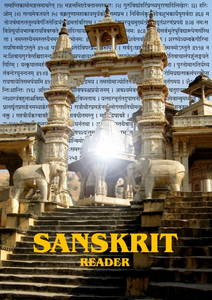 This Reader introduces India’s Sanskrit literature. The selection of more than 1600 verses covers subjects essential for the understanding of ancient Indian culture and modern Hinduism.
It consists of 300 pages A4, and is available for 25 Euro plus postage. You can order from: kontakt@vedischer-kulturverein.de. Alternatively, the best price (£12.24) is from the publisher.
You can view the first 18 pages here.
Even more amazing, however, is that you can download an 800 page Sanskrit Reader Course for free. This utilizes verses from the scriptures to illustrate the introduction of the alphabet and grammar, declensions and conjugations. There is also a list of dhatu-s and all of the words in the Bhagavad Gita, together with an indication of their derivation.
Heiko Kretschmer from Germany is to be congratulated on what has clearly been a labor of love in providing this wonderful resource. Download here (nearly 4MB).
Book Extract

New extract added to this section of the website:
Anatomy of Desire: How to Be Happy Even When You Don’t Get What You Want by Gina Lake
satyam j~nAnam anantam brahma (Part 3)
Till now we have seen that Brahman is anantam satyam…limitless existence. Now let us consider the word, j~nAnam Even this word has a regular meaning and an implied meaning. The regular meaning would be ‘knowledge of something; Computer knowledge, book knowledge, pencil knowledge etc mean the knowledge of a computer, the knowledge ‘of ’ a pencil. I perceive an object, then it enters my mind, as it were, and a corresponding thought modification takes place in the mind. This thought (vRRiti) itself is cognition.
When a thought modification does not take place in the mind, meaning, when a thought is not generated, then cognition does not take place; for e.g., I might be sitting in front of the television, but might be thinking about my child. In spite of the movie running on the screen and the familiar music in the background, I am blissfully unaware of it all because the mind is generating another thought, the child thought. I can ‘know’ the movie and music only when the mind entertains the respective thoughts. Hence, knowledge of an object is its thought in the mind. Continue reading
Who do you think I is? (3)
Link
 PART III: THE ANTIDOTE
Go to Part 2 | Go to beginning
Many people set themselves up as self-help gurus and offer remedies for the children of democracy. They are sensitive to the characteristics of these children, whose governing sound is ‘freedom’ and have been described so well over 2500 years in Book VIII of Plato’s Republic. Here is how Democratic Man is spoken of:
“… He lives on, spending his money and labour and time on unnecessary pleasures as on necessary ones; but if he be fortunate, and is not too much disordered in his wits, when years have elapsed, and the heyday of passion is over… he balances his pleasures and lives in a sort of equilibrium, putting the government of himself into the hands of the one which comes first and wins the turn; and when he has had enough of that, then into the hands of another; he despises none of them but encourages them all equally…
“Neither does he receive or let pass into the fortress (of mind) any true word of advice; if anyone says that some pleasures are the satisfactions of good and noble desires, and others of evil desires, and that he ought to use and honour some and chastise and master the others – whenever this is repeated to him he shakes his head and says they are all alike, and that one is as good as another… Continue reading
Dennis: Free Will (Part 4)

“The experience of willing an act arises from interpreting one’s thoughts as the cause of the act.” Daniel Wegner, quoted in the excellent book: Consciousness: an Introduction, Susan Blackmore, Oxford University Press, 2004. ISBN 0-19-515343-X. Buy from Amazon US or UK.
The scientific views that are often cited in respect of these discussions stem from experiments conducted by Benjamin Libet in the late 1970’s and by Daniel Wegner in the 1990’s. I described these in my books ‘How to Meet Yourself’ and ‘Back to the Truth’. Since very few people have actually read the former, I will quote at length from that: Continue reading
Meaning of ‘Advaita’ (Q. 306)
Q: In Sanskrit, a word’s meaning is determined by the meaning of the dhatu at the heart of the word, modified by the meanings of prefixes and suffixes. So according to Monier-Williams:
- a is a prefix having a negative or privative or contrary sense. This gives us NOT-<whatever follows>, but also indicates the absence of it, or the opposite of it.
- dva means two or both. Continue reading
bright like a million suns – Paula Marvelly
Flautist Upahar performs the poetry of Saint Kabir, translated by Rabindranath Tagore, in Papaji’s Cave, Mount Arunachala, Tamil Nadu, India. Watch this beautiful video paying homage to some wonderful poetry and haunting music.
A Question On Causality, Purpose And Suffering In Non-Duality
[As students of Non-duality, we often come aross situations that apparently seem to be at variance with the Non-dual teachings. Here is such a Question raised by a friend of mine and felt that it would be interesting to share our exchange with a wider audience for possibe further discussion — ramesam.]
Questioner: How could there be no cause and effect? How can things happen randomly with no purpose? I just can’t accept that meeting you was random, or that I found nonduality, and fell in love with it. It seems to appear everywhere. Jesus said ‘Seek and ye shall find.’ There is no randomness in that. We set goals, work hard, then accomplish them. Some people live for fun, engage in risky behavior, then get into trouble; how could it be completely random that some people are in the wrong place at the wrong time, then others are in the right place at the right time. Then there are the people who seem to do everything “right”, then some horrible fate befalls them. Have you ever read anything by Malcolm Gladwell? He wrote The Tipping Point, Outliers, and some other books. His research into why some people are successful and others are not is fascinating.