
In his bhasya to Brhadaranyaka Upanishad 4.3.21 (the Yajnavalkya – Janaka dialogue), Sankara goes to great lengths to explain what is knowledge, ‘merging with Brahman’ or ‘unity with all’, by comparing it to the deep sleep state. I will take a large part of the quote – it is well worth the read:
Continue reading‘Not Two’ – a Critical Review
On the face of it, this is a well-written and readable book, ideally suited for a new seeker. E.g. the sections on ‘The Illusory Nature of the Separate Self’ and ‘Knowledge Dispels Ignorance’ are excellent.
Unfortunately, should any reader accept everything that is written at its face value, they will come away with some serious confusions. In what follows, I apologize in advance for some of what may seem to be harsh criticisms, but my own perception of these points is heightened as a result of spending the last year writing my own work on ‘confusions’ of precisely this sort.
The author uses the traditional teaching method of adhyāropa-apavāda but it is not made clear when what is being said is only provisional. Also, there are very few references to the source of what is being presented. (And one of those that is provided doesn’t exist!) There are many places where the author writes ‘as Shankara said’ but scarcely a single pointer to where he said it. There are numerous places where I, as an informed reader, need those references before I will even consider what is being said to be credible!
Continue readingQ.454 How should one live one’s life?
Q: One of the problems I encounter with Advaita is that, even though it makes sense and resonates with me, it does not help from the point of view of providing guidelines on how to live my life. If we consider Buddhism, for example, we find a clear path on how to live one’s live that goes in accordance with the deeper philosophical explanations of what reality is, etc.
This is the part in which I find myself discouraged and not knowing how to move forward. What could you tell me about this? What would you recommend that I read?
A: All of the guidance given by Advaita regarding ‘how to live’ is directed at preparing the mind so that it is optimally able to gain Self-knowledge. Once this has happened, you know that in reality there is no world, there are no persons. ‘Life’ is just the apparent movement of forms of Brahman.
Continue readingNatural Realism
Natural Realism and Contact Theory of Perception : Indian Philosophy’s Challenge to Contemporary Paradigms of Knowledge, Chittaranjan Naik, Notion Press, 2019. ISBN 978-1-64678-012-9.
A challenging but worthwhile read
[Note that the conventional view of how we perceive objects is what is called the Representational theory of perception. This is the belief that light rays from a source hit the object and are reflected to the eye of the observer. The light is focused by the eye onto the retina, where it triggers responses in receptors. Electrical signals are generated, which pass along the optic nerve and thence to the visual cortex of the brain. Something else then happens to make us somehow reconstruct an image of the original object. It is this representation that is actually perceived and not the object itself.
Continue readingQ.453 Consciousness is happiness?
Q: I have just read your book ‘How to meet yourself’. I am not sure if I understand what you mean when you say that “Consciousness is happiness” and that “I am happiness”. Since everything is an appearance within consciousness, wouldn’t happiness be just that? Why would we equate consciousness to happiness?
A: Before answering the question, it would be useful to note the difference between Consciousness and consciousness. Consciousness with as capital ‘C’ is used throughout in all of these answers to refer to Brahman, the non-dual reality. The mind is conscious because Consciousness is reflected by the mind. The body and mind are both inert in themselves. It is important not to confuse these terms.
The actual paragraph is:
“Fourthly, it would not be meaningful to talk about Consciousness being happy or unhappy. Being complete and without limitations of any sort, it is more appropriate to say that Consciousness is happiness. This, then, is an aspect of my true nature. Since I am Consciousness, there is nothing that I need, nothing to be achieved, nowhere to which I have to get. I am already perfect and complete – I am happiness”.
Continue readingNothing To Do?
“Do you need to “become” brahman or are you brahman already?”
— it is a Question often raised in Non-dual discussions.
“The implication in raising such a question is that there is nothing more to do than just hearing the teaching, “you are already brahman,” and lo, behold, you are brahman!
But such a statement, IMHO, is misleading and even mischievous.
I suggest, therefore, reformulating that question in order to arrive at what actually Advaita points to. The reformulated version would be something like this:
“Are you right now Pure Awareness, unborn and immutable, undivided, immortal and untainted by anything else?
OR
Are you right now Awareness + a load of various other things which are mortal, constantly changing, inert and limited?” Continue reading
Q.452 Why is non-duality teaching ‘cold’?
Q: I am wondering why none of the teachings on Advaita/non-duality address the seeker with compassion or answer the question directly in a manner that would embrace the seeker. I have read several questions regarding thoughts and the creation of observed reality. Understanding that the person asking is still seeking, why would the near hostility of the answer that there is “no person to think, no concrete reality to experience, etc.”. possibly be acceptable from the standpoint of pure awareness.
Wouldn’t it be aware that this is not just ‘not an answer’, but a steering away from the question, and in terms of attaining a nondual experience not helpful? I would think awareness should know to first answer the question and then provide the next level view.
This is by far not the only site/teaching/vision of non-duality where this semi-hostility and often circular logic is present. I frequently see angry articles that just say “LOOK, it’s all right there, just LOOK”, as if that is helpful for someone who is seeking to understand. It’s not. It’s off-putting.
By far the worst answer I frequently come across is: “but who is asking?” That answer, while I have yet to see it here, is reprehensible. It is not an answer intended to help; it is intended to put people off and convey a sense of superiority. It shows less than no compassion and is ostracizing.
Why does it seem that the modern teaching of non-duality is hostile, cold and harsh with an almost elitist and upper crust air that defies an idea of an ever present awareness? What am I not seeing? Is there no teacher that can lead without being dismissive?
Continue readingQ.451 Nothing to be done?
Q: After reading and listening to non-duality teachers I got to know that there is nothing that can be done; there is nothing to attain and nothing to achieve. Whatever ‘is’, simply is.
So what should we do actually? After knowing this truth how should we live our life? Earlier I wanted to do sAdhana to attain self-realization and enlightenment. Now I have understood that it is the ego which is asking that.
Now in my life I have a feeling that, whatever activity I undertake, it’s just about keeping my mind and body engaged. Be it any activity – reading a book, doing meditation, working at the office – I feel that there is a separation between ‘I’ and the ‘mind’. When an activity or any kind of work starts, then the Mind and body are involved in it but I am separate from all of them. When the activity finishes, I again have my body and mind available to be engaged in another activity.
A: You seem not to be differentiating between absolute and empirical reality (paramArtha and vyavahAra). From the absolute viewpoint, there is only Brahman so that doing, enjoying, knowing etc. have no meaning – there is no one, no thing. But from the empirical perspective – from your personal viewpoint – there is a world and people. And there are j~nAnI-s and aj~nAnI-s (people who know the truth and those who do not). If you do not know the truth, you will suffer in life, so what can (and should!) be done is to find out the truth: that who-you-really-are is Brahman. Of course it is the ego that wants to do this but this desire is the one desire that is not only permissible, it should be encouraged!
Once your mind truly and irrevocably knows the truth (this is the meaning of being ‘enlightened’), you can then do whatever happens to be your svadharma or ‘calling’. This may just be carrying on doing your everyday job, living a family life, or whatever. But you may need to continue nididhyAsana in the form of study, reading, teaching, discussing Advaita so that the Self-knowledge is consolidated and you benefit from peace and happiness etc. for the remainder of the jIva’s life.
‘brahman,’ the Bliss – 2/2
Everyone must face the consequences of his/her actions. But who is it that ensures it? Who brings a guy back, once he is dead, and make him reap his just desserts?
The scripture only can provide an answer. And the answer is:
विज्ञानमानन्दं ब्रह्म … | — 3.9.28 (7), brihadAranyaka
Meaning: Knowledge, Bliss, brahman.
Shankara explains that It is Pure Intelligence and is also Bliss. It is a Bliss not smitten with pain. It is serene, beneficent, matchless, spontaneous, ever content and homogeneous, he amplifies.
Shankara, however, says, we cannot close the issue at that. We should explore and understand better what exactly the word “Bliss” would mean.
In our normal parlance, “the word ‘bliss’ is generally known to denote pleasure.” The shruti uses the word ‘bliss’ as an adjective to brahman. Can we infer from this that shruti says brahman is pleasurable?
Here are a few more examples where the Upanishads talk of brahman and Bliss: Continue reading
‘brahman,’ the Bliss – 1/2
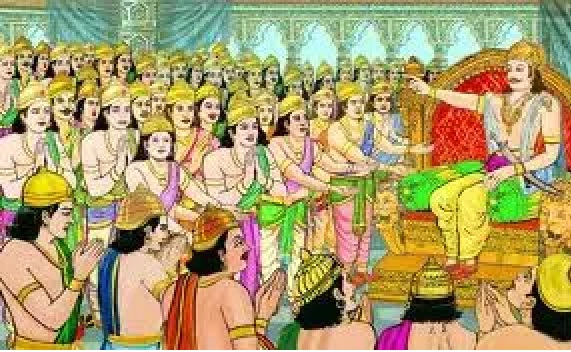 Ha, finally, a gentle streak of relief seems to have descended on to the faces of the assembled august Audience, sitting on the edge of their seats for hours with knotted foreheads, wide-open eyes and mouths, waiting in tension for the next onslaught of verbal missiles. None in the Royal Assembly could answer the final question of the Challenger and that decided what was at stake for the day. The fierce war of words seems to have come to a close when the well-statured Pundit, an embodiment of Knowledge Supreme, just began to take slow and steady steps, along with a horde of his disciples, followers and admirers, towards the exit door of the Royal Court. The gathered experts started to wipe the drops of sweat on their bald pates, foreheads and chest using their upper garment as a hand towel. Rolls of murmurs and exchanges opened up among small groups of the men, cascading into unclear sounds. Some people were talking within themselves or speaking to nobody in particular as they recapitulated the dense moments and the profound depths of the discussions. Continue reading