
Chapter 1 Upodghatprakaranam
Upadesa SAhasrI means A thousand Teachings. Its authorship is attributed to Adi ShankarAchArya. It has two parts- prose and verse with many paragraphs and verses which is a figurative justification of the title. Prose part has 116 paragraphs. Verse part which has 19 chapters is the focus here. Some of the chapters are small and chapter 18 titled Tat Tvam Asi is the biggest with 233 verses. There are totally 675 verses across all 19 chapters. Upodghat means introduction and prakaranam means chapter. Verse 1 is a prayer and much more. A prayer is generally for successful completion of the objective. Here it contains teachings also. The seeker prays (bows down) to Nirguna Brahman which is of the nature of pure consciousness. It is the Self (essential nature) of a jIva. It resides in the cave (intellect) of everyone and is like a witness of the intellect. It is within and without. It is all-pervading like rope pervading the mithyA snake in rope-snake metaphor. It is omniscient. It is beyond all perceptions and all objects of knowledge.
Self Seeking – Teacher List
In this book (published last week), I attempted to list all living, Western teachers who might be though to be teaching Advaita. Clearly, not everyone was going to agree with my assessment, maybe especially those teachers (and their students) who had been deemed ‘Not Advaita’.
There has already been a 1* review at Amazon UK which contained no comments and did not include a name. There is no way to cancel this so that the only way to redress the situation is for there to be positive reviews. I do not want anyone to provide insincere reviews. Please read and review honestly – 1* reviews are fine if justified.
Here is what I said in the book about my assessment of teachers:
Continue readingChAndogya Upanishad (Chapters 6 to 8)-Part 9
7.25.1 and 7.25.2
The infinite alone is below, is above, is behind, is in front. It is in all directions-to the south, to the north. That alone is all this. The empirical world is mithyA. There is no second entity supporting Bhuma. There is nothing else besides Him on which He can be established. It is self-supported, so to say. That the wave supports water is a misstatement. There is no wave other than water. In order to avoid a possible misconception that individual soul is different from the Infinite, the Upanishad gives instructions: “I am indeed below, I am indeed above, I am behind, I am in front, I am in the south, I am in the north, I am indeed all this”. Even then, non-discriminating people might conceive I as representing mind and body. Therefore, further instructions are imparted: The Self indeed is below, the Self is above, the Self is behind, in the front, in the south and in the north, and the Self is indeed all this.
AI and Consciousness (Part 8)
*** Go to Part 1 *** *** Go to Part 7 ***
Q: I am not interested in pursuing the Western philosophical or scientific aspects any deeper. Nor am I interested in moral/ethical considerations. I would like to consider how this scenario would be explained and understood by Advaita. Also, I would like to extend the ‘object’ of the discussion to an alien, whose external interactions are entirely similar to the human head but whose physical indicators (EEG, MRI scan etc.) are quite different.
***********************
A: Excellent — let’s bring it back into the Advaita Vedānta framework, stripping away Western preoccupations with neurophysiology and ethics.
1. Consciousness in Advaita
- Consciousness (cit) is not a property of brains, bodies, or systems; it is the non-dual reality itself.
- Every “entity” that appears — human, animal, plant, alien, AI, severed head — is nothing but Consciousness in essence.
- The difference lies in the upādhi (limiting adjunct) — body–mind apparatus — through which Consciousness seems to manifest as “awareness,” thought, perception, etc.
BrihdArnyAka Upanishad (Part 9)
Chapter 3 Section 1- Asvala brahman
3.1.1 and 3.1.2 King Janak of Videh performs a sacrifice in which many Vedic scholars are present. The king desires to know the most erudite scholar whom he will reward with 1000 cows with gold covered horns. None of the scholars comes forward except Yajnavalkya (in short Yvk), a Vedic scholar who straight away asks one of his disciples to drive home the cows indicating that he considers himself the best. Naturally, other scholars object.
AI and Consciousness (Part 7)
*** Go to Part 1 *** *** Go to Part 6 ***
Q: I am specifically interested in the status of ‘consciousness’ with respect to a severed head. Let’s assume that it still has functional eyes/ears/nose and effective speech via a computer interface. I am also not interested in whether we call it a ‘person’ or the same person from whose head it came. Presumably, if we are able to communicate with it, we assume that it is ‘alive’ in the usually accepted sense? And ‘conscious’?
A: Short answer up front: If the severed head contains a living brain whose thalamocortical systems and integrative processes are functioning, and it reliably reports experiences and behaves as if awake, then — by the standard neuroscientific and most contemporary philosophical criteria — we would have strong reason to treat it as conscious. There remains, however, an unavoidable epistemic gap (we infer another’s subjective experience from behaviour and neural markers), so certainty is never absolute. Below I set out the reasons, the tests one could run, how different philosophical theories read the case, and the remaining uncertainties.
Continue readingChAndogya Upanishad (Chapters 6 to 8) Part 8
7.16.1, 7.17.1, 7.18.1, 7.19.1, 7.20.1, 7.21.1, 7.22.1, and 7.23.1
Sanatkumar wants to remove the wrong conclusion of Narada. He remarks that one speaks well who speaks truth implying that Narada’s knowledge is short of truth. He also says that one speaks truth who understands truth. Narada is curious and expresses his desire to understand truth and understanding of truth. And for understanding, one must reflect. Reflection means Vedantic inquiry. In the absence of inquiry, one may say that fire or the three colours in it are the supreme entity. For inquiry one must have faith in scriptures and the teacher. It is not a token faith for name’s sake. It must be sustained and steadfast. Steadfastness stands for earnestness in obediently listening to the preceptor with a view to attaining knowledge of Brahman.
Confusions over Kindle
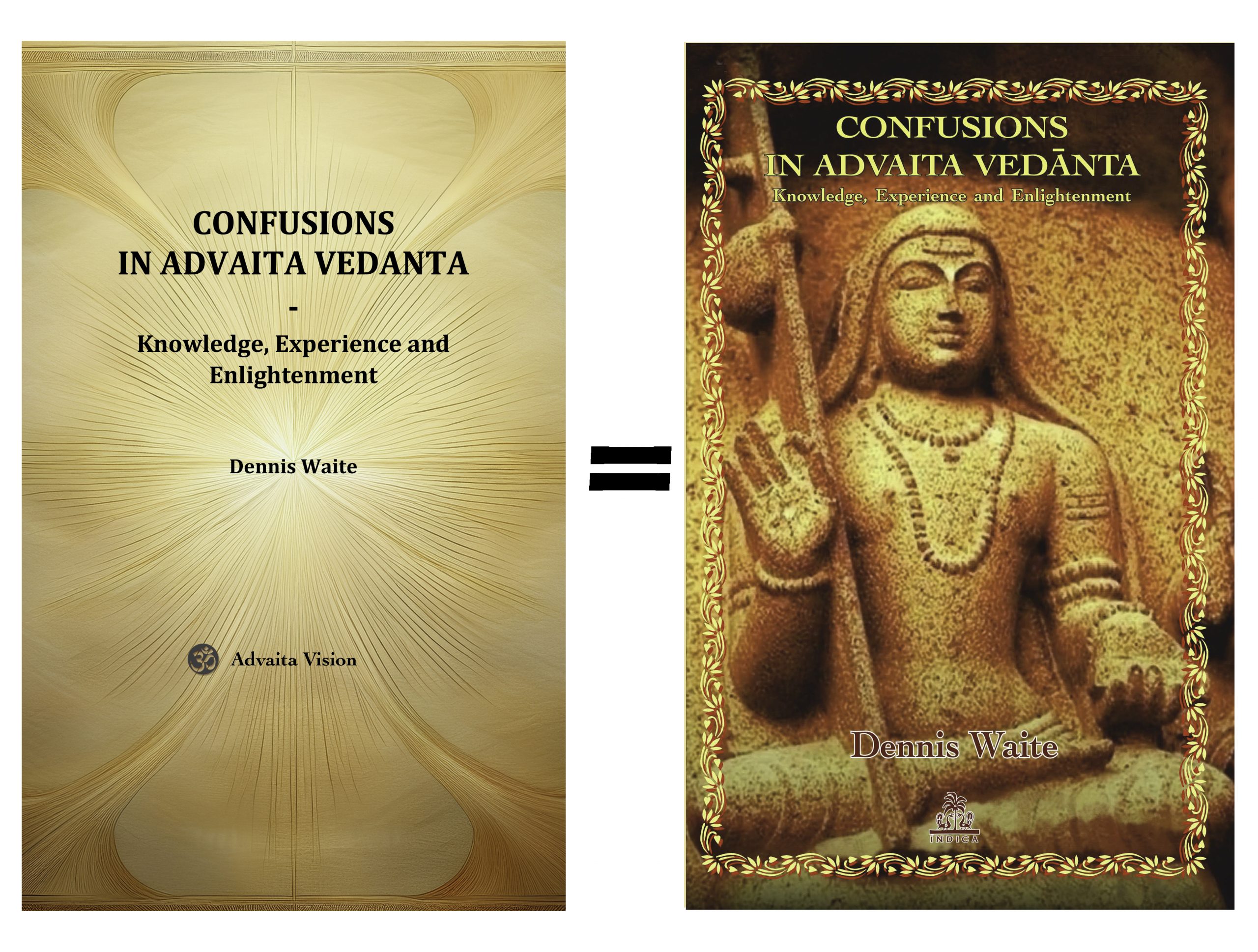 (Potential) readers of my last book – Confusions in Advaita Vedanta: Knowledge, Experience and Enlightenment – will have been experiencing difficulty when trying to purchase the book from Amazon. The book was published in India and, although available from Amazon in India, it is currently only available in the US in hardback (at $42.48). In the UK, you can purchase the hardback for £55, providing you are prepared to wait for 2 -3 weeks for delivery. Clearly not very satisfactory! The main problem appears to be the 50% tariff imposed on India by Trump, making the process not economically feasible.
Now, my Indian publisher – Indica Books – has very kindly agreed for me to publish the series on Kindle. This is an unusual arrangement, for which I am very grateful. I have spent the past two weeks changing fonts, re-editing, regenerating the index and sorting out the transfer to a PDF suitable for KDP (Kindle Direct Publishing). Fortunately, I recruited the help of ChatGPT here and, after probably a dozen VBA macros (ChatGPT is still learning, unfortunately, and tends to over-complicate things!) and a lot of manual work, this conversion is now complete – published by Advaita Vision.
Accordingly, you may now purchase Vol. 1, ‘Knowledge, Experience and Enlightenment’, on Kindle. In the US, this is $9.99 and in the UK £7.50. It is also available at other Amazon stores around the world – Germany, France, Spain, Italy, Netherlands, Japan, Brazil, Canada, Mexico, Australia and India. The prices are similar (converted at appropriate exchange rates).
Purchase from Amazon US……………………Purchase from Amazon UK.
Note that you can still puchase hardback and paperback versions direct from Indica Books. Just email indicabooksindia@gmail.com or info@indicabooks.com and the book will be posted. Payment is via PayPal or direct bank transfer. The direct link to purchase is here.
The task of converting and issuing Vol. 2, ‘Ignorance and its Removal’, will be much easier as my publisher has supplied the Word document already in the font in which I am publishing the Kindle version. Since this book has not yet been printed in India (and may yet be some weeks away), the Advaita Vision Kindle version will be available in advance of that.
BrahmjnAnavalimAlA
BrahmjnAnavalimAla (BJVM) means Garland of Knowledge of Brahman. It is attributed to ShankarAchArya. It has 21 verses. Brahman is the reality, world is mithyA and jIva is not different from Brahman is in verse 20. The verse adds that it is the correct understanding of shAstra and that it is the claim of vedAnta.
BJVM summarizes various aspects of vedAntic teaching directly without explanations. As such, it is meant for nidhidhyAsana though verse 1 says that listening it once gives BrahmjnAna and moksha.
Self-knowledge is unfractured (akhandakAra) vritti. In verses 2 and 18, the phrase punah-punah (repetition) occurs. The idea probably is that BJVM should be chanted repeatedly so as to make jnAna vritti firm. The verse 18 says: “He who realizes after repeated contemplation (emphasis added) that he is a mere witness; he alone is liberated. He is the enlightened one. This is proclaimed by Vedanta.” Links to the text and chanting are below.
Brahma Jnanavali Mala | Vedanta Shastras Library
https://www.youtube.com/watch?v=BF8zi90QLEA&list=RDBF8zi90QLEA&start_radio=1
AI and Consciousness (Part 6)
*** Go to Part 1 *** *** Go to Part 5 ***
[Note that, if you are only interested in Advaita-related aspects, you can safely ignore this part and the next and wait for Part 8.]
Q: One can envisage that scientific advances will soon enable the possibility of keeping the severed head (or extracted brain) of a human alive and able to communicate (perhaps electronically to a computer rather than by speech). What have Western philosophers said about the status of such an entity in respect of consciousness?
************************
A: Great question — it sits at the intersection of metaphysics, personal identity, and applied ethics, and philosophers have discussed closely related thought-experiments for decades. Below I summarise the main Western philosophical positions that bear on the scenario you sketch (a severed head or extracted brain kept alive and able to communicate), give the ethical implications each view highlights, and point to accessible sources you can read next.
I’ll give a short roadmap first, then the positions, then the ethical consequences and a brief practical summary.
Continue reading