
Brihadarankya Upanishad (Part 15)

Part 14

Part 16

4.3.15 to 4.3.17                                                                                                            After enjoying the dream world, a jiva goes to deep sleep or to the waking state. During dream he is only a bhokta though seemingly attached to action. There is no real attachment. He is not a karta and does not earn karma. The Upanishad says that similar to the dreamer, the Self is not attached to any action.

4.3.18                                                                                                                             Self is like a big fish. As the fish swims alternately between two banks without becoming affected by what happens on the bank, the Self moves between the dream and waking states without being affected by what happen in these states.
Continue reading

Chandogya Upanishad (Chapters 6 to 8) (Part 14)

Part 13

Section 13 (8.13.1), section 14 (8.14.1), and section 15 (8.15.1)
Vedantic teaching is over with section 12 of the chapter 8. Sections 13 to 15, each containing one mantra, are sort of miscellaneous.
A meditator longs for krama-mukti prays. He has practised meditation on space in the heart as Isvara. Space is one of the five elements. But here space is considered as a symbol of Isvara for meditation. It is revealer of name and form. By practice of meditation, he has reduced papas (demerits) like a horse shakes the dust off his body and the moon comes out of the grip of Rahu. Meditation has purified the mind and sense organs. He is desirous of going to the abode of Brahmaji to realize Atma so that he attains freedom from the cycle of life and death.
After enumerating of lineage of teachers, i.e., Brahmaji, Prajapati, Manus and his descendants, the Upanishad concludes with an assurance. He who serves his teacher, lives as prescribed by the Vedas and has control over mind and body, practices non-injury except otherwise ordained by scriptures, reaches the abode of Brahmaji and does not return. Continue reading

Quintessence of 10 Upanishads – 3 (Isha)

[Part – 2 (Isha)]

The Upanishad says:

अनेजदेकं मनसो जवीयो नैनद्देवा आप्नुवन्पूर्वमर्षत् । 
तद्धावतोऽन्यानत्येति तिष्ठत्तस्मिन्नपो मातरिश्वा दधाति ॥        —  mantra 4, IshAvAsya upa.

[Meaning: It is unmoving, One, and faster than the mind. The senses could not overtake It, since It ran ahead. Remaining stationary, It outruns all other runners. It being there, MAtarisvA allots (or supports) all activities. (Trans: Swami Gambhirananda).]

We need not look at the Lord and AtmA as mutually contradictory or conflicting. The verbal expression may seem superficially contradictory like an oxymoron, but if one probes deeper, the implied meaning will be clear. Therefore, one may say that AtmA is alone, absolutely steady and unmoving; but also say at the same time that It can move faster than even the mind. 

On one hand AtmA can be described to be formless; on the other hand, one may say that AtmA has manifested as the manifold (in a multiplicity of forms). When It is One with no second, It is the AtmA with no adjuncts and when It appears as the world, It is the Lord (Ishwara) having many forms.  Continue reading

Anirvacanīya

Explanation of key terms in Advaita – No. 3

Anirvacanīya: Navigating the Inexplicable in Advaita Vedānta

In the study of Advaita Vedānta, seekers eventually encounter a logical wall: If there is only one non-dual reality (Brahman), how do we account for the diverse, changing world we see every day? If Brahman is changeless, how does it appear to change? To resolve this without contradicting the core experience of the world or the absolute truth of non-duality, the tradition employs a sophisticated technical term: anirvacanīya (often transliterated as anirvachanIya).

Literally translated as “indescribable,” “unutterable,” or “not able to be categorized,” anirvacanīya is the cornerstone of Advaitic epistemology and ontology. It provides a way to talk about the world, ignorance, and the creative power of the Absolute without granting them ultimate reality.

Continue reading

Upadesa Sahasri (Part 6)

Part 5

Chapter 8 Merging of the mind
The chapter is meant for a seeker who has completed sravan and manan and is engaged in nidhidhyasana. He is convinced that his true nature is consciousness which is complete. Though he has contentment and peace, due to habits formed over many births, there is contrary thinking off and on. It is viprit bhavana. There is a tendency to make efforts to get over this because people are attached to the idea of cause and effect (8.5). The author says that he has composed a dialogue (chapter 8) between Self and mind to convince the seeker that viprit bhavana does not affect at all the true nature (consciousness) of the seeker. Let viprit bhavana which is due to prarabdha take its own course. The author has earlier (4.3) clarified that prarabdha has the capacity to overpower knowledge and it comes to end with death. In Naiskrama-Siddhi, Suresvaracharaya says that jnana removes avidya but not avidya vasana. However, when avidya vasana raises its head, jnana vasana also operates to neutralize it.

Continue reading

Quintessence of 10 Upanishads – 2 (Isha)

 [Part – 1 (Isha)]

असुर्या नाम ते लोका अन्धेन तमसा वृताः । 
तांस्ते प्रेत्याभिगच्छन्ति ये के चात्महनो जनाः ॥   —  mantra 3, IshAvAsya upa.

[Meaning:   Those worlds of devils are covered by blinding darkness. Those people that kill the Self go to them after giving up this body. (Translation: Swami Gambhirananda, 1957).]

The Upanishad counters the argument of the Mimamsakars saying that it is not a worthy stand to take, for it is tantamount to killing one’s Atma. AtmA is none other than what the Upanishad has been describing as the Lord. 

How can the Lord be the same as AtmA?

AtmA is the generic name. It denotes the intrinsic nature as explained by Shankara in his commentary on brahma sUtra-s.  Continue reading

Adhyāsa

Explanation of key terms in Advaita – No. 2

If adhyāropa-apavāda is the most important term regarding the teaching method of Advata, adhyāsa is the most important term describing the essence of the teaching.

Adhyāsa: The Fundamental Error of Mistaken Identity

In the study of Advaita Vedānta, the term adhyāsa is arguably the most critical concept to grasp if one is to understand the human condition and the path to liberation. Often translated as “superimposition,” adhyāsa refers to the fundamental mistake of apprehending one thing as something else. It is the cognitive error of mixing up what is real (sat) with what is only apparently real (mithyā), thereby creating a sense of confusion that defines our everyday experience. This concept is so pivotal that Ādi Śaṅkara devoted the entire introduction of his commentary on the Brahmasūtras—known as the Adhyāsa Bhāṣya—to explaining its mechanics and implications.

Continue reading

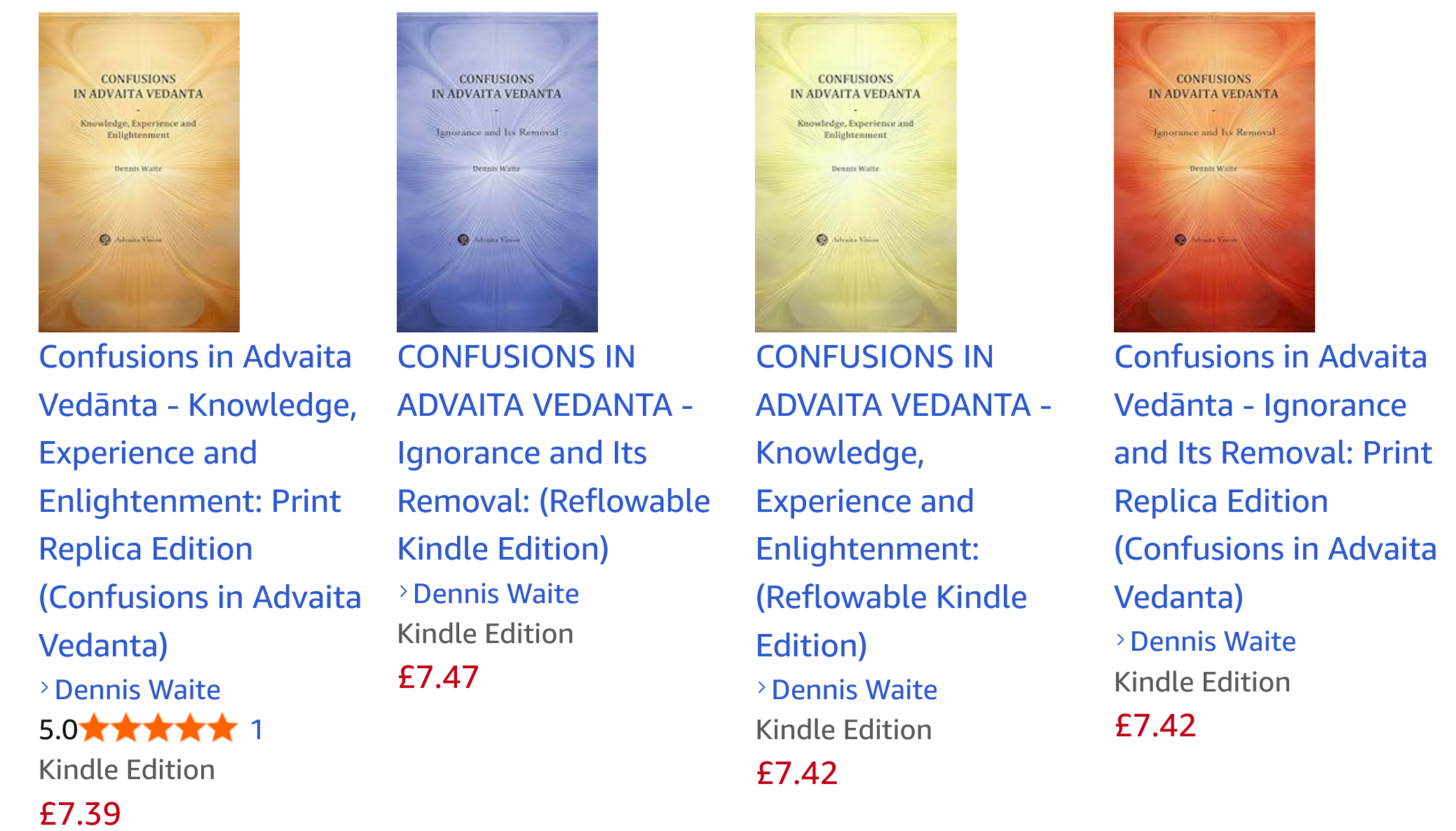
Kindle Confusions

DO NOT CLICK ON THE IMAGES ABOVE TO BUY THE BOOKS!
The correct links are as follows:
Knowledge, Experience and Enlightenment
Amazon US (Kindle print replica) $9.99; Amazon US (Kindle reflowable) $9.99
Amazon UK (Kindle print replica) £7.39; Amazon UK (Kindle reflowable) £7.42

Ignorance and Its Removal

Amazon US (Kindle print replica) $9.99; Amazon US (Kindle reflowable) $9.99
Amazon UK (Kindle print replica) £7.39; Amazon UK (Kindle reflowable) £7.42

See ‘Knowledge, Experience and Enlightenment‘ for details of Volume 1 and ‘Ignorance and Its Removal’ for details of Volume 2.

Continue reading

Brihadarankya Upanishad (Part14)

Part 13

Part 15

Chapter 4 Section 3 4.3.1 to 4.3.5                                                                                  In a series of questions Janaka asks YVK about the lights which a person uses for worldly transactions. Most obvious is the sunlight. When sun has set, it is the moonlight. When both sun and moon have set (Amavasya), it is the light of fire. When sun, moon, fire are unavailable, speech serves as the light to transact. Speech (sound) includes odour.

Continue reading

Quintessence of 10 Upanishads – 1 (Isha)

bhASyakAra bhagavatpAda Shri Shankara’s exhaustive commentaries on the 10 Major Upanishads constitute the first leg on the journey of imparting the Non-dual Wisdom to an eligible student seeking eternal Freedom (mokSa) from being reborn in the world. They form the Instructional core (upadesha prasthAna) of the Non-dual message.

Late Shri Yellamraju Srinivasa Rao (YSR), a well-known Advaitin, gave extensive Talks in Telugu on each of these 10 Upanishads adhering strictly to Shankara’s bhASya (commentary). He also supplemented his discourses on each of the 10 Upanishads with a 90-min Talk summarizing the content of that specific Upanishad (thus a total of about 900 minutes on Summaries).

I rendered into English Shri YSR’s Talks on the Summaries and edited them slightly for brevity etc. I offer them here for the benefit of any interested seeker for his/her personal use only for study, reflection and deep contemplative meditation. They may not be used for any commercial purposes. Continue reading