
“Do you need to “become” brahman or are you brahman already?”
— it is a Question often raised in Non-dual discussions.
“The implication in raising such a question is that there is nothing more to do than just hearing the teaching, “you are already brahman,” and lo, behold, you are brahman!
But such a statement, IMHO, is misleading and even mischievous.
I suggest, therefore, reformulating that question in order to arrive at what actually Advaita points to. The reformulated version would be something like this:
“Are you right now Pure Awareness, unborn and immutable, undivided, immortal and untainted by anything else?
OR
Are you right now Awareness + a load of various other things which are mortal, constantly changing, inert and limited?” Continue reading

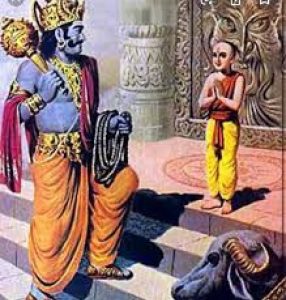 On the insistent questioning of the highly determined Naciketas, Lord Yama had no alternative but to reveal the secret code to ending the transient mortal world and realizing the “immortality” that one actually and already is. It is not some thing new that one acquires. It is prAptasya prAptiH (