QUESTIONS NOT RAISED OR ANSWERED – Part 1

[Here are three questions that I did not come across a seeker raising them. Nor did I find any teacher discussing directly those specific issues and answering them in a logical way. Maybe my literature search is incomplete, I admit. Before I go on to provide my replies to these questions, I will very much appreciate to know the reactions / thoughts of the interested / knowledgeable readers – ramesam.]

The Questions:

A.  Bhagavad-Gita related: Continue reading

Clearing some myths about mithyā

Adi Shaṅkara’s vision of advaita is most succinctly expressed in the following pithy statement: Brahma satyam, jagan-mithyā; jīvo-brahmaiva nāpara. (Brahman is Absolute Reality, satyam; the universe is dependent reality, mithyā; the individual, jīva, is none other than Brahman itself).

In this statement there is one word that has caused great confusion by being wrongly understood – much of the critical rejection of advaita (as well as the fundamentalist stand on non-duality adopted by some Western advaitins) can be avoided if this word is understood correctly. The word is mithyā.

Traditional advaita vedānta postulates two orders of reality: absolute and relative. The name given to the relative order of reality is mithyā, commonly mis-translated as ‘illusion’. Whereas the neo-advaita teachers accept only one level as valid (i.e. satyam), vedānta accommodates both levels. In the Taittiriya Upaniṣad it talks about two birds on the same tree: one enjoys the fruit of the tree, the other just witnesses. The Īśa Upaniṣad says that one should see everything as the Lord, but if that’s not possible due to attachment to the body then one should live a life performing one’s duty. The very structure of the Vedas themselves reflects this acceptance of a two-fold reality and prescribe (in the karma kāṇḍa section) the best way to live the worldly life and in the vedānta section it reveals the vision of truth. Satyam is the absolute level of reality, mithyā is the ‘as though’ real. Continue reading

Self ‘knowing’ the Self (Q. 317)

Q: Nisargadatta Maharaj (especially in his later books) emphasises that the “I am” or Consciousness is not the final Reality which he calls Parabrahman or Awareness. He goes on to state that Awareness is “unaware of itself”. However, others such as Francis Lucille and Rupert Spira seem to disagree. Francis Lucille, for example, specifically states that Awareness (in the sense Nisargadatta means) is aware of itself as itself.

 I am not exactly clear what Nisargadatta was meaning. It could be interpreted as the Final Reality being essentially almost a nihilistic eternal stupor rather than the more appealing (at least to this body/mind) satchitananda. I rather suspect not, and that he was merely indicating the essential non duality of reality perhaps along the lines of Ramana Maharshi’s comment : “Although (the Self) is consciousness, since there is nothing for it to know or to make itself known to, it is said to be different from the sentient and the insentient.”

 Nevertheless, it perplexes me that if Awareness is not aware of itself as itself as Francis Lucille suggests then do we not have the situation whereby an enlightened sage such as Ramana Maharshi is before his “death” not only aware as the Self but conscious thereof and in a better position, so to speak, than Final Reality which is not so aware? Continue reading

ANESTHESIA, DEEP SLEEP, DEATH AND CONSCIOUSNESS – Part 3/3

[Part 1/3         Part 2/3]

To eff the ineffable:

We travelled the depths of Non-duality in Part 2/3.

As Jeff would put it, “I am realized, you are not” is a silly game. There’s no one – none – that’s not Brahman. You are already realized! So relax.

And let’s know what the brainy brain-scientists say consciousness is.

What consciousness is and how the brain produces it (if it does), is still one of the great challenges to science. Until a few decades ago, science was averse to dabble into this subject for lack of adequate investigative tools (both conceptual and instrumental). “Today consciousness research has become a passion for many scientists.”

But what is consciousness? It’s like asking what life is or what energy is. You know it when you see it. We say that “a brain that is fully awake and constructing experiences is fully conscious.” The thalamus, a sort of hub located deep in the brain for information flows from the senses to the upper reaches of the brain is crucial for consciousness. A person turns into a vegetative state if the thalamus is damaged or the information flows are inhibited. This does not mean that thalamus produces consciousness; it may just show that one is conscious – much like a thermometer which doesn’t actually make the heat, but tells you how hot it is.

Dr.Giulio Tononi of the University of Wisconsin–Madison and his colleagues are studying
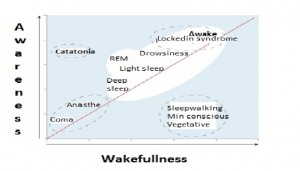
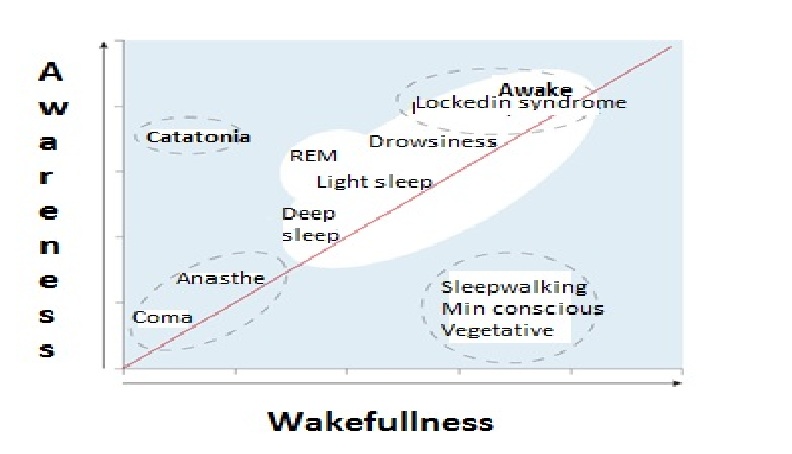
States of consciousness (After L. Saunders, 2012)

brains that are deeply asleep, under anesthesia or in comas to understand consciousness. As shown in the figure at the right, “awareness typically tracks with wakefulness — especially in normal states of consciousness. People in coma or under general anesthesia score low on both measures, appearing asleep with no signs of awareness. Sometimes, wakefulness and awareness become uncoupled, Continue reading

ANESTHESIA, DEEP SLEEP, DEATH AND CONSCIOUSNESS – Part 2/3

[Part 1/3      Part 3/3]

Before going into a consideration of Deep Sleep, once again a small detour.

Dennis raised in an e-mail the question of Sleepwalking. Where would it fit in the Model?

Some people amble around in sleep and even hurt themselves.  A few persons could commit heinous crimes in the state of somnambulism.  A well-known case is that of Kenneth Park in 1987 when he strangulated his father-in-law and killed his mother-in-law. However, he was let out by the court on the ground that he was sleepwalking when he harmed and killed people.  A similar case of acquittal also occurred in 1846. Apparently the body of the sleepwalkers is active but the mind seems to be asleep.

Neuroscientifically speaking, in the case of sleepwalking, the motor cortex of the brain is functional whereas the frontal lobe vested with executive functions is at rest. This means that a part of the mind (that propels the body to act) is active while the part responsible for reasoning and self-control is asleep. Continue reading

Ecosystems

If you enjoy wildlife television programs, and you live in the UK, then you’re probably watching ‘Secrets of our living planet’ presented by Chris Packham. If, on the other hand, you’re not particularly interested in wildlife programs, you really ought to give this one a look because it is not the run-of-the-mill type. (And if you live outside the UK, watch out for it because it is almost certain to be in your area soon.) In fact, it is actually about ecosystems and some novel connections are highlighted, which you will almost certainly not have heard of. These have something of the ‘wow’ factor of those books by Lyall Watson, such as ‘Supernature’, although this series seems to be grounded in genuine scientific observation. Continue reading

ANESTHESIA, DEEP SLEEP, DEATH AND CONSCIOUSNESS – Part 1/3

Recently there was an interesting question about the disappearance of ‘me’ when a patient is administered anesthesia in preparation for a major surgery.  It is quite intriguing where the missing ‘self’ has gone and when under anesthesia (Q. 313).

Peter, Sitara and Dennis answered the question very ably explaining the Vedantic philosophy behind the various states of consciousness (as we usually understand the term).  The false concept of the sense of a separate ‘self’ we think we possess and the reality of an eternal Self; the misunderstanding that arises if we take the word Consciousness to mean the same in psychology (& medicine) and Advaita;  the possible existence of multiple ‘minds’ which derive their illumination from an unchanging, everlasting, self-effulgent One Brahman were dealt with by them. Hardly can anything be added to their clear exposition made from the stance of Non-duality beyond saying a word of our appreciation and gratefulness to them.

I would like to use this opportunity, if I may, to bring to the notice of a wider audience an approach I developed in 2004 relating the state of our alertness to our body-mind system in order to understand who we really are. We shall also in the process examine what are Deep Sleep and Death and what is the condition of the brain under different states, including awake, dream, deep sleep, death, coma, anesthesia etc.

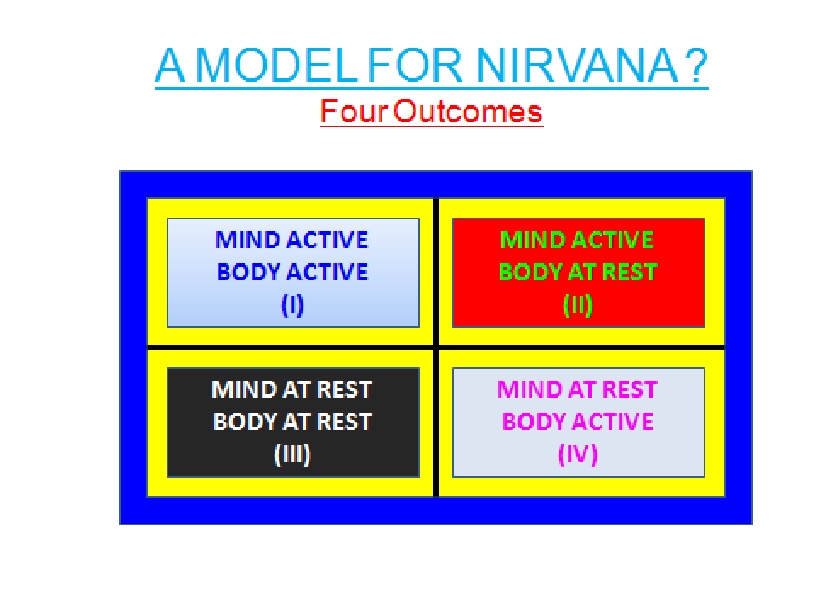
Let me call this as “A Model for Nirvana.”

Four Outcomes

Four Outcomes


Continue reading

shrutisAra samuddharaNam (Part 4, final)

The shrutisAra samuddharaNam

of

shri toTakAchArya

An Overview by C.S.Baskaran
(Part 4 – final)

Read Part 3


Refutation of the claim by the Dvaitin that “A Principal statement like tat tvam asi is neither acceptable nor can be rejected. It does not serve any purpose”

A Principal sentence negates the identification with the three gross, subtle and causal bodies for the seriously inclined student of Vedanta and such identification is the cause of the birth and death cycle. It generates the knowledge of the self (which equates to liberation) instantaneously. If one can accept the God and Creation through the Veda pUrva (karma kANDa) texts, why not accept the same Vedas’ Principal statement “tat tvam asi” as equally valid? When a sincere seeker is taught a Principal statement like “tat tvam asi”, “aham brahmAsmi”, “ayam Atma brahman” etc, his or her own attachment to the body certainly goes away. But, in the case of ordinary people, the false notion continues, in spite of repeated hearing of the above texts. Without the removal of false identity with the body-mind-intellect complex the transmigratory existence through cycles of birth and death cannot end. Continue reading

Under Anaesthesia (Q. 313)

Q: I recently had an experience that leaves me baffled. I have read your books, the sections on deep sleep consciousness, and it does not seem to match. The incident occurred when I will was given anaesthesia for hip replacement surgery. I went from eyes open in the operating room to who eyes open in the recovery room without any sensation in between at all. The experience was seamless and continuous from one consciousness to another. Time was absolutely absent. There was no reflection possible on the three-hour interlude. There was no interlude. There was no feeling of having slept well or otherwise.

  This experience has left me with a problem. This was the nonexistence of any kind of consciousness, even in retrospect It seems neither the small self or the real self existed at all. Please comment. Continue reading

manonAsha – not the literal death of the mind

Most seekers who have investigated the teaching of Ramana to even a small extent will be aware of the concept of manonAsha. This is often presented as the idea that enlightenment is synonymous with the ‘death of the mind’. And indeed this is its literal meaning. Consequently, some writers claim that, following enlightenment, the j~nAnI literally no longer has a mind. This goes along with similar ideas such as that, for the j~nAnI, the world literally no longer exists.

This way of thinking is unfortunate. Shankara himself emphasised that we should not discount either our experience or reason, when it comes to interpreting the scriptures. And, speaking for myself, whenever I have encountered writings on Advaita which significantly contradicted my perception of what seemed to be ‘reasonable’, they have always proved to be misguided or incomplete, if not plain wrong. Continue reading