
Q: One thing that has been troubling me is how I can know that Advaita is not just another interpretation of the world and self. For example, and to put it simply, a psychologist might explain the world using concepts and ideas in the field of psychology; a physicist might explain the world using ideas and laws found in physics etc. How do we know that Advaita is essentially ‘right’? Yes, a psychologists interpretation of the world and a physicists interpretation of the world are both ‘right’ in their own context, but *ultimately* they are wrong because, if Advaita is right, Brahman cannot be conceptualised?? But how do I *know* that Advaita is correct and not just another interpretation, another ‘way’ of seeing the world? Continue reading
Tag Archives: brahman
Clearing the mind (Q. 311)
Q: I come across a lot about clearing the mind….but if there is no person, no-one that can have a will of his/her own, surely a desire or will to clear the mind is a nonsense? The mind cannot be tamed because there is not a person to whom it belongs, someone with their own free will? Is that at all right? Surely a clear mind would only arise because it is the will of Brahman?
A: It’s only nonsense once you know that you are not a person!
Also, you have to be very clear when you are talking about Brahman. Strictly speaking, the term ‘brahman’ refers to the non-dual reality and, if you are using it in this sense, it is not meaningful to speak of ‘the will of brahman’ – brahman does not have any will; there are no ‘parts’ to brahman and there is nothing other than brahman.
If you are talking about the person (appearance) within the world (appearance), then you have to refer to Ishvara as the ‘creator’ and the dispenser of body-minds in accordance with accumulated karma from past lives.
You have to be clear in your own mind about this distinction because, for example, the Brahma Sutras uses the word ‘brahman’ in both senses and expects you to know which one is being referred to in any given instance!
Science and the nature of absolute reality (Part 4)
Science is not a pramANa (means of knowledge)
While philosophy may remain satisfied with the conceptual comprehension of the absolute and science with the never-ending search for it, religion points out the way to its immediate apprehension. Swami Satprakashananda (Methods of Knowledge according to Advaita Vedanta, Swami Satprakashananda, Advaita Ashrama, 1965. ISBN 81-7505-065-9. Read Extract from this book, which is highly recommended.)
Science relies on making observations as its fundamental starting point. From these, inferences may be made, theories postulated, predictions made on the basis of those theories and experiments devised to test those predictions. But, again, those experiments rely upon further observations. No definite, conclusive statements may be made because further observation might show them to be false. A classic example of this was the belief that swans were white. So entrenched was this belief up to the end of the eighteenth century, because every swan that anyone had ever seen had always been white, that one text book on logic used the statement ‘All swans are white’ as an example. And then an exploration to Australia found a black swan… Continue reading
shrutisAra samuddharaNam (Part 3)
 The shrutisAra samuddharaNam
of
shri toTakAchArya
An Overview by C.S.Baskaran
(Part 3)
In spite of the contradiction pointed out to his theory as above, the Dvaitin contends further that by the same argument the principal statement “tat tvam asi” renders the indwelling self unreal, in which case what is the difference between the two sentences “mind is Brahman” and “indwelling self is Brahman”? This is answered as follows:
Taking the first sentence “mind is Brahman”, the relationship between the two words mind and Brahman is that of effect and cause. Hence we understand the unreality of the effect – the mind – as in the case of “pot is clay”. As for the second, the indwelling self can never be created and never be born – only the body has birth. Continue reading
Objectification (Q. 310)
Q. I’ve been thinking about two things.
To determine that awareness is my true self and that my true self is not my ‘I’ concept, I’ve been looking into the ‘I’ concept. It is not my mind, because I can say ‘my mind’. It is not my body, because I can say ‘my body’, but could it be the mind body complex? Most would say no, because the mind and body are plural and the self cannot be plural. However, I’m confused because I don’t see it this way. I see the mind and body as acting as one, which means that the ‘I’ could possibly be it. It is difficult to determine where the mind begins and the body ends, and vice versa, so I see them as one, like the Yin Yang symbol. How do I know that the true self is not the ‘I’ concept that arises within me? Is it because I can make the ‘I’ concept the object of awareness, thus it cannot be the subject? Continue reading
shrutisAra samuddharaNam (Part 2)

The shrutisAra samuddharaNam
of
shri toTakAchArya
An Overview by C.S.Baskaran
(Part 2)
Identity of the Self and Brahman: The indwelling self is identical with the ever changeless Brahman – the pure existence consciousness. It is the cause of this Universe. The indwelling self (jIvAtman) is aware of both the ‘I’ thought (ahaMkAra ) and ‘this’ (idam- vRRitti ) that resolves in deep sleep. This is the central theme of this text. How such a statement is made, if asked, the answer is that it is not a contradiction as revealed by The Scriptures/ Upanishads. It is proved by shruti, pramANa, logic, and experience as in deep sleep. Seven such pramANa-s are referred to as follows. Continue reading
Interview with the Gita
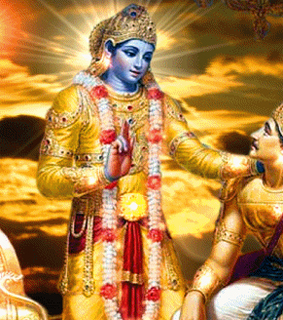 We are very fortunate to have access to Bhagavad Gita – described as Mother, Goddess, Shower of the Nectar of Advaita and the Release from the Endless Cycle of Rebirth – to answers the many questions that relate to our day to day living. The advice relates to every person who, like Arjuna, find that, when the minds alone is involved, it is clear what’s needed, but when feelings become engaged they are no longer convinced they know what’s the right thing to do. And, at the end of each chapter, Gita is described as Brahma vidya [Knowledge of Reality] and yoga shAstra [scripture that prepares the mind for Brahma vidya]. So the questions start from this point: Enlightenment is the unshakable knowledge ‘Aham BrahmAsi’ [I am Brahman]…
Q: What stops us from knowing this truth of oneself 24/7?
Gita: Mind has three basic defects:
1. it is impure (i.e. it is ruled by appetites and aversions)
2. it is unsteady (i.e. it is unable to hold one thought for any prolonged period of time, let alone forever – i.e. it is NOT capable of being ‘unshakable’)
3. what it holds to be true is erroneous.
Krishna describes this sort of mind of the irresolute as ‘bahu shAkAh anantAh’ – many branched and endless. Continue reading
When is an experience ‘true’? (Q. 309)
Q. Questions are always coming up in mind. Things are confusing. At the moment, for example, I’m trying to understand how one can know whether experience is valid or not e.g. if one saw an apparition of Christ, is one to interpret it as real/unreal, true/untrue etc. and how would you know one way or another….questions about truth and validness are always crossing my mind. Continue reading
Science and the nature of absolute reality (Part 2)
 Read Part 1
Although science is good at investigating objects, even there it is doomed to fail – because the essence of objects, too, is ultimately the same non-dual reality. As Atmananda Krishna Menon puts it, in his ‘Notes on Spiritual Discourses’: “As long as the least trace of subjectivity remains, objectivity cannot disappear. And until objectivity disappears completely, the real nature of the object can never be visualized. This is the fundamental error committed by science as well as philosophy, both in India and outside, in trying to approach the Truth through the medium of the mind.” (Vol 3 Notes, 1386)
Notes on Spiritual Discourses of Shri Atmananda: Volumes 1, 2 and 3, Shri Atmananda and Nitya Tripta, Non-Duality Press 2009, ISBN 978-0956309129 (Vol 1) Buy from Amazon US or Amazon UK. Continue reading
The Hole in The Whole
There is no Whole without a ‘h-o-l-e’ in it.
There is no hole without the whole around it.
The whole never contracted to become the hole.
The hole cannot expand to become the whole.
Pain is our struggle to keep up the identity
And the separateness of a “me”
That struggle for the survival by a “me”
Has been going on for millennia.
That story is the Theory of Evolution.
Suffering is our effort to become
Back again One Whole
Seeking for integration
Propels us for Self-inquiry.
That story is the Theory of Liberation.
The whole and the hole together simply “are.”
That is Oneness. So just Be.
That “Beingness” itself is Meditation.