Moving beyond mithyā

The aim of my previous blog on this topic was to clarify the term mithyā and thereby bridge the apparent gap between everyone’s perception of a diverse and ‘real’ universe and the advaita teaching that says that there is only one single non-dual Reality. Mithyā is that which cannot be dismissed as unreal nor can it be accepted as absolutely real. Due to a mistranslation of the word, many declare the mithyā universe to be an illusion and consequently act as though it can be discounted as if it was absolutely non-existent. Through the analogy of water and wave we are led to understand that, whilst still perceiving the wave, we nevertheless know that what we’re seeing is nothing but water. Similarly when looking out at the mithyā universe the wise person knows that what’s being seen is nothing but Brahman, pure existence-consciousness without limit.

This is not such an easy achievement. Continue reading

Apparent contradictions in Advaita (Q. 319)

Q: I read some serious critique of Advaita by a philosophy professor in a web page. If you have time, I`d like to know your thoughts about it.
 
Here it is:
 
. The View is Self-Contradictory: The first problem with the core of Sankara’s philosophy is that it seems to be self-contradictory. As advocates of the other Hindu schools of thought have pointed out, if the only reality is Brahman, and Brahman is pure, distinctionless consciousness, then there cannot exist any real distinctions in reality. But the claim that this world is an illusion already presupposes that there is an actual distinction between illusion and reality, just as the claim that something is a dream already presupposes the distinction between waking consciousness and dream consciousness. Moreover, Sankara’s idea of salvation–that is, enlightenment through recognition that all is Brahman–already presupposes a distinction between living in a state of unenlightenment (ignorance) and living in a state of enlightenment. So this view contradicts itself by, on the one hand, saying that reality (Brahman) is distinctionless, while on the other hand distinguishing between maya and the truth of Brahman, and by distinguishing between being enlightened and unenlightened. Continue reading

Panchadasi part 1

A series of posts, presenting a new translation and commentary by James Swartz on the Panchadasi. This was presented by James as a week-long course during July 2012 and was very well received. It will be posted in around 35 parts at the rate of one part every 2 – 3 weeks. I will be editing and commenting on the material as we go and James may provide additional commentary if time allows. So there may be scope for readers to provide feedback. Please email me via the ‘Contact Form’ if you do not understand anything and wish to seek clarification.

Read Part 1 of the Panchadasi.


Consciousness

For most spiritual seekers ‘consciousness’ has a positive connotation; they want to extend, raise, deepen their consciousness, or simply become more conscious. But as with so many other terms – soul, spirituality, freedom, love, truth, bliss, energy – everybody understands something else by them.

In Advaita Vedanta every term is defined unambiguously. In our normal usage of words, depending on the context, one defines consciousness in diverse ways. Generally, however, a material viewpoint forms the basis of the Western view. We think that consciousness depends on the brain, for example that one can switch it off or can raise and extend it (temporarily) by certain drugs. Also we think that we can direct our consciousness, align it to something or withdraw it from something.

We consider ourselves as conscious if we remember whether we have switched off the iron and as unconscious if we forgot it. Also, we should always remain conscious of internal processes – we consider ourselves more conscious if we note that an emotion has arisen inside us at the time that is arises, than if we note this only afterwards or not at all. Continue reading

Am I awake yet? – Fred Davis

So, am I awake yet, or what?

by

Fred Davis


I edit Awakening Clarity, a Nondual blog, and as a result of that I get emails from the four corners of the worlds.  A fair number of them express confusion.  The writer has had some sort of spiritual experience.  And now they want to know where they are on the spiritual map.  One response that arises here when someone asks me something along the line of, “Hey, am I awake, or what?” is exactly this:

“If you’re concerned about whether you’re awake or not, then you’re not–at least not right now.”  Such a question simply would not occur to conscious awakeness. Generally, in fact, given the nature of the situation the person is writing in about, and their choice of language their letter contains convincing evidence that they are not awake right now–at least not in the way they are asking about.  In truth, everyone is always equally awake, so all we are ever talking about is whether or not we are consciously awake, knowingly awake–right now. If we can get clear on this we can see that there’s no room left for higher or lower, better or worse, more spiritual or less.  All of those things spring from beliefs, opinions, and positions (BOPs), which conscious awareness simply doesn’t have.  The apparently separate being it’s working through will certainly have a broad array of BOPs–that’s essentially what a separate being is–but not the awakeness behind it.  You will understand, of course, that language is failing us here; we do what we can. Continue reading

Self ‘knowing’ the Self (Q. 317)

Q: Nisargadatta Maharaj (especially in his later books) emphasises that the “I am” or Consciousness is not the final Reality which he calls Parabrahman or Awareness. He goes on to state that Awareness is “unaware of itself”. However, others such as Francis Lucille and Rupert Spira seem to disagree. Francis Lucille, for example, specifically states that Awareness (in the sense Nisargadatta means) is aware of itself as itself.

 I am not exactly clear what Nisargadatta was meaning. It could be interpreted as the Final Reality being essentially almost a nihilistic eternal stupor rather than the more appealing (at least to this body/mind) satchitananda. I rather suspect not, and that he was merely indicating the essential non duality of reality perhaps along the lines of Ramana Maharshi’s comment : “Although (the Self) is consciousness, since there is nothing for it to know or to make itself known to, it is said to be different from the sentient and the insentient.”

 Nevertheless, it perplexes me that if Awareness is not aware of itself as itself as Francis Lucille suggests then do we not have the situation whereby an enlightened sage such as Ramana Maharshi is before his “death” not only aware as the Self but conscious thereof and in a better position, so to speak, than Final Reality which is not so aware? Continue reading

Repetition of practices (Q. 316)

Q: I can see that whatever is seen cannot possibly be me, the seer, the perceiver. The perceiver cannot be perceived because it is perceiving. That seems really obvious and clear (usually, not always, don’t need to claim any more than is really the truth at present.)
 
Whatever practices, meditations I’ve ever done always end up at the same place: I come back to I/me, the perceiver. Whatever experiences of bliss, ecstasy, I’ve had always end up going away. I come back to: I, the perceiver. I’ve gotten to the point where I don’t care whether some bliss state occurs because I know it won’t last, and, ha, it took many years of going through the same thing over and over again. I’d have that bliss state, or whatever we might want to call it, try to hold on to it, be disappointed when it went away and then “work”
to get it back again!!! Seems absurd now…
 
…the question is: I guess I continue to understand that I can’t be what I perceive, whether outwardly, in the world, or inwardly, persona maybe….just continue to come back to “I” perceiving all this? There is no particular joy in this or happiness, in the sense that I know all these experiences don’t last. But there seems to be some bed-rock perceiver which doesn’t go away except in deep, dreamless sleep…As I’m writing this I think again that I really need a teacher, but don’t see that happening anytime soon. In the mean time….books, being the perceiver and not the perceived…I guess!!! Thanks. Continue reading

ANESTHESIA, DEEP SLEEP, DEATH AND CONSCIOUSNESS – Part 3/3

[Part 1/3         Part 2/3]

To eff the ineffable:

We travelled the depths of Non-duality in Part 2/3.

As Jeff would put it, “I am realized, you are not” is a silly game. There’s no one – none – that’s not Brahman. You are already realized! So relax.

And let’s know what the brainy brain-scientists say consciousness is.

What consciousness is and how the brain produces it (if it does), is still one of the great challenges to science. Until a few decades ago, science was averse to dabble into this subject for lack of adequate investigative tools (both conceptual and instrumental). “Today consciousness research has become a passion for many scientists.”

But what is consciousness? It’s like asking what life is or what energy is. You know it when you see it. We say that “a brain that is fully awake and constructing experiences is fully conscious.” The thalamus, a sort of hub located deep in the brain for information flows from the senses to the upper reaches of the brain is crucial for consciousness. A person turns into a vegetative state if the thalamus is damaged or the information flows are inhibited. This does not mean that thalamus produces consciousness; it may just show that one is conscious – much like a thermometer which doesn’t actually make the heat, but tells you how hot it is.

Dr.Giulio Tononi of the University of Wisconsin–Madison and his colleagues are studying
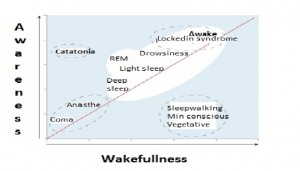
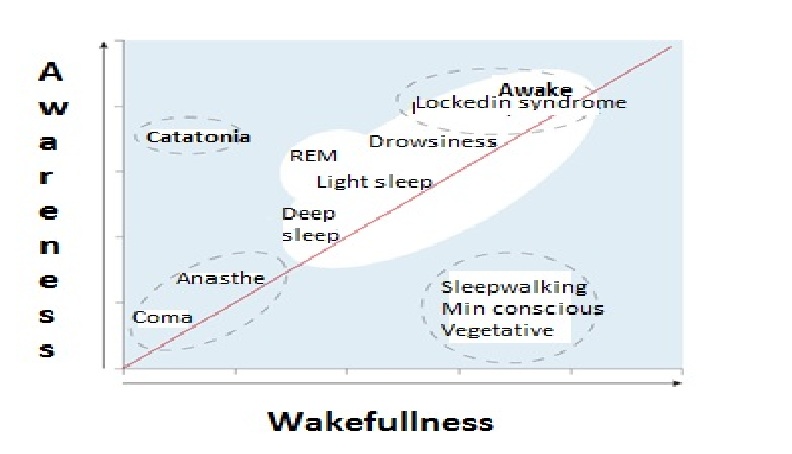
States of consciousness (After L. Saunders, 2012)

brains that are deeply asleep, under anesthesia or in comas to understand consciousness. As shown in the figure at the right, “awareness typically tracks with wakefulness — especially in normal states of consciousness. People in coma or under general anesthesia score low on both measures, appearing asleep with no signs of awareness. Sometimes, wakefulness and awareness become uncoupled, Continue reading

ANESTHESIA, DEEP SLEEP, DEATH AND CONSCIOUSNESS – Part 2/3

[Part 1/3      Part 3/3]

Before going into a consideration of Deep Sleep, once again a small detour.

Dennis raised in an e-mail the question of Sleepwalking. Where would it fit in the Model?

Some people amble around in sleep and even hurt themselves.  A few persons could commit heinous crimes in the state of somnambulism.  A well-known case is that of Kenneth Park in 1987 when he strangulated his father-in-law and killed his mother-in-law. However, he was let out by the court on the ground that he was sleepwalking when he harmed and killed people.  A similar case of acquittal also occurred in 1846. Apparently the body of the sleepwalkers is active but the mind seems to be asleep.

Neuroscientifically speaking, in the case of sleepwalking, the motor cortex of the brain is functional whereas the frontal lobe vested with executive functions is at rest. This means that a part of the mind (that propels the body to act) is active while the part responsible for reasoning and self-control is asleep. Continue reading