 Part 11 of the New Book Serialization!
The second dialog between the sage Vasishta and the Dreamer begins.
The dreamer asks about the difference between an avatar and a lunatic and Vasishta explains that the Absolute never assumes name and form.

Part 11 of the New Book Serialization!
The second dialog between the sage Vasishta and the Dreamer begins.
The dreamer asks about the difference between an avatar and a lunatic and Vasishta explains that the Absolute never assumes name and form.
Q: What is the difference between the witness, witness consciousness and consciousness? I know myself as the witness or maybe as witness consciousness but I do not know myself as all there is which, I guess, would be knowing myself as consciousness. But how can I ever not see the world of objects? So do I not remain a witness choicelessly?
A (Sitara): Contained in your question are seven questions (which I have passed on to the other bloggers, so some may refer to them):
1. What is the difference between the witness, witness consciousness and consciousness?
This will be answered below along with the last question.
2. (implied question) Is there a difference between the witness and witness consciousness?
Answer: no, not in the way I use the terms. But there is the possibility of a flawed use of the term ‘witness’. Witness means the ultimate subject that cannot be objectified. If witnessing is attributed to the mind, the so-called witness is nothing but a thought, i.e. it is just another object. And the so-called witnessing is nothing but an experience.
If, however, witness is used in the sense of ‘ultimate subject’, you can use ‘witness’ and ‘witness consciousness’ interchangeably. I prefer the term ‘witness consciousness’ (or simply ‘witnessing’) because the term ‘witness’ suggest too much of a personality. Continue reading
shabdAdi rUpam bhuvanam samastam
shabdAdisattendriya vRRitti bhAsyA
sattendriyANAmmanaso vashe syAt
manomayam tad bhuvanam vadAmaH
shabdAdi rUpam = of the form of sound etc; bhuvanam = world; samastam = entire;
shabdAdisatta = the existence of sound etc; indriya = organs; vRRitti = functions;
bhAsyA = illumined;sattA = existence; indriyANAm = of the sense organs; manaso = of
the mind; vashe = control; syAt = is; manomayam = made of mind; tad = (here tad=
tasmAt) therefore; bhuvanam = world; vadAmaH = we say.
The entire world is of the form of sound etc. the existence of sound etc is illumined by the functions of the organs. The existence of sense organs is in the control of the mind. Therefore, we say that the world is made of the mind.
The entire world and the whole gambit of transactions that take place within it are but divided only into five categories viz. sound, sight, smell, taste and touch. There cannot be any transaction beyond these five divisions. The world is rightly called prapa~ncha – a division into five categories (pa~ncha means five). The world therefore is five -fold based on the five sense organs. Continue reading
Q: Since brahman is non-dual, attributeless, changeless, and eternal, and since brahman is everything, it must follow that everything is also non-dual, attributeless, changeless, and eternal. So how can it be that we experience duality, attributes, change, and impermanence in the world? How can the changeless manifest change, even if this change is in appearance only (mithyA)? How can there be anything but the “perfect” unchanging oneness if everything is this oneness?
A (Ramesam): The manifestation of Consciousness (= Brahman) as the world (multiplicity) in a sense is an “explanatory gap” from a strict rationalistic point of view. It is, perhaps, the ‘weakest link’ in the Advaita siddhanta (theoretical framework).
Having said so, there are a number of ways to resolve the ‘One –-> many’ problem. I shall list here several metaphors just to answer the “appearance” of the world part without getting into the bigger questions related to why and how of “creation” itself (origin of the universe). Continue reading
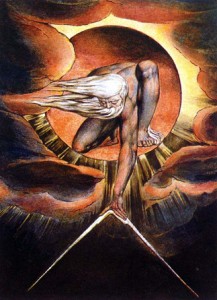 One of the more difficult ideas for some Western seekers to accept is God, the Lord. The usual picture is of a highly judgmental white-bearded figure, sitting in heaven, dispensing punishments and rewards. God, in this picture, is all-controlling, all-powerful and thus I am small and insignificant and a mere pawn in his game. This sort of idea of the Lord is also prevalent in the East. For the godless, prayer and worship obviously have no place, and for the theists, prayer and worship are ultimately to secure a place in heaven or worldly comforts and pleasures. In one of her talks to her London students, Swāminī Ātmaprakāśānanda put all of this into perspective so that anyone with an open mind could get a wider, more liberating vision of these important and vital matters. This part deconstructs the concept of Lord…
What is this world? The world is nothing but a world of objects – different objects, perceptible through different senses. You can reduce the whole universe into five types of objects, perceptible through the five different senses. Every object becomes as good as non-existent if it is not perceived by the appropriate sense organ.
Despite its size, the universe would be as good as non-existent if you didn’t perceive it. The universe has the status of being existent only when it is perceived by you. The Gītā says: “They say the sense powers are superior (to sense objects); the mind is superior to the sense organs; the intellect is superior to the mind. Whereas the one who is superior to the intellect is He (ātmā).” (BhG 3.42) Continue reading
Q: I understand the advaita vedanta teaching – that we are what is perceiving, the consciousness in which the world, including our body-minds, appear. And that it is mAyA that makes us think we are a separate self. I can see this as one logical explanation of our experience. As many teachers say, there is nothing in our experience that can prove to us that there is a “real” world out there, since everything has to arise in consciousness.
It seems to me that an alternative, plausible explanation of our experience, is that there is a world which this body-mind experiences. However, even in this model, it is clear to me that there is no separation – that everything is inter-dependent, and that we are simply conditioned beings, programmed by our genetics and environment, and under the illusion that we are somehow separate from the world. But the truth is that we are just chemicals / molecules / energy quanta, the essence of which is the same in all things. As Krishnamurti used to say, you are the world and the world is you. This also seems to be more in line with the Buddhist emptiness / dependent origination explanations.
So the question is, do you find one model of reality more “provable” / plausible above the other? I presume you will say the advaita model, but why not the above alternative model I sketched out? I know that both end up at similar conclusions – that the ego is illusory and there is no separation, but it would be interesting to know if one is “truer” than the other. Continue reading
sarUpa budhirjagatIshvare cha
sarUpa dhIrAtmani yAvadasti
arUpa Atma yadi kaH prapashyet
sA dRRiShtirekA anavahirhi pUrNA
sarUpa budhiH = the notion they have a form; jagatIshvare cha = in the world
and Ishvara; sarUpa dhIH = notion that Truth has a form; Atmani = in one self;
yAvat = as long as; asti = is there; arUpa Atma = if self iswithout form; yadi = if
(one has knowledge); kaH = who; prapashyet = sees; sA dRRiShtiH = that
vision; ekA = alone; anavadhiH = infinite; hi = indeed; pUrNA = full
As long as, in oneself one has the notion of being with form, i.e. as long as one is identified to the body mind, so long, the world and Ishvara also will be considered to be with form. If the self is without form, who sees? That vision, indeed is infinite and full.
It is the identification with the body which gives rise to different notions about oneself and the world. If one considers oneself limited to the body and mind then, naturally, the world and Ishvara are separate from him. Being separate, they are then limited and hence with form. So, a person having the wrong notion of oneself being the body will see a world which is limited.
Continue reading
[The topic of Dreams is something I have not originally planned to include here in this series which was primarily designed to address the issue of Upanishadic support for considering deep sleep itself as Liberation (moksha).]
Please allow me here to take a short digression to discuss dreams because of a few questions raised by our esteemed readers.
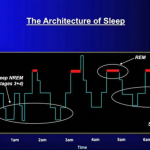
Fig. 1. Sleep Hypnogram (After M. Walker, 2009) – Click on the figure for enlarged view.
First of all, I would like to correct the misconception that some of us have that the moment we hit the pillow and get lost in sleep, we just flow through one continuous phase of dreaming, then deep sleep and, lo behold, we get up refreshed in the morning. So, to this extent, the sequence of Awake state (A), Dream state (U), and Deep sleep (M) corresponding to AUM as presented by Mandukya Upanishad is awfully way out. *** The Upanishad says that these three states arise in an everlasting turIya which is compared to the ‘silence’ at the end of AUM. *** Several experimental studies carried out over a period of more than half a century demonstrate that the architecture of our sleep pattern is vastly different as experienced by us every night. A typical hypnogram (the nightly sleep cycle) we go through each night is shown in Fig. 1. (Please click on the figure for an enlarged view).
Q: As you know, all spiritual traditions in Tibet, many in India and even the early Christians took reincarnation for granted.
In Advaita however the idea is blatantly refused. Balsekar says, since there is no ego and the idea of an individual person is an illusion, what or who is there to be reincarnated?
Does this mean that the other traditions are wrong or is it a question of understanding, meaning that the people who argue differently do so from a different level of understanding / consciousness? Continue reading
In my Talk on “Inquiry in Science and Vedanta “, the slides numbered 50 and 51 are about the three states of consciousness — Awake, Dream and Deep Sleep. (The full PowerPoint Presentation can be viewed at : http://beyond-advaita.blogspot.in/ ). The three worlds are represented by the three distinct circles I, II and III and a ‘Me’ is shown by the circle IV in the Slide 50 (Fig. 1 below). In our normal understanding, we think that “I am a separate ‘self’ (individual) and I pass through three distinct worlds viz. the Wakeful world, the Dream world and the Deep Sleep world.” We also take that the worlds to be external to ‘me.’
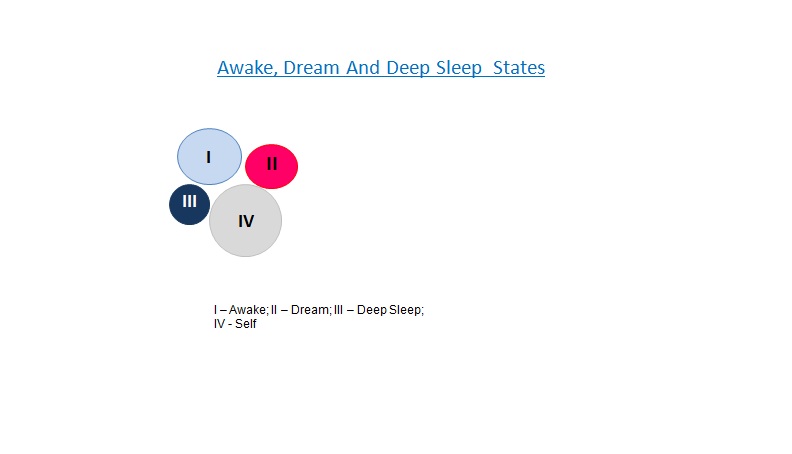
Fig 1: The Normal Worldview – an individual “I” (IV) passes through three distinct worlds (I, II, III) that are external to ‘me’ during a day of 24 hrs.