
‘sAdhana in Advaita’ – 3/6:

[Part – 2]

Our mind is accustomed to get the impression of an object which has a finite shape (form). It is easy for the mind to think of finite forms. But AtmA is formless. Further, if AtmA were to be located at a particular place, the mind can see in that direction to find the AtmA. But AtmA is everywhere. It exists in all directions, at all points; there is no specific locus for It. The mind cannot look for It in all directions at the same time. The doctrine also says that AtmA is not an object to be seen but is “my own real nature.” How do I see my own nature? Therefore, it feels like a big effort to get a thought that corresponds to the AtmA.

As a result, we find the practice (sAdhana) in Advaita to be difficult. However,  the very problems could be the cues which help us to have AtmAnubhava. We have from Bhagavad-Gita,

प्रत्यक्षावगमं धर्म्यं सुसुखं कर्तुमव्ययम्    —   9.2, Bhagavad-Gita.

[Meaning:  Immediately comprehensible, unopposed to dharma, very easy to perform, imperishable.]

Krishna says that the Self is seen directly and easily at every locus. We need to understand carefully the implication of this statement. Continue reading
‘sAdhana in Advaita’ – 2/6:

[Part – 1/6]

In order to experience the Self, AtmAnubhava, we should first know where the “I” is. If the ‘I’ is not already with us, we have to make an effort to obtain it.

In general, there are four ways by which we can obtain a thing. Say, we have to obtain a pot. If no pot is available, we have to newly produce (make) one. Or suppose it is available with someone or somewhere. We have to procure it from that place. Or, say, we have some components and not exactly a pot. We have to assemble the components or modify them in order to get the pot. Or, a pot is available but it is dusty or dirty. We have to wash off the dirt and make it neat and clean. These four ways are known as utpatti (production), Apti or prApti (procurement), vikArya (modification) and samskriti (refinement) respectively. Now let us apply it to the problem we have.

Do we have to newly produce the Self, or get It from some other place, or cleanse and refine the Self that already exists?

One may produce an idol or a symbol of a deity but none can manufacture the formless Self. Moreover, the knowledge that “I am” is already with us and that knowing itself is the Self. Therefore, we need not newly produce the Self. Continue reading

‘sAdhana in Advaita’ – 1/6:

[This Series of posts is based on Shri Yellamraju Srinivasa Rao (YSR)’s Audio Talk in Telugu – An Overview of The Advaita Doctrine  –   4/192 .The write up here is a free translation after slight modifications and editing. The Talk was described by a seeker as “Powerful and Compelling.” I do not know if I could achieve that ‘force of persuasion and spirit’ in the translation. Yet I hope the Reader gets at least a flavor of the original Talk, if not the whole taste, in this English rendition.]

Any philosophical knowledge system comprises three components  – The Doctrine (siddhAnta), The Method or the Process (sAdhana) and The Results or the Fruit (siddhi). (‘siddhi‘ is attainment and need not be confused with ‘sAdhya’ which means aim or objective to be achieved).

The doctrine expounds the subject matter of the teaching. The method or the process is the effort we make to experience what is taught. The result or the fruit is the fructification of our effort, which is the im-mediated direct “experiential understanding” of what was taught.

We begin the study of any subject with an intention to learn and implement, and complete the study with an experiential understanding of the subject. We hope to experience a feeling of satiation at the end of the study. The effort to implement what we learn, sAdhana, therefore, is an important part of any teaching. ‘siddhAnta’ or the teaching is like a recipe, while ‘sAdhana’ is like cooking a dish following the recipe. In fact, the Sanskrit word sAdhana also means cooking! The siddhi or the fruit is the ‘contentment’ we get after eating the dish. Continue reading

Consciousness, Ego and Self-knowledge

Introduction
Verse 3.42 of the Bhagavad Gita says that the sense organs are superior to the gross body, the mind is superior to the sense organs, the intellect is superior to the mind and the Atma is superior to the intellect. Superiority also refers to subtlety.  Our interest is in the mind, the intellect and finally in the Atma.  There are five fundamental elements called panchabhutas.  They are space, air, earth, water and fire.  The subtle body is made of panchbhutas in their primary or nascent forms.  When the panchabhutas undergo a process of compounding among themselves, the gross or physical body emerges. The mind and the intellect belong to the category of subtle body, i.e., made of the five elements in primary form.  The Atma is beyond the panchabhutas because It is not a thing or physical entity.

Consciousness
We all know that we are a conscious entity. We also feel so.  We are also certain that consciousness is different from the gross body. However we are not so sure whether the consciousness is different from the mind because consciousness ordinarily gets mixed up with the mind.  Vedanta says that the consciousness is different from the mind. It is based on the axiom that the subject (observer) is different from the object (observed). This is Seer-Seen discrimination (Drg Drisya Viveka). Continue reading

Q. 473 TM

Q: Good afternoon, I wonder if i may ask you about meditation please ? In particular TM, Transcendental Meditation.

I have been meditating twice daily for two years now and have not noticed any changes, no more calmness or anything really. I enjoy it while i do it but the feeling does not carry over into daily life.

From your experience would it be best to give it up or persevere a little longer please ? Is there something better than thus type of meditation?

A: Can you describe in some detail what you actually do and what you find? Continue reading

Q.468 Roles versus Witness

Q: I have been reading Vedanta for a few years and have a question. We are always playing some form of role such as Employee, Worker, Husband, Son etc. My understanding is that Advaita tells us to let the role do its own work but you remain who you are which is the ‘Absolute witness’.

How do we practice this in our daily life?   It seems difficult to have the same kind of energy when you are in that state.

A: What you are speaking of is karma yoga as preparation for j~nAna yoga. The aim in daily life is to respond appropriately to whatever is in front of you, perform the task with attention and do not be attached to the results. This is all a part of the process of acquiring discrimination, mental discipline and detachment. You need these in order to study Advaita (by listening to a qualified teacher explain the scriptures). It is not the purpose of any of this to acquire ‘good energy’ (whatever that means). Continue reading

Shankara and Mind

In his comments on the post ‘SamAdhi Again (Part 2)‘, Venkat said: “Dayananda has nothing useful to say about realisation. All of his statements are his mundane interpretations that don’t reconcile to anything that the great masters from Gaudapada and Sankara have said.”

And “Could you provide a couple of quotes from Sankara to support your Dayananda comment:
“Therefore, the knowledge is that I am thoughtfree (nirvikalpa) in spite of the experience of vikalpa . . . mithyA is not a problem – it is useful; mind is useful and that is all there is to it””

This attitude was also supported by Shishya in his comment on the same post: “I think Venkat put it very well.”

Accordingly, I have collected together a number of quotations that support the contention that only knowledge (and not action or samAdhi etc.) produces enlightenment; that ‘enlightenment’ is nothing other than Self-knowledge arising in the mind; and that the mind continues after enlightenment. These quotations demonstrate that those readers who have been criticising Swami Dayananda and his followers have been doing so unjustly.

*****

A. Bhagavad Gita bhASya

2.21

“(Similarly) the same Self, which is in reality beyond all changes of state, is called ‘enlightened’ on account of discriminative knowledge separating the Self from the not-self, even though such knowledge is only a modification of the mind and illusory in character (and implies no real change of state).

2.56

“Moreover that monk (i.e. man of realization) is then called a man of steady wisdom; when his mind is unperturbed; when his mind is unperturbed by the sorrows that come on the physical or other planes; …and has gone beyond attachment, fear and anger.

and BG 2.55 says that a stitha praj~na is a man who drives away all desires that crop up in the mind. Continue reading

Vedanta the Solution – Part 56

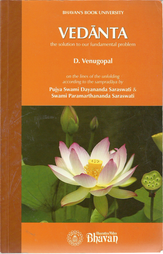
VEDĀNTA the solution to our fundamental problem by D. Venugopal

Part 56 concludes the examination of the idea that enlightenment involves an ‘experience’ – this is a misunderstanding of the concept of anubhava. And there is an extended analysis of the ‘tenth man’ metaphor, showing how the mahavAkya-s can give direct knowledge of the Self – aparokSha j~nAna.

There is a complete Contents List, to which links are added as each new part appears.

Q.443 A ‘simple summary of advaita’

Q: Based on your own search and discoveries over all of these years, and the writing of all of the books and blogs, if you had to summarize all of this, the truth of life, what would you say? 

A: Not sure what you are looking for here. My ‘personal’ view is surely not important and I could scarcely find any better summary than Shankara’s. Anyway, I spent an hour thinking about it (while washing up and vacuuming) and here is my one line summary:

The form does not matter – it is the substance that is important.

Q: How do we know that energy/matter is Consciousness and not just what it is as energy/matter? And why does it matter? Can’t Consciousness just be what it is by itself and simply aware?

A: Energy and matter are both objects of experience. They are transient and finite, changing one into the other and ultimately ending in Absolute zero. Consciousness is the non-dual, unchanging, eternal and infinite reality.

It does not matter from the standpoint of absolute reality. It does not even matter to most jIva-s, since they just get on with the usual pleasure-seeking aims. It matters to one who is seeking Self-knowledge.

Consciousness DOES just be what it is (there is nothing else) but is not ‘aware’ in the usual meaning of the word, since there is nothing else of which to be aware. Continue reading

Vedanta the Solution – Part 54

VEDĀNTA the solution to our fundamental problem by D. Venugopal

Part 54 looks at Ramana Maharshi’s ‘Who am I?’ practice and explains that the ‘I thought’ cannot be removed by self-investigation. It also explains that we do not have to get rid of vAsanA-s in order to gain mokSha.

There is a complete Contents List, to which links are added as each new part appears.