manonAsha – not the literal death of the mind

Most seekers who have investigated the teaching of Ramana to even a small extent will be aware of the concept of manonAsha. This is often presented as the idea that enlightenment is synonymous with the ‘death of the mind’. And indeed this is its literal meaning. Consequently, some writers claim that, following enlightenment, the j~nAnI literally no longer has a mind. This goes along with similar ideas such as that, for the j~nAnI, the world literally no longer exists.

This way of thinking is unfortunate. Shankara himself emphasised that we should not discount either our experience or reason, when it comes to interpreting the scriptures. And, speaking for myself, whenever I have encountered writings on Advaita which significantly contradicted my perception of what seemed to be ‘reasonable’, they have always proved to be misguided or incomplete, if not plain wrong. Continue reading

Common misunderstandings related to Vedanta

Below is the view of a bright young friend, Prashant Parikh, a keen, enthusiastic student of traditional Vedanta…

There are some errors in understanding I come across routinely, so I’m addressing a few of them briefly.

1) The Self can’t be experienced: The human mind is designed to go outwards (or even inwards) to gain experience. That is good, it allows us to innovate and progress in our worldly lives. However, when it comes to gaining AtmA jñAnam, the mind again looks for experience of an object called AtmA. This will fail miserable. AtmA is the very Self, the subject. Only an object endowed with attributes can be experienced. The consciousness, which is the Self, cannot be known as an object of experience. The Self can only be understood through the process of acquiring jñAnam through the timeless veda utterances. Tat tvam ask [Thou art That] is the teaching of the Guru, aham brahman asmi [I am Absolute Reality] is the understanding of the student 🙂 Continue reading

Discovering the Gita

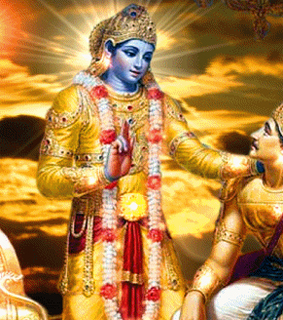
The most succinct description of the Gita is in the first verse of the ‘Meditation on the Gita’ traditionally recited before Chapter 1. It is a salutations to Bhagavad Gita, addressed as ‘Bhagavati, Amba’ (goddess, mother). This is what it says about her:
> She is revealed to Arjuna by the Supreme Lord himself.
> She is presented by the ancient sage Vyasa in eighteen chapters in the middle of the Mahābhārata.
> She is a shower of the nectar of non-duality that frees one from the root cause of unhappiness in life.  Continue reading

Interview with the Gita

We are very fortunate to have access to Bhagavad Gita ­– described as Mother, Goddess, Shower of the Nectar of Advaita and the Release from the Endless Cycle of Rebirth – to answers the many questions that relate to our day to day living. The advice relates to every person who, like Arjuna, find that, when the minds alone is involved, it is clear what’s needed, but when feelings become engaged they are no longer convinced they know what’s the right thing to do. And, at the end of each chapter, Gita is described as Brahma vidya [Knowledge of Reality] and yoga shAstra [scripture that prepares the mind for Brahma vidya]. So the questions start from this point: Enlightenment is the unshakable knowledge ‘Aham BrahmAsi’ [I am Brahman]…

Q: What stops us from knowing this truth of oneself 24/7?
Gita: Mind has three basic defects:
1. it is impure (i.e. it is ruled by appetites and aversions)
2. it is unsteady (i.e. it is unable to hold one thought for any prolonged period of time, let alone forever – i.e. it is NOT capable of being ‘unshakable’)
3. what it holds to be true is erroneous.
Krishna describes this sort of mind of the irresolute as ‘bahu shAkAh anantAh’ – many branched and endless. Continue reading

shrutisAra samuddharaNam

The shrutisAra samuddharaNam

of

shri toTakAchArya

An Overview by C.S.Baskaran

A rare and much less known secondary scripture shrutisAra samuddharaNam is a composition  by  Shri Totakacharya, one of the four disciples of Shri Adi Sankara Bhagavatpada. Though most of the secondary Scriptures are on the same subject of oneness of jIva and brahman, ideas basic to Advaita Vedanta, this work is unique in certain ways. Firstly, it is composed in a meter that is named after the AchArya as toTaka meter. These verses are melodious when sung with their breath-taking rhythm, they remind us of Sri Sankara’s famous bhaja govinda stotram. He elucidated the nature of Brahman as one and non-dual, real, knowledge and bliss through a number of scriptural texts. Secondly he does not refer to the mAyA concept that is important to Advaita Vedanta nor discuss the tenability of the reflection theory (bimba pratibimba vAda) nor the limitation theory (avachCheda vAda ). The reasons are the possibility of his explaining the oneness of inner self (jIva ) and supreme self ( brahman ) of Advaita Vedanta without resorting to those concepts. He later became the Pontiff of the Sankara Matt established by his Guru at Badari, North India. With the blessings of my Guru, I shall try to give a short overview of this text. Continue reading

Fundamentalism vs the eclectic

In common with many people in the West who are pursuing a spiritual path, I went down a couple of blind alleys before finding my present teacher, Swamni Atmaprakāśānanda, who had been given the vision of the truth of the Self by her guru, Swami Dayānanda Saraswati.

Of course one doesn’t know that one is going down a blind alley at the time and some alleys are so long that it takes several years before you bang up against the wall beyond which there’s no understanding. This was the case for me. The first alley was long. In the mid 70s, I came across a Philosophy School in London that offered a tantalising and a balanced diet of Upanishad and Gita study, meditation and other practical exercises and disciplines, Sanskrit, fine music, fine food, opportunities for service, regular retreats and the guidance of a ‘realised master’ from India (whom we didn’t personally meet, but received transcripts of his ‘Conversations’ with the founder of he school. These had been translated from Hindi and edited before we got to hear them – and the original recordings erased so no authentication possible). It took several years before discovering that all the right ingredients without an experienced cook will serve up a meal that might satisfy the hungry for a while, but is eventually one that’s lacking in real nourishment. I eventually left to follow my own direction. Continue reading

Who do you think ‘I’ is?

PART I/3: THE IDENTITY CRISIS

According to the teaching of Advaita Vedanta even the most well balanced people have an identity crisis (even if they don’t know it). If we meet a person who claimed to be Napoleon we’d most likely quietly cross to the other side of the room. The ancient sages of India, despite knowing that most of insist we are characters very different from who we are in truth, are slightly more accommodative of our self-delusion and try to help us rise above it. Everyone is born ignorant of the world and also of the truth of one’s identity: that is part and parcel of the human condition. Worldly ignorance is relatively easy to overcome, but self-ignorance requires subtle work and takes longer.

It is a rare person, says the Upanishad, who turns back from worldly involvements and wants to know who the observer is. Most, however, remain firmly fixated in their partial views of who they are, and end their lives deluded. The view is partial because they know ‘I am’, but do not know what ‘I’ is: and never even think that it is worth the enquiry. It’s not just the Eastern tradition that finds this a waste of a human embodiment, the same sentiment is also evident in the Western tradition in the words of Socrates: ‘An unexamined life is not worth living.’ Continue reading