Tattvabodha – Part 4

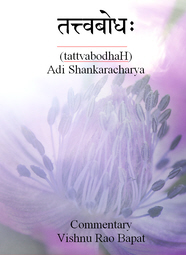
OLYMPUS DIGITAL CAMERAPart 4 of the commentary by Dr. VIshnu Bapat on Shankara’s Tattvabodha.This is a key work which introduces all of the key concepts of Advaita in a systematic manner.

The commentary is based upon those by several other authors, together with the audio lectures of Swami Paramarthananda. It includes word-by-word breakdown of the Sanskrit shloka-s so should be of interest to everyone, from complete beginners to advanced students.

Part 4 begins to look at the six sAdhanA-s (shamAdhi shakti sampatti), and in this part addresses shama (control of mind) and dama (control of senses). There is also a hyperlinked Contents List, which will be updated as each new part is published.

Tattvabodha – Part 3

OLYMPUS DIGITAL CAMERAPart 3 of the commentary by Dr. VIshnu Bapat on Shankara’s Tattvabodha.This is a key work which introduces all of the key concepts of Advaita in a systematic manner.

The commentary is based upon those by several other authors, together with the audio lectures of Swami Paramarthananda. It includes word-by-word breakdown of the Sanskrit shloka-s so should be of interest to everyone, from complete beginners to advanced students.

Part 3 discusses viveka (discrimination) and vairAgya (dispassion) in the ‘fourfold attainment’, sAdhana chatuShTAya sampatti. There is also a hyperlinked Contents List, which will be updated as each new part is published.

Atma vichAra

The Self cannot be ‘known’ in any objective sense because it is the ultimate subject – there is no other subject that could know it. This is why science can never tell us anything about the Self. Science works by collecting data and analyzing it; formulating theories and then using them to predict what will happen when data are gathered in a different situation. This can never be applied to Self/brahman, because brahman has no data.

Strictly speaking, vichAra refers to investigation into ‘things’ so that Atma vichAra is effectively a contradiction in terms; the Self is not a thing. Spiritual investigation has to be done rather differently. The correct term is shAstra mImAMsA and it is really scriptural ‘investigation’ that we must conduct in order to find out about the Self. Monier-Williams translates mImAMsA as “profound thought or reflection or consideration; investigation, examination, discussion”. The philosophical branch that studies the Upanishads etc at the end of the Vedas (Vedanta) is called uttara mImAMsA. (uttara means “later, following, subsequent, concluding” but also “superior, chief, excellent, dominant”.)

We ‘discover’ the Self by removing ignorance. If someone holds up a screen in front of our face and then brings an object to show us, but keeps it behind the screen, we can say nothing at all about the object. However, as soon as the screen is taken away, the object is revealed to our senses and the perception takes place automatically. Similarly, knowledge of the Self is obscured by ignorance but as soon as that ignorance is removed, the Self is immediately self-evident; we do not have to do anything to ‘investigate’ it.

Scripture functions like a mirror. When we look into a mirror, we do not literally see our face and body, we only see an image of it. Yet this enables us directly to perform whatever actions are required on the body itself – combing the hair, shaving and so on. We do not shave the image but the actual hair on the face. Similarly, the scriptures do not directly represent the Self but the information therein, when explained by a qualified teacher, directly enables the ignorance in our mind to be removed, revealing the Self-knowledge which is as though hidden beneath.

Actions will never bring about Self-knowledge, since action is not opposed to ignorance. Nor will practices such as meditation or prayer. As Swami Paramarthananda puts it, meditation will only bring about quiet ignorance.

As Shankara puts it (if he was the author of vivekachUDAmaNi v.13): “It is through reflection over the words of a truly benevolent soul that one comes to a knowledge of reality, and not through bathing at sacred places, charity or hundreds of breathing practices”. [1] I.e. it is through shravaNa, manana and nididhyAsana and not through asking ‘Who am I?’ that one gains Self-knowledge.

[1] The Crest Jewel of Wisdom; viveka-chUDAmaNi, commentary by Hari Prasad Shastri, Shanti Sadan, 1997. ISBN 0-85421-047-0.

Should I stop enquiring???????

ripplesShould I stop enquiring???????

Vijay Pargaonkar

(मुञ्डकोपनिषत्) MundakaUpanishat 3-2-9

“Anyone who knows that supreme Brahman becomes Brahman indeed……….”


My search for Brahman started with aparokshAnubhUti (supposedly written by Shankaracharya) where it is stated that knowledge of liberation is obtained through enquiry. It then goes on to explain what constitutes enquiry:                                                               (अपरोक्षानुभूती) aparokshaAnubhUti (Shloka #11 & #12) (translation by Vimuktananda)

“Knowledge is not brought about by any other means than Vichara (Enquiry), just as an object is nowhere perceived (seen) without the help of light”.

“Who am I? How is this (world) created? Who is its creator? Of what material is this (world) made? This is the way of that Vichara (Enquiry)”. Continue reading

Tattvabodha – Part 2

OLYMPUS DIGITAL CAMERAPart 2 of the commentary by Dr. VIshnu Bapat on Shankara’s Tattvabodha.This is a key work which introduces all of the key concepts of Advaita in a systematic manner.

The commentary is based upon those by several other authors, together with the audio lectures of Swami Paramarthananda. It includes word-by-word breakdown of the Sanskrit shloka-s so should be of interest to everyone, from complete beginners to advanced students.

Part 2 provides an introduction to the series and begins the discussion of sAdhana chatuShTAya sampatti. There is also a hyperlinked Contents List, which will be updated as each new part is published.

Tattvabodha – Part 1

OLYMPUS DIGITAL CAMERAI am pleased to announce that Dr. VIshnu Bapat has granted permission for us to host his unpublished commentary on Shankara’s Tattvabodha.This is a key work which introduces all of the key concepts of Advaita in a systematic manner.

The commentary is based upon those by several other authors, together with the audio lectures of Swami Paramarthananda. It includes word-by-word breakdown of the Sanskrit shloka-s so should be of interest to everyone, from complete beginners to advanced students.

Here is the link to Part 1. This provides an introduction to the series and covers the Invocation. There is also a hyperlinked Contents List, which will be updated as each new part is published.

Brahma Sutras

Southern Aeschna(Originally posted to Advaita Academy Oct. 2010)

Most readers of this site will certainly have heard of this text- the third branch, nyAya prasthAna, of the source for the teaching of advaita. (The other two branches of the so-called prasthAna traya are the Upanishads or shruti, and smRRiti, of which the most important is the bhagavadgItA.) But few have probably read it. You may have attempted to do so but been quickly put off by its seeming complexity. This is not surprising!

The basic text was written by vyAsa and otherwise known as bAdarAyaNa. And ‘text’ is not really the right word. It is actually written in short, numbered sutras whose meaning is often obscure, to say the least. The practice of the time required that writers of such works used as few words as possible – and vyAsa must have been one of the most proficient! The reader is expected to remember what has gone before and fill in the appropriate words as necessary. He is also expected to know the Upanishads and other works off by heart so that the relevant references do not have to be spelled out. Continue reading

Life is a dream – The world is real

DIALOGUE in Quora

A. Of course, if everything is like a dream (mithyA), then the sages and their scriptures are a part of that dream. But that doesn’t necessarily mean that the teachings and the scriptures are not useful for awakening from the dream.

B. That is true, in my understanding. ‘Life is a Dream’ (Calderón de la Barca’s play), ‘All the world’s a stage’ (Shakespeare). As to Vedanta, here is what a sage (among so many others) has said: “Vedanta plays the role of the dream lion in this world. Vedantic knowledge itself is part of the illusory world. But then it dissolves the entire illusion of this world, revealing reality as it is.” Sw. Parthsarathy.

A. If no one dies, then no one is enlightened either, and yet we still talk as if people really do die and really do become enlightened.

B. True also. That modifier, ‘as if’, is crucial.

In the next para. you write: “…an individual who appears to exist while not really existing (AS AN INDIVIDUAL) has appeared to become enlightened while not really being enlightened (AS THE PURPORTED INDIVIDUAL).” I have taken the liberty of adding the capital letters, for advaitic sense. Further, while ‘everybody is enlightened’, as Neo advaitins claim, ‘no one is enlightened’, as the sage Gaudapada declared. Are these two seemingly contradictory statements true – and in what sense? *

A. I think the problem with brain damage is the possibility that a j~nAnI [sage] would lose most or all of the knowledge (including Self-knowledge) that he gained through his studies.

B. This is as seen from the vyavaharika (empirical) perspective, which cannot be denied (only understood). Jñani/s (sages) also experience thoughts and emotions. With them, these either quickly disappear, or are transmuted or resolved into consciousness; in fact, they are only consciousness, as mind is also a projection of consciousness.

Something more for pondering: “People forget the reality of the illusory world”. Huang Po.

(*) Gaudapada (Shankara, and the whole tradition of advaita Vedanta) deny multiplicity as being real. In essence ‘all is One’. The Neo-advaitin’s dictum (’everybody is enlightened’) is thus true and false at the same time.


Necessity of karma kanda

According to Shankara, the entire Veda is important in that, till the seeker reaches the stage of pursuing the higher knowledge (jñana kanda) the duties enjoined in the other parts (karma kanda) are necessary for him. Otherwise, the Veda would not teach them. So, a spiritual seeker has to undertake scriptural study.

The path of action (karma yoga), states Shankara, is the ‘means to the supreme bliss indirectly’ in that it prepares the mind of the spiritual aspirant for knowledge, and thereby makes him competent for adopting the path of knowledge (jnana yoga), which is the direct path to liberation. Man cannot abstain from action, and as action binds man by resulting in karma… it is essential to know how to act without accruing further karma. This is the secret of action, called naiskarmya in the Gita… true renunciation is a mental disposition wherein the mind becomes serene without the distractions of the world.

(Spiritual Path). The Roots of Vedanta – Selections from Shankara’s Writings, p. 326

Knowledge, Action and Liberation

OLYMPUS DIGITAL CAMERAMost readers will be aware of the Brahmasutras – the third ‘leg’ of the prasthAna traya (the threefold set of scriptures that constitute the authority for Advaita – and some will even have read them! And you may also know that the first, famous sutra is athAto brahma jij~nAsA – Now, therefore, an enquiry into Brahman. It is the claim that Brahman forms the subject matter of Vedanta and has to be enquired into if we are to gain Self-knowledge.

The author of the Brahmasutras is said to be vyAsa, also known as bAdarAyaNa and the purport of the work is to summarize, in an extremely abbreviated form, the philosophy of vedAnta, showing how this naturally derives from the (last portion of) Vedas. (Of course, this does not mean a summary of Advaita. Others have written commentaries on the Brahmasutras and shown how it is commensurate with the philosophies of dvaita and vishiShTAdvaita.)

What fewer readers will know is that there is a similar (much longer) work, called the pUrva mImAMsA sUtra-s, written by the ‘father’ of pUrva mImAMsA philosophy, Jaimini. And, surely not coincidentally, the first sutra in this work is athAto dharma jij~nAsA – Now, therefore, an enquiry into dharma. This makes the claim that dharma forms the subject matter of the Vedas and has to be enquired into if we are to gain liberation from saMsAra. The word ‘dharma’ is often translated as ‘duty’ and the meaning of this word relates to what we ought to be doing with our lives. Their claim is that knowledge is useless, since it cannot produce any benefit. They utilize only the first part of the Vedas – the karma kANDa – believing that only actions can achieve anything and that, consequently, we must assiduously follow the injunctions, rituals and meditations prescribed there in order to attain liberation at some point in the future.

Continue reading