

States of Consciousness – 2, 3, 4 and 1/2?

Okay, here is your starter for 10 – your time starts now! (If you’re not familiar with this phrase, it relates to the quiz show ‘University challenge’, which was on British television for many years.)

The question is: how many states of consciousness are there?

I can almost see your mind tripping up and reading that question again. Surely, you will say, there are three states of consciousness – waking, dreaming and deep sleep. What can I possibly mean by querying this? Well, actually, depending upon how you answer this question, the number of states of consciousness could be two, three or five (or 4 ½) or you could argue that the very question is misconceived!

It is true that most of the scriptures refer to 3 states. If you have read my book ‘A-U-M: Awakening to Reality’, you will know that it refers to jAgrat, svapna and suShupti. These three states are mithyA and the reality underlying them is called turIya. In the tattva bodha (attributed to Shankara), the question is asked: avasthAtrayaM kim? – What are the three states? Admittedly, this is a somewhat leading question but the answer is given: jAgratsvapnasuShuptyavasthAH – they are the waking, dream and deep sleep states. And it goes on to explain each in turn. Continue reading

Q. 430 Brahman=changeless, eternal?

Q: I’m aware that I’m on (very) shaky ground when I talk/think about brahman. But there’s something that’s been bugging me for a long time now about the ‘definitions’ of brahman I’ve read.

Brahman is always described as changeless and eternal.

Let’s start with ‘changeless’. When I think (conceptualize, make images) about a changeless ‘force’ (for want of a better non-object word), I envision something static and dead, without animus, without vitality. Absolute zero, utter lack of motion/vibration, fixed-ness. But I can’t put this static-ness together with brahman, the ‘mother of all existence and vitality’. How could utter stillness give rise to such a vibrant universe?

Onto ‘eternal’. Why does brahman have to be eternal? Why couldn’t it have arisen with the Source Event (Big Bang, etc.) and evolved into its ‘current’ fullness? Likewise, why couldn’t it end with the collapse of the universe back to a zero-dimensional point?

So changeless and eternal elude/confuse me. But I suspect that’s because I’m trying to image-ine them, which is an oxymoron: conceptualizing the non-conceptual. Continue reading

‘Know thyself’ – Delphic Oracle

What is the interpretation given by modern philosophers to the Delphic injunction “O man, know thyself”? (Question in Quora)

This knowledge or question is one modern philosophers, psychologists, educators, and people in general are, to my knowledge, not interested in.

‘… self-knowledge, is hard to come by. To ‘know thyself’ (Orphic oracle) is a tall order, and most people are not interested in making the effort, or know how to go about it. But man is called upon to surpass, transcend himself, not to ‘make himself’. Until that happens, it has been said, “we are all hypocrites”. As we have seen, we cannot blame the ‘ego’ (or one’s ‘personality’: “the way I am”), that phantom, mask or impostor, for having infected us in the first place. Is it genetics? Heredity? Clearly, in the end, no one can escape responsibility – if we take the individual (‘I’, myself) as separate, or s/he take themselves as such. What we call ‘my ego’ is nothing but an excuse, a rationalization and, ultimately, an escape from real freedom.’ — Ego, ‘ego’, and metaphysics – Consequences for Psychotherapy Continue reading

Q. 429 Discussion on ‘I am That’

Q: I have a couple of questions about ‘I Am That’.

As I understand it, this essentially says: Atman = brahman. So the ‘I’ is not the ahaMkAra ‘I’, rather the Atman ‘I’.

1. Did I get that right?

2. When one begins to reflect upon ‘I Am That’, is one expected to feel the I as the ahaMkAra I? And then move, gradually, towards realizing the I is in fact Atman?

3. The reason I ask (2) is because I have a great deal of difficulty ‘feeling’ my ahaMkAra I. It just doesn’t ‘compute’ with me. Does this brain/body sense things, have feelings, emotions, thoughts; am I aware of external and internal things? Yes! All the time. But are these sensations, feelings, thoughts, etc. = ahaMkAra ‘I-me’? No. They’re just… stuff that happens, electrochemical dances in a brain in a skull in a body that is identified as ‘Jack’ Is this a problem – that I can’t consciously/directly feel my ahaMkAra I? That when I look for it, I see mithyA, nothing of essential substance? Could my not being able to directly experience my ahaMkAra I be a stumbling block? Continue reading

Enlightenment (Part 3)

(Read Part 2)…

Simply wanting to become enlightened is of no use unless one understands that this means the acquisition of Self-knowledge. Swami Dayananda explains this:

“With so many concepts of mokSha available, a mere desire for mokSha is not good enough. It must be converted into jij~nAsA, a desire to know. This is very important. This conversion means recognizing the fact that mokSha is in the form of knowledge, which is to be gained here in this life. So mokSha is not later or elsewhere.

“Conversion of one’s desire for mokSha into jij~nAsA implies a certain cognitive change. To begin with, one has some idea about mokSha, which may not be more than a belief. When one thoroughly exposes oneself to the teaching, there is the possibility of discerning that the mokSha is in the form of knowledge alone and not in any other form.” [vivekachUDAmaNi – Talks on 108 Selected Verses, Swami Dayananda Saraswati, Sri Gangadharesvar Trust, 1997. No ISBN. Purchase from http://books.arshavidya.org/]

As I have put it elsewhere:
“The Self is already ‘enlightened.’ There is nothing that can or need be done to alter this fact. The problem is simply the mind and, in its ignorance, the identification with something limited, be it mind, body, role or whatever. Accordingly, to remove that ignorance, knowledge is needed and this process is all at the level of mind in the phenomenal world. When sufficient knowledge has been acquired, the ignorance is dissolved and the mind realizes that already existent truth. But nothing has actually changed. Continue reading

Vedanta the Solution – Part 47

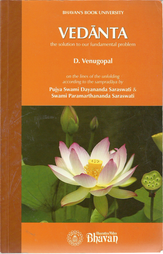
VEDĀNTA the solution to our fundamental problem by D. Venugopal

Part 47 begins the explanation of the mahAvAkyatat tvam asi‘. It first deals with the ‘direct’ (vAchyArtha) meaning. The 3 indicators (lakShaNA-s) for deriving the implied or intended meaning (lakShyArtha) of a word are then examined.

There is a complete Contents List, to which links are added as each new part appears.

Q. 428 A dialog on getting to know brahman

Q: I’m struggling (a lot) with ‘believing in’ Brahman.

I realize the problems inherent in this struggle: (1) It’s probably futile in my early stage of Advaita studies; (2) Brahman is beyond mind, so any attempt to truly apprehend it is doomed to failure. And yet I persist. 😉

I can walk with Advaita Vedanta through all the Neti-ing – I/Truth am not this, not this – but when Advaita makes the leap to IS THIS … I shake my head and turn away. Brahman seems like an abstraction born of fear/uncertainty, like other similar abstractions such as Heaven, The Ground, The Truth, etc. (I am not saying I know that Brahman IS an abstraction born of fear, rather that it seems to me that it could be.)

So I keep looking for analogies, things I can/do or ‘believe in’ that might be similar enough to Brahman that I could relax into it a bit.

Today I thought: Perhaps Brahman is (quasi-)synonymous with Nature? Nature – ‘everything that is’ – is all-encompassing in a way that suggests Brahman to me. Science’s take on Nature is conceptual, but the essence of Nature is, I think, not conceptual.

So: ‘Everything that is’ + non-conceptual – this sounds Brahman-esque to me. Yes? No? Continue reading

Q. 427 pramANa and reason

Q: Regarding the relationship between scripture, logic, and experience in the context of Vedanta being a pramANa:   It seems like the ‘rule’ is that for scripture to be considered valid it must be both supportable by reason and non-negatable by reason. But what exactly does that mean?

A (Dennis): Basically, according to Advaita, THE pramANa is scripture (shruti). In practice, this should be unfolded by a qualified teacher, who you trust not to mislead you. You make the conscious decision to take what is said ‘on trust’ until such time as you realize its truth for yourself. Shankara said that you should not accept any scripture that is contrary to reason. But ‘unreasonable’ scriptural statements usually turn out to be gauNa, which effectively means ‘figurative’, and are explained (reasonably!) somewhere close by in the text in which they occur.