Q.394 – Becoming One

Q: The question about Ishvara, Atman, Brahman gets confusing once a person starts reading and gaining knowledge from different branches of religions or schools of philosophy. So to put my question as simply as possible: If we are all Brahman then how does Karma come into play for us as individuals ? (As technically it’s Brahman acting against Brahman.)

One other thing:

Let’s say there are two people ( You and Me ) who realises the truth and doesn’t need to take rebirth again, so once their body dies, their Atman merges back with Brahman. So once that happens, do both these people become one ? At the highest level, Yes ! Because they were always One ! But would a part of them both remain ‘Them’ ? As in a person who sent a mail and a person who replied to it ? If so, then is that ‘Part’ what we’d call a soul ?

A (Dennis): In reality there is only brahman, non-dual, formless, eternal etc.

The world (including the ‘person’) is mithyA, neither real nor unreal, depending for its existence on brahman. The ‘person’ is a mind-body, ‘animated’ by Consciousness via a ‘reflection’ of brahman in the mind. This concept, called chidAbhAsa, is fundamental to understanding the seeming problems you raise. See my essays on this subject: There is an article called “The ‘Real I’ verses the ‘Presumed I’ – An Examination of chidAbhAsa” – https://www.advaita-vision.org/chidabhasa/ and a follow-up blog called ‘Continuing Reflections on Reflection’ at https://www.advaita-vision.org/continuing-reflections-on-reflections/. Continue reading


Overview of Western Philosophy – Part 10

(Read Part 9 of the series.)

Rousseau and Kant

Revolution
The reaction to the perceived unreasonableness of the empirical method was most apparent in the philosophy of Rousseau in France, which eventually contributed to the Romantic Movement, with its disdain for reason and advocacy of giving free rein to feelings and instinct. It was also taken up by those who instigated the French Revolution. Rousseau believed that man is inherently good but that the rise of civilisation, begun through the inequalities created in claiming ‘private property’ had corrupted us. Voltaire, on reading of his ideas, sarcastically commented that he was too old to start walking on all fours or searching out the savages in Canada. They also quarrelled over an earthquake in Lisbon. Voltaire saw in it a justification for questioning the beneficence of a God that would allow such a thing. Rousseau thought it served them right for living in seven-story houses rather than out in the countryside where they ought to have been. In any case, he did not think that we could use reason when talking about God; our attitude should be one of awe and reverence.

More dangerously, Rousseau was advocating democracy in his writings and questioning the divine right of kings. He believed that there should be discussion and agreement amongst the people to determine what he called the ‘general will’. This would then be formed into legislation which, once accepted by everyone, would be forcibly imposed. His best known work, ‘Social Contract’, opens with the challenging statement: “Man is born free, and everywhere he is in chains. One man thinks himself the master of others, but remains more of a slave than they are.Continue reading

Continuing Reflections (on reflections)

reflections

Back in April I wrote an article which looked into the concept of chidAbhAsahttps://www.advaita-vision.org/chidabhasa/. This is the idea that the ‘notion of I’ is a reflection, in the mind, of the non-dual consciousness. The theory is called pratibimba vAda in advaita. It says that there is only one ‘real’, pAramArthika or witnessing Consciousness, although there are many jIva-s; one ‘original’ (bimba) and many ‘reflections’ (pratibimba-s).

But of course, reality is non-dual, so it makes no sense to talk of a ‘Consciousness’ and a ‘reflected Consciousness’! So how do we explain this? In order for there to be a reflection, there have to be two things: an original thing, and some medium in which a reflection can take place. This is obvious in the case of the mirror. We cannot see our face in order to be able to shave or apply make up by looking into empty space. We cannot even do it by looking at a blank wall. There has to be a mirror or some reflecting medium which can serve as a mirror. Here, we seem to be saying that there is Consciousness and a reflecting medium – the mind. But of course if we have these two things, then we’re talking about dvaita not advaita.

Shankara’s Advaita introduces the concept of mAyA to provide a sort-of explanation for the world-appearance but the dvaitin may argue that, pedantically, brahman and mAyA are still two things. Only if we can explain everything in terms of paramArtha alone, he might say, can we establish non-duality. Of course, we can be pedantic too – you cannot explain anything in paramArtha, only in vyavahAra! But we acknowledge that mAyA is mithyA. In reality, there are no jIva-s, no world, no reflections. So, the bottom line is that reality is non-dual, so that we do not really have to justify the theory at all! Continue reading

Q. 393 – Idealism or Realism?

Q:       Advaita often uses certain language and metaphors, and these can often come across as sort of a “subjective idealism plus”. Where subjective idealism argues that the “outside world” is a completely nonexistent illusion produced in a mind, Advaita sometimes seems to say yes, that’s true – only, behind that mind that imagines the world is consciousness witnessing the mind, which is “projected” onto consciousness by the mysterious maya. In other words, Berkeley was right, only he didn’t go far enough. This leaves Advaita sounding like total solipsism, blended with hardline idealism. Consciousness, some sort of unimaginable void incapable of anything, is having a mind and a world “imagined” onto it by maya, which despite the incapability of consciousness to do anything is still a “power” of that consciousness. (Of course, this is very much a conceptualization, taking these metaphors too literally and looking at these terms and concepts through a very Westernized lens. But this is often the way some teachings sound!)

      But in addition to the talk of all things being total illusion, I will also hear that Advaita is realist – that the universe is not a hallucination; that it is, in one sense, “actually there”; and that it is in comparison to the changeless paramarthika viewpoint that vyavahara is “unreal”. This position makes much more sense to me than imagining the universe to be some sort of magic trick.

      Now, I recognize that these explanations – both of them – are attempts to “point” at truth, and not a tidy description of truth itself. Ultimately, there is only brahman; there are no “illusory things” and no “real things”. But I’m far from truly grasping that yet, so I suppose my question is: which of these descriptions more accurately reflects the nature and relation of vyavahara and paramartha? Or are both illustrations only as useful as what they can communicate to a student? Or am I just getting way too caught up in concepts here? Continue reading

Who (or what) is it that ‘acts’?

Those who have read any of my books, or the brief biography that is available on this site and others, will know that I began my ‘philosophical investigations’ with the School of Economic Science, as it is known in the UK. And you will also know that I have commented frequently upon the misguided notions that were propagated by the school in the name of Advaita. One of the key misunderstandings that I had, which was not cleared for many years, despite reading widely and discussing Advaita with many people on the Internet, relates to ‘action’.

As usual, this was a Sankhyan idea effectively being passed off as belonging to Advaita. It was the notion that it is ‘the guNa that act’, or that action is a function of prakRRiti. In the first edition of ‘The Book Of One’, I actually had a chapter called ‘The Myth of Action’ and the first section of this was entitled ‘Only the guNa Act’. Here are several paragraphs from this:

 “The three qualities of nature, the guna, of which all of nature is constituted, are in constant motion and this is the only ‘action’. Yes, the body acts – it is constituted of the three guna – but we do not. Here is a useful practical example of this: It may be that you cycle from time to time. I enjoy cycling in the New Forest, where I live – free exercise in beautiful surroundings and fresh air. However, there are a few hills along the routes, and sometimes you have to go up these rather than down. Many people just get off and walk their cycle up. Others take it as some sort of challenge and insist on trying to cycle to the top without having to dismount. When the going becomes hard, they make an extra mental effort, along the lines of ‘I am damn well going to get to the top, even if it kills me’! This is the hard way! Continue reading

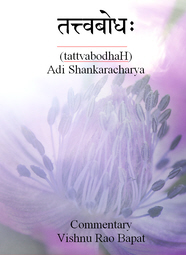
Tattvabodha – Part 20

Part 20 of the commentary by Dr. VIshnu Bapat on Shankara’s Tattvabodha.This is a key work which introduces all of the key concepts of Advaita in a systematic manner.

The commentary is based upon those by several other authors, together with the audio lectures of Swami Paramarthananda. It includes word-by-word breakdown of the Sanskrit shloka-s so should be of interest to everyone, from complete beginners to advanced students.

Part 20 looks at the process of ‘grossification’ (pa~nchIkaraNa or ‘quintuplication’) whereby the five gross elements are formed from proportions of the tamasika aspects of the five subtle elements.

There is a hyperlinked Contents List, which is updated as each new part is published.

Overview of Western Philosophy – Part 9

(Read Part 8 of the series.)

A Return to Scepticism

The Scottish philosopher David Hume accepted Locke’s empiricism and also agreed with Berkeley that we cannot ever know that there is a world outside of and separate from ourselves. Indeed he claimed not to understand what people meant by the idea of ‘substance’. We only know about perceptions, colour, sound, taste and so on. If this thing called ‘substance’ is something else, we have no knowledge of it – why invent it? If we took away the sensible qualities of things there would be nothing left, would there? Why should we need anything to explain or support our perceptions and impressions? Questions about why they arise are unnecessary and the answers suggested to explain them are unintelligible. The idea of ‘mind’ is just as illogical. If we simply dropped both of them, we would have no need to try to imagine ways in which such supposedly different ‘things’ might interact, as Descartes had wasted so much of his time doing.

He was also sceptical of Descartes’ conviction of his own existence as a thinking individual and made his own attempts to find some irreducible ‘self’ of which he could be certain. He decided that, whenever he attempted to look for ‘himself’ he could only find thoughts, feelings and perceptions; never a ‘self’ that is the perceiver, feeler and thinker. And so he concluded that there was no such thing. One feels one wants to get hold of him and shake him and say: “Yes, when you look, all that you find are thoughts, feelings and perceptions but who is it who finds this? What is the ‘who’ that is doing the looking?” He also felt similarly about God. We may well feel convinced that there is a God – this is effectively the definition of faith, a firm conviction without any empirical evidence – but this is not the same as knowledge. Continue reading

Understanding Reality – Part 3


Understanding Reality
in the Vision of Advaita Vedānta

by Wolfgang P., wpl@gmx.net

Read Part 2 of this article

Consciousness is limitless, anantam

What is ‘everything that is experienced’? It is the empirical universe, the world, jagat, which consists of everything we experience. Every object or content of consciousness is jagat, and this jagat is mithyā, depending upon sat-cit for its existence. Not only the gross objects, but also the subtle ones, like emotions, thoughts, concepts and so forth. There is literally no limitation to the possible contents of consciousness. Even when you say, “I found something that cannot be an object of consciousness” you have proven yourself wrong at the very instance, since this ‘something’ has to be already a content of consciousness to make the claim in the first place.

Is consciousness limited space-wise or time-wise? If yes, consciousness would be an object within space and time, having a certain location, a certain spatial and temporal expansion. But this is not the case. Consciousness is not an object within space and time. It is the other way round: Space and time are experienced in consciousness, so they are also mithyā. Furthermore, sat-cit is not limited spatially. Consequently, there cannot be two of them, otherwise they would have a spatial border. Therefore, sat-cit can only be one. If we apply this reasoning to time, the same applies. As time is mithyā to sat-cit, sat-cit cannot be dependent upon time. Hence, sat-cit is beyond time, which means it is uncreated, ajāti, and eternal. Continue reading