Q. 388 – Proof of Methodology

Q: I read an article of yours in which you said that traditional Advaita is a “proven methodology.” You also say that it is impossible to tell if another person is enlightened. But if you can’t tell if someone is enlightened as a result of practicing Advaita, how can you say that Advaita is a “proven methodology”? What constitutes “proof”?

Responses from Martin and Dennis

A (Martin): There are two parts to the question: 1) what constitutes proof in the context of Advaita Vedanta; 2) What does the questioner mean by enlightenment.

1) Is a proof here the proficiency in discussing/remembering/debating on topics of this tradition shown by one who has followed it for x number of years?

Answer: That can hardly be a proof. Whether parrot-like or not, ability in this regard may show, at best, a degree of intellectual understanding in the areas discussed as well as, possibly, a good memory and lexical ability. A real proof would consist in bringing about a complete change in outlook on life, meaning an inner transformation in the way the person sees the world and reacts to it. Does he/she see themselves as a doer? This may not be evident to anyone other the one undergoing the change. Continue reading

Knot of the Heart

I first encountered this term many years ago in discussions on the Internet with people who were influenced by Ramana Maharshi. The context was that, in order to attain enlightenment, it was not simply to do with gaining knowledge, or some key experience, but to do with breaking down some sort of emotional or psychological barrier. Maybe this is a peculiarly Western problem, whereby anything to do with the heart is equated to emotions. At any rate, the concept did not ring true for me at the time!

Also, prior to this, I had encountered the concept of the self or Atman living in the ‘cave of the heart’. This is an ambiguous and unhelpful phrase, if ever I heard one! If you read my review on the Mundaka Upanishad, you will have seen that I addressed this particular concept. As far as the literal idea is concerned, it is the vishiShTAdvaitins who believe this. They claim that the jIvAtman is aNu parimANa – atomic in size, as opposed to vibhU parimANa – all pervasive. (Note that the word parimANa should not be confused with pariNAma, meaning ‘transformation’, or pramANa, meaning source of knowledge!) Their idea is that the jIvAtman is minute and occupies a tiny space in the body, with its attribute of consciousness somehow radiating out to all parts of the body. There are many jIvAtman-s and only one paramAtman. Needless to say, these ideas are systematically refuted by Vyasa and Shankara. Continue reading

Serialization of Yogavasishta 7

Professor Sri Kuppa Venkata Krishna Murthy, Chairman and Managing Trustee of I-SERVE, the Institute of Scientific Research on Vedas, has kindly given permission for Advaita Vision to serialize his 6-volume ‘Musings on Yogavasishta’. Written in Telugu, the work has been painstakingly translated by our Dr. Ramesam Vemuri and published by Avadhoota Datta Peetham.

Rather than reproducing successive extracts from the books each month, as has been done with our other two serializations, the books themselves will be made available for download in PDF format. Each part will be associated with a page at the main website, which will contain a Contents List for that volume. Links to all of the volumes will be provided on a general Contents Page.

The present volume, “Musings on Yogavaasishta” – Part VI (Nirvana – Liberation, Book-I), is a presentation by Brahmasri Kuppa Venkata Krishna Murthy, the Vidyadhikari of Avadhoota Datta Peetham, Mysore and forms a part of his lectures on “Yogavaasishta” telecast by GEMINI T.V. in Telugu. This volume is a rendering of the same into English by Dr. Vemuri Ramesam. In it: The 5000 stanzas of the sixth chapter on Liberation
(Nirvana Book I) have been ably condensed and lucidly explained in simple words. Possible methods of alleviation from the state of Bondage and annulment of mind are described through the stories of Bhushunda and others.

Please go to the Contents Page to read the Announcement and general introduction from Ramesam. The page for this Sixth Volume, Part 6 (NIRVANA – LIBERATION Book 1) also contains the download link for the PDF file (1.2MB).

This is the Final Part of the series. Our thanks again to Professor Sri Kuppa Venkata Krishna Murthy and Dr. Vemuri Ramesam for their generous gift.

Birth and Death

One of the most startling passages that I encountered when I first began to study advaita was that in chapter 2 of the Bhagavad-Gita in which Arjuna bemoans the fact that he is expected to kill his teachers and relatives. Krishna responds with the following amazing statement (II.19 – II.20): “He who thinks that the spirit kills, and he who thinks of it is killed, are both ignorant. The spirit kills not, nor is it killed. It was not born; it will never die: nor once having been, can it ever cease to be: unborn, eternal, ever enduring, yet most ancient, the spirit dies not when the body is dead.” (Ref. 1)

Needless to say, the idea of death is one that disturbs most people. Indeed, it is probably the most feared event for the vast majority whether or not they believe that it signifies the literal end of their existence. Life appears to have the profile of a hill. We start at the bottom; slowly we begin to make an impression on life, ‘making a name for ourselves’, acquiring all of those things that are considered to make life significant – job, spouse, peer recognition, house and money etc. And then, there comes a time when we feel that we have achieved all that we are going to achieve. Ambitions cease; physical and mental capabilities decrease; ailments become more frequent; there is a gradual slide into physical decay and ultimate death. As Macbeth puts it so depressingly:

Life’s but a walking shadow, a poor player
That struts and frets his hour upon the stage
And then is heard no more.

Or, as Jaques puts it in ‘As You Like It’:

Last scene of all,
That ends this strange eventful history,
Is second childishness and mere oblivion,
Sans teeth, sans eyes, sans taste, sans everything.
Continue reading

Vedanta the Solution – Part 30

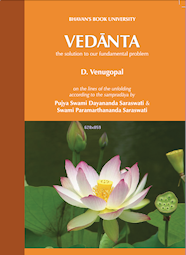
VEDĀNTA the solution to our fundamental problem by D. Venugopal

Part30 concludes the discussion on the ‘description’ of brahman as satyam j~nAnam anantam and then looks specifically at the meaning of ‘existence’ (sat) with reference to the body-mind-sense-complex.

There is a complete Contents List, to which links are added as each new part appears.

Tattvabodha – Part 15

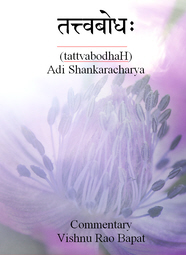
Part 15 of the commentary by Dr. VIshnu Bapat on Shankara’s Tattvabodha.This is a key work which introduces all of the key concepts of Advaita in a systematic manner.

The commentary is based upon those by several other authors, together with the audio lectures of Swami Paramarthananda. It includes word-by-word breakdown of the Sanskrit shloka-s so should be of interest to everyone, from complete beginners to advanced students.

Part 15 continues to look at the metaphor of the five sheaths, from the Taittiriya Upanishad. This part explains the bliss sheath and then goes beyond the sheaths to examine the nature of the Self – Atman.

There is a hyperlinked Contents List, which is updated as each new part is published.

The Mystery – Part 5

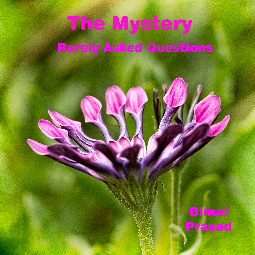
Continuing this new, short series presenting the booklet by Bimal Prasad, in which he answers some ‘Rarely Asked Questions’ on Life. Primarily from the perspective of Advaita, questions addressed include the nature of happiness, consciousness, mind and ego. There is also practical guidance on meditation in the final chapter. Answers are relevant and succinct, so that many of the issues of interest to the seeker are covered.

This fifth part looks at how we can be ‘in the present’ and at how the mind functions. See the Contents List or go straight to Part 5 of the series.

The complete (electronic form) booklet may also be purchased from Amazon.

Overview of Western Philosophy – Part 4

(Read Part 3 of the series.)

Part 4 – Sceptics, Epicureans and Stoics

Sceptics

The Sceptics, noting that different peoples had differing opinions on many subjects, wondered how one could ever justify holding a particular belief. Arguments for one view rather than another were founded on unproven premises and there seemed to be no means of ever being certain about anything. They concluded long before Kant in the 18th Century that we could have no real knowledge about the nature of things and believed that in situations where we were essentially ignorant we ought not to make judgements. This course of action (or perhaps we should call it ‘inaction’) was thought to lead to peace of mind. The outcome was that adherents behaved in whatever way those around them behaved and did not really believe in anything themselves  (what we might now call cynically!). Again, this philosophy offered some consolation to those seeking escape from a difficult life – don’t worry about the future since you can never know anything about it anyway. In fact, the above description seems remarkably similar to the way that the modern generation seems to behave so that it has clearly lost little of its force as a philosophical outlook on life. Continue reading

Time for the Wind – Ending

time_for_windAn Explanation of the Ending

One or two readers of this book have expressed some mystification over the ending; and maybe the other three were too polite to comment…  Accordingly, it occurred to me that it might be helpful to write this brief essay to provide a little more explanation.

WARNING: If you haven’t yet read the book, what I am about to write will not be relevant to you and will spoil the experience if you do decide to read it later.

Here is the link to download the PDF document but, if you still haven’t read the book, here are links to purchase from Amazon first:

Buy from Amazon US (book)
Buy from Amazon US (Kindle)
Buy from Amazon UK (book)
Buy from Amazon UK (Kindle)

If you would like to read the Prologue to whet your appetite, read it here! The initial announcement for the novel also contained a further extract from the book.

Serialization of Yogavasishta 6

Professor Sri Kuppa Venkata Krishna Murthy, Chairman and Managing Trustee of I-SERVE, the Institute of Scientific Research on Vedas, has kindly given permission for Advaita Vision to serialize his 6-volume ‘Musings on Yogavasishta’. Written in Telugu, the work has been painstakingly translated by our Dr. Ramesam Vemuri and published by Avadhoota Datta Peetham.

Rather than reproducing successive extracts from the books each month, as has been done with our other two serializations, the books themselves will be made available for download in PDF format. Each part will be associated with a page at the main website, which will contain a Contents List for that volume. Links to all of the volumes will be provided on a general Contents Page.

The present volume, “Musings on Yogavaasishta” – Part V The Calm Down, is a presentation by Brahmasri Kuppa Venkata Krishna Murthy, the Vidyadhikari of Avadhoota Datta Peetham, Mysore and forms a part of his lectures on “Yogavaasishta” telecast by GEMINI T.V. in Telugu. This volume is a rendering of the same into English by Dr. Vemuri Ramesam. In it: The 5000 stanzas of the fifth chapter on The Calm Down (Upasama)   have been ably condensed and lucidly explained in simple words. Possible methods of alleviation from the state of Bondage and annulment of mind are described through the stories of Janaka, Bali, Prahlada, Uddalaka, Gadhi, Sraghu, Parigha and others.

Please go to the Contents Page to read the Announcement and general introduction from Ramesam. The page for this Fifth Volume, Part 5 (THE CALM DOWN) also contains the download link for the PDF file (0.9MB).