Q.380 – Finding a teacher

Q: I’ve been reading books about the perennial philosophy recently and they often state that to develop spiritually you need to be attached to an exoteric tradition or you probably won’t detect any errors, and will be essentially wasting your time or worse. I’m not attached to any tradition, never have been, and can honestly say that the only one I’d be interested in would be Hinduism.

Hinduism strongly suggests that you need a teacher, but my question is, how are you supposed to get a teacher when there are so many experts out there taking advantage of our ignorance, and money.

A (Dennis): A true teacher will never take advantage of your ignorance and will only take money to support basic needs (travel, hotel, food etc, as relevant). If someone is charging lots of money for large gatherings, give them a wide berth!

That is one point. The other is that you could spend a lifetime doing the rounds of the various traditions and not feeling comfortable with any. There may be a single truth behind them all but the finer details of the process, and even the final positions, differ. You cannot even refer to ‘Hinduism’ as a single approach. Vedanta, which is probably what you mean, has three branches with quite different teaching. Advaita uses scriptural-based arguments, logical reasoning and experience to refute all the other Indian philosophies.

Ideally, the optimum way forward would be to read widely in all the traditions and then decide on one to pursue in depth. Only then, look for a teacher – and do that by asking those who have already been following that path for some years to make recommendations based upon their knowledge. The problem with this is that you do not know which books to read to begin with. I, for example, have read very many books on Advaita and I am now able to say that a large percentage contain erroneous or at least misleading statements. Either that, or they are so academic as to be unreadable! All very difficult!

I can’t really help any further, I’m afraid. My knowledge is really only in Advaita. I know that this ‘works’ but why should you believe me? And that is the third point. Eventually, you have to resort to ‘faith’ to some degree, where this means putting trust in someone whom you believe to be trustworthy.

Time for the Wind

time_for_windReaders of this blog, and its associated website www.advaita.org.uk, will (I hope!) associate my name with my books on Advaita, which have been published fairly regularly since 2003. What very few people know is that I have also written a novel! In fact, this was the first book I wrote. I actually began it around 1974, while I was working as a contract computer programmer and temporarily idle. Unfortunately (I was still being paid), I was not idle for very long and the book was not completed until 1982! Since then I have revised/rewritten it four times! I did attempt to get it published back in the nineteen eighties, but without success. Earlier this year (after completing ‘A-U-M’), I decided the time had come, even though I have had to subsidise the publication as I am not recognised as an author of fiction.

I usually describe the novel as an ‘ecological thriller’, since the action revolves around a landfill site and waste disposal. The science fact also develops quite quickly into science fiction. By the time of the third iteration, however, I had reworked the material to introduce aspects of philosophy, with emphasis (surprise, surprise!) on Advaita. Originally, there had been lots of quotations from T. S. Eliot, but I discovered when writing ‘Back to the Truth’ that copyright permission for lots of Eliot quotes would be both difficult and expensive to obtain. Then I had the brainwave of changing one of the main characters from someone calling himself ‘Elyot’ (T. S. Eliot’s grandfather) to someone calling himself ‘Krish’ (short for ‘Krishna’). And, of course, I used quotations from the Gita instead of from ‘The Four Quartets’.

‘Krish’ only communicates via computer and, in addition to helping the principal character with his investigations into the waste disposal activities, he also discusses matters of Self-inquiry. Blending these elements without artificiality was quite difficult but I think I have succeeded. I was asked to write a blog on these writing aspects for the publisher to tie in with publication in early December. I reproduce this below, together with an extract from the book. (I will post another extract in a few weeks.) Continue reading

Q.379 – Practice, Enlightenment and Reincarnation

Q: My understanding is that the purpose of spiritual practice is to purify the intellect so that it ‘reflects’ Consciousness without distortion. This enables the mind to recognize the delusion caused by ahaMkAra. This would mean that ‘enlightenment’ is a function of the mind. Is this correct?

If this is so, it would seem to mean that any ‘benefits’ gained from enlightenment would only apply to this body-mind, in this life. Is this so?

Scriptures indicate that one may have to undergo many lives before gaining mokSha, and suggest that fruits of previous lives accumulate to enable this. But, if enlightenment is an event in this mind, how can previous lives be of any benefit? Is there something in the mind that is ‘carried over’ into future births?

A (Ramesam): The most fundamental aspect of Advaita teaching is that an individual (jIva) is non-different from the Supreme Self (brahman). It follows, therefore, from this that a seeker is already of the nature of ever pure, all-knowing and liberated entity. As Gaudapada explains in his kArikA on mANDUkya Upanishad, by Its own freedom, brahman takes the form of an individual (and the world) and there is neither a creation nor liberation, neither a seeker nor something to be sought. Continue reading

S N Sastri

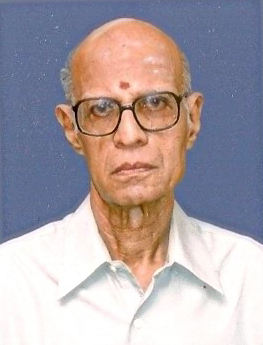
SNSastriSri S. N. Sastri (1922 – 2015)

It is with sadness and regret that we have to announce the death of Sri S. N. Sastri, one of the oldest and most respected scholars of Advaita. Sri Sastri was a moderator of the Advaitin forum for as long as I can remember. Recently, he had mostly ceased to participate in discussions as he found them very tiring but he remained an authority to whom we often turned for guidance – I consulted him on the topic of eka jIva vAda earlier this year and we were last in touch regarding ‘A-U-M’ only a couple of months ago.

To read a brief biography, bibliography and a selection of his writing, see http://www.advaita.org.uk/discourses/s_n_sastri/s_n_sastri.htm.

Vedanta the Solution – Part 23

venugopal_vedanta
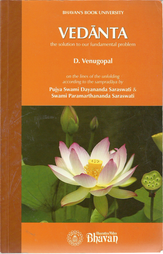
VEDĀNTA the solution to our fundamental problem by D. Venugopal

Part 23 begins the chapter on ‘Analysis of the subject in its three states of experience’. This first part looks at the three aspects of the body-mind-sense complex – the causal, subtle and gross bodies.

There is a complete Contents List, to which links are added as each new part appears.

Tattvabodha – Part 8

OLYMPUS DIGITAL CAMERAPart 8 of the commentary by Dr. VIshnu Bapat on Shankara’s Tattvabodha.This is a key work which introduces all of the key concepts of Advaita in a systematic manner.

The commentary is based upon those by several other authors, together with the audio lectures of Swami Paramarthananda. It includes word-by-word breakdown of the Sanskrit shloka-s so should be of interest to everyone, from complete beginners to advanced students.

Part 8 looks at the makeup of the gross body, its functions and purpose, and the modifications that it undergoes.

There is a hyperlinked Contents List, which is updated as each new part is published.

dUra

VenicedUra

Continuing the reposting of blogs from Advaita Academy, here is one from 2010. It is interesting to note that I have not further encountered this word since then! So it was a one-off. Nevertheless, it remains an interesting one and has a useful message.

I encountered a new Sanskrit word recently and its use and interpretation are quite enlightening. No doubt we are all familiar with those statements in the Upanishads which extol the extreme virtues of brahman. For example, in the Katha Upanishad, we have “the self is lesser than the least, greater than the greatest” (I.ii.20). And in the Isha Upanishad, we have “Unmoving, it moves faster than the mind” and “unmoving, it moves; is far away, yet near; within all, outside all” (verses 4 and 5). (These quotes are from ‘The Ten Principal Upanishads’ by Shree Purohit Swami and W. B. Yeats – a poetic rendering.) Then again, in the Kaivalya Upanishad (v.20), it is said “I am smaller than the smallest; I am the biggest, I am everything…Continue reading

Q. 378 – Existence and Experience

Q: Without hot, cold doesn’t exist. Without up there is no down, without in there is no out etc. The basic nature of duality. However if you apply this to the non-dual Brahman…

In the absence of that which is not (Brahman), that which is (Brahman), is not (doesn’t exist.)

My idea is that the Relative Reality is not only dependent on the Absolute (Brahman) but that actually both are interdependent on each other. I know this is counter to Advaita and forgive me and my lack of knowledge, especially of the Sanskrit terms, and I’m sure it makes your skin crawl to continually refer to things such as relativity as a reality.

Why do I say something can’t exist without it’s opposite? I will do my best to explain my ideas.

A thing cannot exist without it’s opposite because it cannot be experienced without it’s opposite, or rather awareness of it’s opposite. If a thing cannot be experienced then it does not exist, to the one experiencing it.

Ultimately, everything exists in one of two ways, either as a potential or possibility, or as a realized form. Continue reading

Vedanta the Solution – Part 22

venugopal_vedanta

VEDĀNTA the solution to our fundamental problem by D. Venugopal

Part 22 concludes the chapter on ‘Enquiry into the Self as subject’, equating Consciousness and Existence and looking at the relationship between the body-mind-sense complex and Consciousness.

There is a complete Contents List, to which links are added as each new part appears.