About amartingarcia

Surgeon, retired. Student of non-duality and advaita vedanta

What is Death – Mythology ll (Tristan and Isolde) – part 5


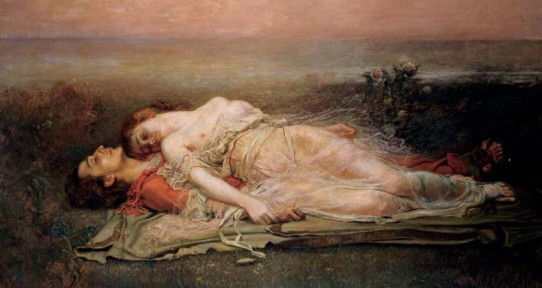
tristan2013


The power of the feminine principle (Shakti, Prakrit-Nature): Creation, Life, Nurturing – and its cycles. Also representing desire, as well as beauty. Woman, however, (embodiment of the Goddess) can also be redemptress (e.g. Mary in Christianity).

In Wagner’s opera ‘Tristan und Isolde’, desire is linked with Life, and Love with death –  sacrificial death (Liebestod), which admits of multiple implications and interpretations. The Romantic hero – and Wagner was one, at least ideally – could only be redeemed by and through woman; in that opera love could not be fulfilled in earthly terms (for it was unlawful). The Romantic ideal was a combination of love, sacrifice, transcendence, union – union through the transcending of the human personality, of individuality itself. Is this not a universal theme, as well as being very German?. In Wagner’s own words, “What Destiny separated in life emerges as life transfigured by death”.  Continue reading

What is Death – part 4 (Mythology).

aesculapius2

(Asclepios or Aesculapius)

Part 3 of this essay should have ended with the clarification that the statement:  ‘there is no other transmigrant but the Lord’, is but a doctrine, even though a very high spiritual or metaphysical doctrine, and, as every doctrine, it is (only) mithya, that is, ultimately not real, not the “realest” real. It can be stultified.

During my long written dialogue with Peter Bonnici centering on the ‘terrestrial garden’, I had said: ” They (myth and mithya) are quite different, though there is an overlap in the way we can make use of either of them in order to bring out a deeper understanding of something that may only be implicit”.

Peter’s eloquent reply was: “There is definitely a difference between the two. Though, as you say, there is overlap. Everything, including language and stories and concepts and symbols come under the category of mithyā– their existence cannot be denied, their usefulness at the transactional level cannot be denied, but their absolute independent reality can be denied. They are expressions of sat-cit, pure existence-consciousness. And they ultimately resolve into sat-cit, a thorn to remove a thorn is also discarded at the end. There is only one thing that isn’t mithyā: Brahman, Reality, the Whole. So myths do have value and are not to be dismissed. The analogy given is of using the branch to locate the moon”. Continue reading

What is death – part 3 (Transmigration)

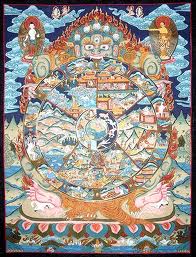
The wheel of transmigration

Although whatever is understood by transmigration or reincarnation does not strictly belong in this discussion on the “problem”, or the “reality” of death, it is so entrenched in people’s minds due to cultural and religious accretions, that a short account of it is not altogether out of place here. In the milieu of Hindu and Buddhist traditions reincarnation occupies the main doctrinal position in their exoteric or “religious” aspects, apart from belief in and worship of a deity or deities, and second only to the doctrine of karma – to which it is intimately related. Death of the body – the ‘gross body’ – is a foregone conclusion once it is irreversible (biological death).

A conventional account of reincarnation is as follows: ‘as for the jiva-atman carrying these vrittis, if during his lifetime the individual had performed some special acts of merit (punya) or demerit (papa), then the jiva-atman would proceed to heaven or hell. After spending his special karma-phala there, he comes back to the earth’. A more elaborate description is that once the seeker realizes nirguna Brahman he/she merges with Him/It, thus attaining immediate liberation (sadya mukti)’.Those who are eager to go beyond paths [the journey of life here and hereafter] tread no path’ (com. on Mu U. lll.2.6). ‘Just as the footmarks of birds cannot be traced in the sky or of fish in water, so is the departure of the illumined’ (Mahabharata). These two quotations are taken from ‘Methods of Knowledge’ – According to Advaita Vedanta’, by Swami Satprakashananda, p. 299. Continue reading

What is Death – Part 2

In the case of the human being, is death – whatever meaning we give to it – an ending, a transformation (in psychological terms), a recombination of parts (physics and biology), or a transfiguration, such as what is called reincarnation, transmigration  or metempsychosis (religious tradition)? Is it terminal, or a new beginning, a renewal – in someone of the senses enumerated above?

Or is death simply illusory? In the restricted sense we are now having in view (related to a human being), what is the meaning of ‘death’ – a question which, whether it has a precise answer or not, must have been asked countless times, at least ever since one or more individuals started to ask these kinds of questions, that is, to philosophize? It is frequently said that according to Plato philosophy begins in wonder. With such a broad view or approach of the problem we can appreciate how many possible answers, or rather areas of research and inquire are open to ourselves. We saw that, whether a (“short-lived”) event or a (gradual) process,  death can be defined in simple terms in what concerns the body, in fact the body of any organism, as was stated in Part 1. Going beyond this, and entering directly into the realm of philosophy – the philosophy of Vedanta in particular – the problem is also simplified by just saying that the only ‘things’ that ‘die’, or are annihilated, are forms, phenomena, which are impermanent. Essence or substance, being changeless, does not die. Continue reading

What is Death

“O grave, where is thy victory?” Paul of Tarsus

“There is no death nor birth. That which is born is only the body… If a man considers he is born he cannot avoid the fear of death. Let him find out if he has been born”. Ramana Maharshi

What is death? To begin with, we have the concept. What is the reality – if any – behind that particular concept, taken in general? Given that all concepts have a referent, is there a clear referent to the concept ‘death’? If so, is it an event, or a process – let us say in he case of a body? As soon as we start thinking or talking about it we are confronted with a series of difficulties, for there is not an unambiguous definition of that word or concept. Can it be defined in either positive or negative terms? What is its substratum, if any? As an adjective – ‘dead’ – that concept has a number of meanings or uses, not only a lack of vitality or function, and it frequently suggests certainty, assuredness and finality. In the New World Dictionary twenty different applications of the word are listed. Death, thus, whatever it is, is ubiquitous and multifarious, but what is it in its primary sense, as related to life? Continue reading

Review of article on Shankara – Part 6, and final

Maya

A tarka (reasoning, argumentation) is required for the analysis of anubhava, as both SSS and RB agree – consistent with Shankara’s position. That is, language and thought, needless to say, have a role to play, chiefly for exposition and analysis.

However, after two long, dense paragraphs RB contends: “If the tarka required to examine anubhava is itself completely dependent on ´sruti, then by no means is anubhava the ‘kingpin’ of pram¯an.as.”

Prior to this, SSS was quoted as maintaining that “for this unique tarka all universal anubhavas or experiences (intuitive experiences) themselves are the support.” The author states that this affirmation  involves circular  argumentation, and that to say that Shankara interprets the Vedas  as being consistent with anubhava is wrong, the truth being the opposite: anubhava is consistent with the Vedas: “it should be clear that according to Sure´svar¯ac¯arya, the direct realization is directly from just ´sruti itself, thus satisfying the criteria for it to be a pram¯an.a…. The direct realization of the self is from ´sruti alone.”  Continue reading

Review of article on Shankara – part 5

Under the section ‘Tarka vs Sruti’, the more or less unconscious devise (upadhi) of removing the subject from the ‘picture’ aimed at understanding the world, is broached, and the author (RB) quotes E. Schrödinger in that connection: “It became inherent in any attempt to form a picture of the objective world such as the Ionians made”. And so, “…the desire for understanding the world through our imperfect sensory knowledge invariably leads to certain, frequently overlooked, assumptions”.

It is curious that the first sleight of hand – by ‘primordial man’, the demiurge of mythology or Platonic philosophy – consisted in making a scission within reality so that subject and object would emerge in opposition to each other: God and man (the Garden of Eden), and then making a second scission (by imaginative surgery), thus removing the human subject altogether (provisionally! – for the Ionian ‘physiologoi’ knew what they were doing, though, it is related, Thales of Miletus fell once into a ditch while absorbed looking at the firmament’s stars in utter wonder). Certainly, this device – or both combined – made possible all the empirical sciences, literature, art, and everything we know ‘about’ the world. No division or separation (no adhyasa and its attending ‘names and forms’), no world. Allusion was made to this (mythological) result or outcome previously, as well as to the kind of ignorance that became knowledge (with small case). Continue reading

Review of article on Shankara – part 3

Ramakrishnan Balasubrahmanian (RB): “Now the error in calling avidy¯a as something epistemic should be obvious. The following extract, from [SSS], is clearly putting the philosophical cart before the horse:

‘Avidy¯a is subjective and has been explained by ´ Sa ˙ nkara as the natural tendency of the mind to superimpose the self and the not-self oneach other.’

When the conception of j¯ıva itself is due to avidy¯a, how can avidy¯a be the ‘natural tendency of the mind to superimpose the self and not-self’?” (*)

Our reply: To repeat, it is not just avidya as a general concept, that is, ignorance, but avidya-adhyasa, which is a technical (double) concept whose consequences are far-reaching in empirical life, being responsible for all divisions and superimpositions. No reason why this should be considered a circular argument. Continue reading

Review of article on Shankara – part 2

Review of  ‘A New Approach to Understanding Advaita asTaught by ´Sa ˙ nkara Bhagavadp¯ada’ – Ramakrishnan Balasubrahmanian — 2

We saw in the 1st part of this Review the primary or prior, not to say exclusive, importance that the author, RB, gives to the superimposition of a subject, individual mind or jiva, on the Self: “the superimposition of an observer is avidy¯a and is prior to the reverse superimposition”, not mentioning that Shankara does not talk of a ‘reverse process’, as if it was something happening through time,  but of mutual superimposition of Self and non-Self in a primary sense. He continues: “It is not completely incorrect to say that avidy¯a is the mutual superimposition of the real and unreal. ´ San˙ kar¯ac¯arya and Sure´svar¯ac¯arya do mention this … the superimposition of an observer on the inner-self naturally leads to the reverse process of superimposing the inner-self on the inner organ”. RB’s objective in maintaining this priority of the subject in this ‘act’ seems to be to show that SSS is guilty of circularity (petitio principi, in logic). Even so, and rather surprisingly, he claims that avidya is not something subjective (neither is it ontic nor epistemic – see below). Continue reading