Science and the nature of absolute reality (Part 1)

(Note that this was published to the restricted distribution for my ‘akhaNDAkAra’ journal in Jan 2010)

As an adolescent…I craved factual certainty and I thirsted for a meaningful vision of human life – so I became a scientist. This is like becoming an archbishop so you can meet girls. M. Cartmill

There seems to have been a growing trend (since the publication of Fritzjof Capra’s book ‘The Tao of Physics’ in 1975) to claim that science is both willing and able to investigate and understand the non-dual status of reality. More and more, science-based books and essays are appearing, but none seem to be actually founded in the proven methodology of Advaita. This is understandably symptomatic of the present time, in which science is seemingly able to supply all of our needs – if not already, then at least as a promise for the near future. Philosophies such as Advaita on the other hand are based on ancient scriptures, written in Sanskrit which no one can understand. ‘Where is the contest?’ the uninformed seeker is clearly going to ask. Continue reading

What about karma yoga?

Back in the early days of my spiritual seeking, I used to think that there were three main approaches to enlightenment: karma yoga, bhakti yoga and j~nAna yoga and that any could be used successfully, according to the particular personality and capabilities of the seeker. (I later found out about rAja yoga but let’s not complicate things!) The fact that j~nAna and bhakti effectively and inevitably ‘go together’ to some degree has been written about elsewhere by people such as Dhanya and Peter. Swami Dayananda also often writes about the need to understand the place of Ishvara in one’s spiritual pursuits if they are to be fruitful. So I will not mention bhakti again. I am looking in this article specifically about where karma yoga fits in the scheme of things. Continue reading

Dennis: Free Will (Part 5 – final)

Go to Part 4

Other experiments carried out more recently have confirmed that having a relevant thought prior to an action also gives us the feeling that we ‘caused’ the action, even when this is not the case. One experiment involved an arrangement of mirrors whereby the subject sees himself but with another person’s arms in place of his own. Instructions to move the arms in various ways are given and the arms subsequently move accordingly. Although the arms actually belong to an unseen person, the subject nevertheless feels that he has moved them. Continue reading

Dennis: Free Will (Part 4)

Go to Part 3

“The experience of willing an act arises from interpreting one’s thoughts as the cause of the act.” Daniel Wegner, quoted in the excellent book: Consciousness: an Introduction, Susan Blackmore, Oxford University Press, 2004. ISBN 0-19-515343-X. Buy from Amazon US or UK.

The scientific views that are often cited in respect of these discussions stem from experiments conducted by Benjamin Libet in the late 1970’s and by Daniel Wegner in the 1990’s. I described these in my books ‘How to Meet Yourself’ and ‘Back to the Truth’. Since very few people have actually read the former, I will quote at length from that: Continue reading

Dennis: Free Will (Part 3)

Go to Part 2

The metaphor of the motor boat crossing a fast-flowing river was used by Swami Chinmayananda. The current represents karma or destiny, as dictated by our prArabdha saMskAra; the power of the motor represents our own self-effort or free will. If the current is strong and our will is weak, we will be unable to overcome its force. If we are able to exert powerful self-effort (puruShArtha), we may overcome the force of habit and forge a new path.

Advaita tells us that who-we-really-are does not act in any case. For there to be action, there would have to be (at least) two things. But, empirically, we the witness see the body (which is only matter) performing actions. We identify with this and think that ‘I am acting’. The Bhagavad Gita (III.27) says: “The guNa-s of prakRRiti perform all karma. With the understanding clouded by egotism, man thinks ‘I am the doer’.” Continue reading

non-duality magazine

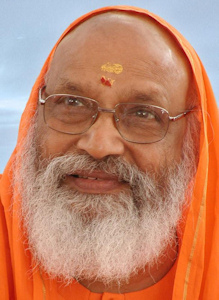
SWAMI DAYANANDA SARASWATI

Interview with non duality magazine

Swami Dayananda Saraswati

Swami Dayananda Saraswati is a contemporary teacher of Vedanta and a scholar in Sanskrit in the tradition of Śankara. Swamiji has been teaching Vedanta in India for more than five decades and around the world since 1976. His deep scholarship and assimilation of Vedanta combined with a subtle appreciation of contemporary problems make him that rare teacher who can reach both traditional and modern students.

A teacher of teachers, Swami Dayananda taught six resident in-depth Vedanta courses, each spanning 30 to 36 months. Four of them were conducted in India and two in the United States. Each course graduated about 60 qualified teachers, who are now teaching throughout India and abroad. Under his guidance, various centers for teaching of Vedanta have been founded around the world; among these, there are three primary centers in India at Rishikesh, Coimbatore, Nagpur and one in the U.S. at Saylorsburg, Pennsylvania. There are more than one hundred centers in India and abroad that carry on the same tradition of Vedantic teaching.

In addition to teaching, Swami Dayananda has initiated and supported various humanitarian efforts for the last forty-five years. The most far-reaching of these is the establishment of All India Movement for Seva in 2000. Awarded consultative status with ECOSOC (Economic and Social Council) by the United Nations in 2005, this organization is devoted to serving people in the remote areas of India, mainly in the field of Education and Health Care.

Swami Dayananda Saraswati has also promoted several international events and participated as a speaker in several global forums, among which are: the United Nations gathering of NGO’s, the UNESCO Seoul Global Convention, the United Nations 50th Anniversary Celebration, the Millennium World Peace Summit, the International Congress for the Preservation of Religious Diversity, the Conference on the Preservation of Sacred Sites, the World Council for Preservation of Religious Diversity, the Youth Peace Summit, the Global Peace Initiative of Women Religious and Spiritual Leaders, a Hindu-Christian dialogue with the World Council of Churches, and the Hindu-Jewish Leadership Summit

Read the interview at non-duality magazine.

Dennis: Free Will (Part 2)

sun on grassGo to Part 1

There are several Sanskrit words that carry the sense of free will but, if we look at these a little more closely, a pattern quickly emerges.

 A voluntary action, ‘acting of one’s own free will’ is kAmakAra. The kAra part is the ‘doing’ and kAma means ‘wish, desire, longing’. Even more specifically, sakAma – ‘acting of one’s own accord or free will’ –literally means ‘with desire’. svachChanda is another variant: sva means ‘one’s own’ and Chanda means ‘pleasure, delight, appetite’. svatantra indicates ‘independence’ or ‘self dependence’. saMkalpa means ‘will’ or ‘volition’ in general and yatna is an ‘activity of will or volition’. Possibly the closest in meaning is svechChA. which means ‘one’s own wish or will, free will’; svechChAra means ‘acting as one like, doing what is right in one’s own eyes’. But here again, breaking up the word svechChA gives us sva ichChA – ‘one’s own wish, desire or inclination’. Basically, what the scriptures seem to tell us is that having ‘free will’ means acting in accordance with our own wishes or desires.

 Whether or not our own desire influences an action or not is how Aristotle differentiates actions. If the cause of an action is external and we do not contribute anything to it, then it is ‘involuntary’. If the action is triggered by our personal desire or after appropriate deliberation about whether or not to act, then it is voluntary.

Continue reading

Dennis: Free Will (Part 1)

“Men believe themselves to be free, because they are conscious of their own actions and are ignorant of the causes by which they are determined.” (Spinoza. Ethics III)

The topic of free will is one which seems always to stimulate lots of discussion and some strongly held views. It occurred to me the other day that maybe this is because it is crucial to the sense of my ‘self’ as a separate entity. It is very important to ‘me’ that I should have the power of choice. If this is not the case, it somehow demeans who-I-feel-myself-to-be, relegating me to the level of an animal, forever bound by its inherited nature. It would mean that I am at the mercy of whatever chance events occur around me, reacting to them in an automatic, programmed manner, little better than a robot. Continue reading

Dennis: Welcome to Advaita Vision!

Advaita Vision is the new title of www.advaita.org.uk, which is currently being redesigned and overhauled. It is also, via the URL www.advaita-vision.org, the specific link to the Blog section of the site. You can reach it either by entering the link name in your browser, or by clicking on ‘Blog’ in the top menu bar at the main site. (N.B. This latter route will initially only work from the Home Page!)

I am joined in this endeavor by the following, who will be helping with aspects of the site and also providing regular blogs:

Peter Bonnici
Sitara
Dhanya

All have previously submitted material to the site and were, until November of last year blogging for Advaita Academy. Peter and I were also trustees for Advaita Academy but have now left so that we can devote all our efforts to this new venture.

More, general information will be provided here over the next few weeks but for now – enjoy the blogs!

For my own submissions, I will be beginning with a series drawn from the ‘akhaNDAkAra Newsletter’ which I produced 2 – 3 years ago. This was for a fairly restricted circulation so that most will not have read them. It also gives me the opportunity to provide some quality posts without having to do any work! (Or rather, it will enable me to devote my efforts to reworking the site. The first set is on the topic of Free Will, a perennial favorite!