
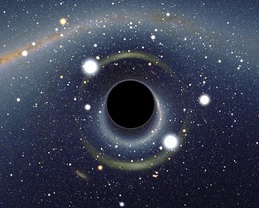
 This article was previously published in two parts on the Beyond Advaita blog maintained by our Dr. Ramesam Vemuri, in continuation of an ongoing series of articles exploring the relevance to Advaita of some of the latest research in theoretical physics. Science is converging to a view that no description of reality can be complete without the observer, and that so-called “objective reality” is really more of a holographic illusion than anything truly solid or substantial. Today’s scientists are busy trying to tease apart Maya’s tricks to see how this illusion works. Leonard Susskind’s theory of Black Hole Complementarity (BHC) — the topic of this article — provides a good example of this driving curiosity in action.
Category Archives: Guest Writer
I Am Awareness
An article by Eaden Shantay
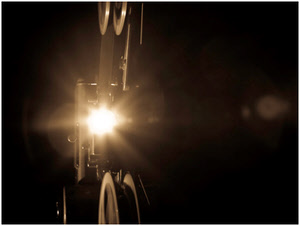
Experience is awareness cast through karma.
Every sensation, emotion and thought is the direct result of past karma (action). In each incarnation we bring forth parabdha karma – that portion of sanchita karma, our total karmic bank account, meant to be experienced, learned from and neutralized in this life.
Think of parabdha karma as images on a film strip, vasanas (impressions) in consciousness left from past action. The light of true self, awareness, then shines through these impressions, creating a three dimensional, five sensory experience called me and my life.
Like any good movie, it’s easy to become hypnotized by the drama and lose touch with what is real. In realizing we are not the projected story but the awareness which animates it, we release the life or death grip we have on moment to moment experience. This is the process of dis-identification or non-attachment the Buddha spoke of.
Imagine the sky with clouds moving through it. The sky is a metaphor for awareness and clouds, the objects of sensation, emotion and thought. In meditation we practice welcoming the clouds, blessing them and then bringing our attention back to the breath. In time, we even let go of the breath and dwell in the space between the clouds – awareness, a reflection of our true nature appearing in the mind. Continue reading
Reflections on Body-Mind and Liberation
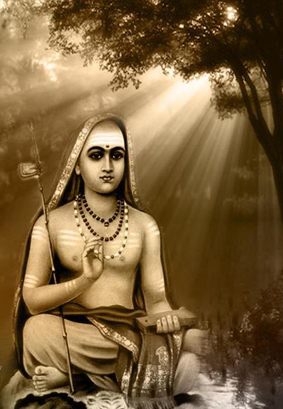 There has been much healthy debate recently on the Advaita Vision Blog about Liberation, who or what is a jnani or jivanmukta, and what it means to follow traditional Advaita. The theme of this post is that we cannot resolve such questions without first gaining a clear understanding of the body-mind and its role in the context of Liberation. What follows are some reflections inspired by a spirited discussion with Ramesam, with due credit to him for stimulating many of the thoughts below. Any errors or possible misunderstandings are entirely my fault. Or perhaps not, since “Words fall back from it.” Continue reading
Should I stop enquiring???????
 Should I stop enquiring???????
Vijay Pargaonkar
(मुञ्डकोपनिषत्) MundakaUpanishat 3-2-9
“Anyone who knows that supreme Brahman becomes Brahman indeed……….”
My search for Brahman started with aparokshAnubhUti (supposedly written by Shankaracharya) where it is stated that knowledge of liberation is obtained through enquiry. It then goes on to explain what constitutes enquiry: (अपरोक्षानुभूती) aparokshaAnubhUti (Shloka #11 & #12) (translation by Vimuktananda)
“Knowledge is not brought about by any other means than Vichara (Enquiry), just as an object is nowhere perceived (seen) without the help of light”.
“Who am I? How is this (world) created? Who is its creator? Of what material is this (world) made? This is the way of that Vichara (Enquiry)”. Continue reading
Seven Stages of Chidabhasa
 Guest Author – Vijay Pargaonkar
Seven Stages of Chidabhasa
Based on Panchadasi by Vidyaranya Swami
Chapter 7.0 “Trupti Deepa”(marathi translation by Pundit Vishnu Shastry Bapat (1908) and hindi translation by Pundit Ramavatar Vidyapati (1912))
Brihadaranyaka Upanishad 4-4-12
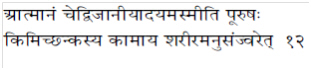
“If a man knows the Self as “I am This” then desiring what and for whose sake will he suffer in the wake of the body.”
(The entire Trupti Deepa chapter of Panchadasi is based on this shruti mantra)
Kutastha, the pure Consciousness, is asanga (without any association) and avikari (immutable). This Kutastha is also the adhisthana (substratum) of “bhrama” (illusions- not to be confused with Brahman) of indriya-sharira (body- mind complex). When it gets associated (the association is only vyavaharic/transactional and not real) with mind through anyonya-adhyasa (mutual superimposition) it is known as Jiva. Kutastha’s reflection in mind “chidabhasa” alone cannot be the Jiva since it has no existence of its own without Kutastha – image in a mirror is not possible unless there is a face behind it. The mixture/combination of chidabhasa and Kutastha is also referred to as purusha in the the shruti above. Continue reading
The Carpenters Story
 Carpenter’s Malady and Cognitive Consonance –
Rajarajeswari Srinivasan
I would like to start this discussion,with a Tamil verse ascribed to an ancient scripture called ‘Thirumanthiram’ attributed to ‘Thirumular’, considered a yogi who came from the north of India to the south. It is said that this work, consisting of more than 3000 verses formed the basis for the Saiva Siddhantha that developed in Tamilnadu. Only the verse has been taken from the text. A story has been added by me, for explanation.
There was a carpenter in a village, who specialized in making wooden toys. He had a son aged four. One day, the carpenter took his son to the temple. The little boy took a strong liking to the temple elephant and wanted to take it home. The carpenter convinced the adamant boy that it was not possible. But over the next few days he made a wooden elephant of reasonable size using a high quality wood and gifted it to his son. By this time, the child had forgotten his passion for the live elephant, and was very happy to possess a toy elephant and started playing with it, imagining it to be a real one. The carpenter’s father who was watching everything, said in Tamil, “marathai marraithathu maamadha yaanai” (“மரத்தை மறைத்தது மாமத யானை”), meaning, ‘the elephant (image) masks the wood’, i.e., “the elephant is perceived and not the wood”. Continue reading
Science and Vedanta (Part 3)
 Part 3 of a 3-part essay by Dr. K. Sadananda, AchArya at Chinmaya Mission, Washington.
What is Absolute Reality?
Vedanta defines the absolute reality as that which can never be negated at any time, trikAla abhAditam satyam. As an example, let us analyze a chair made of wood. Is that chair really real (satyasya satyam) or only transactionally real? When I dismantle the chair or break it into pieces, it is no more a chair. What was there before and what is there now is only wood. Hence wood is more real than chair. Chair is only a name for a form of wood arranged in some fashion to serve some purpose, and gets negated when the form is destroyed. I can do this without breaking the chair into pieces. I can cognitively say that there is really no chair there but what is there is only wood currently in the form of a chair. Chair is only transactionally real but not really real; and what is more real than chair is wood, the material cause for the chair. Continue reading
Science and Vedanta (Part 2)
 Part 2 of a 3-part essay by Dr. K. Sadananda, AchArya at Chinmaya Mission, Washington.
Analysis of Objective Sciences
An objective scientist provides a narrow definition for science as that which pertains only to the objectifiable entities using the objective tools. For example, he says that the existence of God cannot be scientifically established as His existence cannot be proved. Obviously the proof that a scientist is looking for is perceptibility, using objective tools of investigation which themselves are limited to only objectifiable entities. He presumes that God is also an object that can be precisely defined in order to differentiate Him from the rest of the objects in the universe, and is therefore quantifiable using perceptual data. If an object cannot be established by using his objective tools, then he asserts that any assumption of its existence becomes blind belief or at the most speculative.
No object can establish its own existence, since it is not a conscious entity. A chair does not say ‘I exist’; a conscious entity has to establish its existence. A scientist, who dismisses the existence of God, since it cannot be proved using his objective tools, takes his own existence for granted without questioning it. He cannot establish his own existence or that he is a conscious entity using the same objective tools that he is using to establish the existence of God. The reason is that he, as a subject knower, cannot be known since he cannot objectify the subject knower. He knows that he exists and that he is conscious entity, without even questioning the validity of his assertions. Continue reading
Science and Vedanta (Part 1)
 Part 1 of a 3-part essay by Dr. K. Sadananda, AchArya at Chinmaya Mission, Washington.
Science is Objective
The word science is derived from the root ‘scire’, meaning to know. Hence science really means knowledge which reveals a fact or truth. In Sanskrit, ‘vid’ means to know, and ‘veda’ means knowledge. Combining these two statements we can say that Veda means science. Vedanta means that which reveals the ultimate knowledge or absolute truth. From this, it follows that Vedanta is the ultimate science. This is not a fanatical statement but a statement of fact, as in ‘Light travels at 299,792,458 m / s’. This is not an opinion or belief but just plain fact, whether one believes it or not. We will examine here why Vedanta is the science of absolute.
Epistemologically, the word ‘knowledge’ without a qualifier, cannot be defined. The qualifier objectifies the knowledge as in ‘knowledge of Chemistry’ or ‘knowledge of Physics’, etc. It is always knowledge of something. It can be knowledge of the physical or phenomenal world, or knowledge of some subtle entities such as emotions, thoughts, intellectual concepts, etc. The former can be considered as the knowledge of gross entities that can be known via sense input, while the latter can be called the knowledge of subtle entities and can be known without the need of any sense input, or can be inferred indirectly from the sense input. Continue reading
Awareness of Self
 As you know, it is difficult to assess what another person ‘experiences’. It is also difficult to equate various words that might or might not mean the same thing to one person or everyone. Not sure if this is possible. Probably not. So, the following is not the gospel. I could be mad, mistaken, and a fool. Being foolish is not the worst thing. Feel free to call me names like Martin does.
For me, the word awareness has to constitute both subject and object. Someone or thing is aware. It is a function of the human being. We all have it and it is functioning right now. For me, all awareness functions within the context of self and consciousness, self and consciousness being virtually the same thing. I am talking about what constitutes self, not about self’s true nature. Self’s true nature has to be devoid of self completely and therefore out of the realm of all consciousness. Thus, it is also devoid of awareness as this is a function of our human nature, not our true nature. Normal death erases all experience and awareness but not our true nature.
Our human efforts can only concern itself with our human nature and that lasts maybe 70-90 years. To know thyself is a human endeavor that involves using observation. How else can we understand anything? Mind is involved to be sure. Everything we know is reflected in the mind. But this doesn’t seem to be the case with our true nature. Our true nature is not a reflection of our human life. No human faculty can know its true nature, only the human nature can be known. The only way we can ‘know’ our true nature is through the ending of this separate self that we call ‘me’, ‘I’, etc. And, it is not possible for our human nature to bring an end to itself. From what I have read of the sages, conversations I have had with sages (of course, the ones I think are sages!), it happens in a blink of an eye. You are simply swept away. It is a revelation, not an attainment. It is not a result. There are no levels of attainment, only levels of self. No true self. The body may remain, but no person inhabits it. True nature and human nature are not compatible. You can’t have your cake and eat it, too, as the saying goes. To know the self is to forget the self. But forgetting the self is not erasing it from memory. It’s erased from your whole being.
As others have said our own existence is common to us all. By observing this sense of existence, me, self, being it, breathing it, living it, you by-pass all the mental analysis and duality that most are involved with. The sense of problem is relieved and a kind of centeredness that focuses this observation can be felt and deepened. This centeredness is a gateway that our true nature reveals itself through and brings an end to all forms of self.
Posted by ‘Anonymous’