
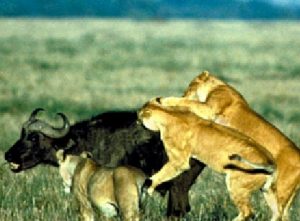
 Man seeks refuge in philosophy usually when things are not working for him/her in the world. When s/he is desperate and exhausts all the means at his/her command, he searches for succor elsewhere, anywhere. Mind becomes palpably uncertain, agitated, and anxious in those times. The misery and sorrow that spring from having to helplessly watch the unsatiated hunger of their children, the endless destitution, disease and penury of their own, the daily grind of laboring in hot Sun for a pittance of a wage, the constant stress from the hawkish creditors who compound their struggles, make the parents desperately want someone who could tell them the purpose of their life and provide at least a ray of hope. Continue reading
Category Archives: Ramesam
dhyAna and samAdhi

dhyAna and samAdhi are quite fascinating, pretty alluring and romantically inspiring terms for an aspirant on the spiritual path. They are almost always spoken in a tone that creates an awe. They sound mysterious, other worldly and ethereal. Many stories are told in the Purana-s about highly revered Sages lost in deep meditation or samAdhi to the extent that they were unaware of their own body being buried in heaps of sand or eaten away by critters and crawlers. Hair-rising narratives too are often reeled out about the powers that dhyAna and samAdhi lead one to – clairvoyance, multiple accomplishments (aNimAdi siddhi-s), infinite longevity (ciranjIvatva), visitations to subtler worlds inaccessible to normal human beings and so on. There is hardly a spiritual Guru who does not harangue about the glories a seeker will be bestowed through practicing dhyAna and samAdhi. Some teachers would even make these as a pre-requisite before any true ‘knowledge’ is imparted. As a result, the words dhyAna and samAdhi acquired varying meaning. Teachers too historically used or interpreted them in different ways. We shall attempt to take a synoptic view particularly from a Non-dual perspective what these terms connote and their role and relevance for a seeker who has adopted the jnAna mArga (The Knowledge Path) in his/her pursuit of liberation.
The write up is structured as a Power Point Presentation downloadable as a pdf file at: http://www.advaita.org.uk/discourses/downloads/dhyAna_samAdhi.pdf. Continue reading
Fear from wild creatures – 3
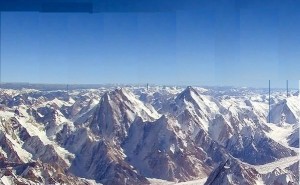
The fear most commonly experienced is the thought that I will end with the death of my physical body. Such a thought equating the ending of the “I” with the ending of the gross body indicates clearly the persisting misidentification of “I” with the body. It is the separate self which feels that it will disappear with the disappearance of the body. The cure for it is the recognition of the fact that the true “I” that I am, as Advaita teaches, is neither born nor will die; “I” is eternal, ageless, and imperishable (Bhagavad-Gita II-20). One who has really understood the Advaitic message abides as the true “I.” ‘To abide as the true I’ means to be knowingly as that immortal and changeless Awareness and not to mistake oneself to be the body and the mind which are transient and perishable. Therefore, disciplining the body through a drill of practices (as done in skill development like car-driving or carpentry) or control of the mind through repeat exercises (as required for computer coding or mathematics) can hardly be called abidance as the true “I.” Conscientiously feeling the difference between the phrases ‘I am the body’ and ‘I am aware of the body’ and experientially realizing that difference will help to firm up the understanding.
Fear from wild creatures – 2
Fear can be caused by a perceived threat which could be either from within the body-mind or from a source external to the body. The source of fear itself and consequently the type of fear can be either real or imaginary. We shall, however, not consider the issues related to the nature of the source causing the fear in this essay. We shall treat fear as a ‘signaling mechanism.’ Viewed thus, ‘fear’ includes all its other manifestations and variations like anger, hatred, disgust, anxiety, revenge etc. The signal itself appears as tightening of muscles, fastness of breath, heaviness in the heart area, slowness of digestive processes, dilation of pupils of the eye, contortion in the facial muscles, perspiration and so on. Depending on the intensity of the threat, the flux of thoughts may alter and even the sense of a ‘separate self’ may disappear.
A point to be remembered is that, though all such reactions are commonly attributed to the source, the perceived source itself is not the cause. It is in the way one’s body-mind are programmed to react. Suppose you sweat on mistakenly seeing a rope as a snake in semi-darkness. The unreal snake in the rope has actually nothing to do with the way your body has reacted. Continue reading
Fear from wild creatures – 1
 “I understand the Advaita teaching that everything is One only without a second, but I am always afraid of dogs and monkeys which are common in my place. Moreover, I also have a fear of snakes etc. as I live in a forest area.
Everything is brahman and therefore, ‘fear’ is also brahman. Though my mind is convinced by the logic of Advaita, why do I suffer from various fears?”
If there is a perception of fear, it automatically implies that there is a ‘me’ as the ‘subject,’ the finite perceiver and there is the ‘other,’ an object, separated from ‘me.’ (For this analysis, we define an ‘object’ as anything that is perceived. Hence ‘fear’ is also an object). This in turn implies that I ignored my ‘Dimensionlessness’ (anantatva) and assumed finiteness to myself.
It is true that on the full understanding of the Oneness of “Whatever-That-IS,” there is no scope for any sort of ‘fear.’ After all, if all is One, and there is no second, where and who is the other to be afraid of?
We have a recent real-life example for this in the 35th Pontiff of Sringeri, Shri Abhinava Vidyatheertha Swami. He found a big cobra snake coiled around his neck when he was meditating in a remote forest area. He told his Successor: Continue reading
Hiranyagarbha – a Boltzmann Brain?
 The unequivocal and uncompromising declaration of Advaita is that ‘Nothing is ever born; there is no creation.’
If so, what is ‘all this’ that we see?
Well, if such a question arises, the scriptures invoke the IkShaNa shruti – to explain creation. It is just a conceptual model – a fact which the shruti itself affirms. A throb in brahman is said to have engendered a formless Hiranyagarbha, as the Creator, whose thought then projects a world. Sage Vasishta explains very clearly in the Chapter on Origination in Yogavasishta that “Hiranyagarbha is born within the Supreme Self. He has no form. His body comprises his mind only. There is no physical body for him. The five fundamental elements are born from Hiranyagarbha through his mentation (thought process). Hence the five elements and the subsequent products arising out of them like the gross worlds do not have reality. They lack Beingness. They are not really born. They are like the horns of a rabbit.”
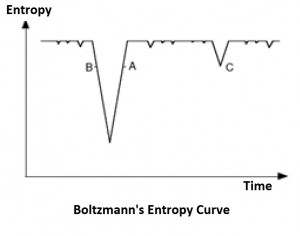
While answering the question of “What is this universe?” the physicists too figured out from their calculations a similar mechanism. What they find is that there is a high probability of a vacuum fluctuation in an absolutely quiescent thermodynamic equilibrium giving rise to a single conscious brain (mind) within it rather than the entire gamut of universes, galaxies, livable planets, living creatures. us and so on. Continue reading
My Tuppence Worth
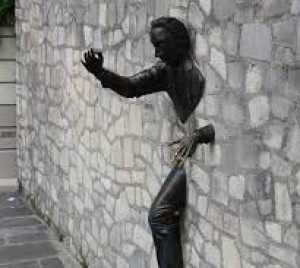
 It was over two scores and a half years ago. I remember an experience when I was living in that part of India venerated by the name AryAvarta, the holy land. The cows and other cattle had a right of way even on the so-called main roads, affectionately christened ‘M.K. Gandhi Marg’ ‘P.C. Chatterji Panth’ or some such tongue twisters by the locals. The citizens or rather the bodies of the inhabitants have a natural agility and ability to automatically adopt all the tricks of an expert contortionist in walking on the road avoiding the animals or their heaps and spurts of fragrant fresh just-in-time deliveries – made, as though, just for you. When you are all focused on keeping your balance as you never know where your next step may have to land, a hearty greeting jolts your auditory senses. You take time to locate the source of that sound, because there is obviously no face visible nearby. You see at a distance a half raised single hand, as a mark of showing respect for you. Adept practitioners of Zen may not know the clap of a single hand, but every one over there knows a salutation by one hand. Their shout says ‘su prabhAtaM,’ a literal translation for “Good Morning.” Continue reading
Ignorance is Also Brahman
Rama: Maharishi Vasishta! Revered Teacher! Kundadanta whom I met on that day is here in this assembly. He has been listening to your instructions for all these days. That is why I have asked you if he has attained Self-Knowledge and if all his doubts have been clarified.
Sage Vasishta: Where is the need for me to say anything? Let us ask him directly.
(Addressing now Kundadanta): What do you say, Kundadanta? Could you understand the essence of Truth? Have you gained Self-Knowledge? Have your doubts been cleared?
Kundadanta: Oh, Greatest of the Sages! Maharishi! My Salutations. Yes, now I am totally free of doubt. I have learnt what all has to be learnt. I understood fully the nature of Consciousness. I realize that even a tiny mustard seed can contain infinite universes within it. I could also understand experientially that there are no worlds at all from an Absolute point of view. I can see clearly that a question on how a large earth can fit into a small room has no locus.
What every creature experiences in the world is only The Supreme Brahman. The ignorance they experience is also Brahman. There is nothing whatsoever anywhere anytime beyond Supreme Brahman. That is the last word!
Vasishta: He is a Great Man Indeed! Congratulations to you, Kundadanta! Continue reading
I-consciousness, Worlds And Brahman
Shri Vijay Pargaonkar, a frequent contributor at this site, recently drew my attention to the teaching of Sage Vasishta towards the end of the 32,000 verse-strong Yogavasishta. I wish to share the following extract from the teaching as it has a relevance to the discussions going on at another thread.
*****
Vasishta: Rama, there are essentially two types of (…) worlds. They are the Stable and the Mobile worlds. The Stable worlds are: Mahah, Janah, Tapah, Satya etc. They are located far away from us.
स यदि पितृलोककामो भवति सङ्कल्पादेवास्य पितरः समुत्तिष्ठन्ति तेन पितृलोकेन सम्पन्नो महीयते ॥ – VIII-ii-1, छान्दोग्य
sa yadi pitRilokakAmo bhavati saMkalpAdevasyapiraH samuttiShTanti tena pitRilokena saMpannomahIyate. — VIII-ii-1, chAndogya upanishad. Continue reading
Living In The Moment Eternally – 2
[Nobody has obviously noticed or pointed out that the continuation articles have not been posted for two years! So I am proceeding with the Series of articles here a bit hesitantly as I am not sure of the Reader-interest. In these two years my computer lost the “memory” of my notes and files stored on the subject (thanks to the hackers from Nigeria). I am hence obliged to go by whatever material I could harness in the ‘now’ from my computer. Part – 1 here. Part – 3 here . ]
The main question of interest for us here is “How does the body of a Self-realized man live eternally in the ‘Now’ and function in the day to day life of eating, moving, acting and interacting in the absence of ‘memory’ of past experience/knowledge for recognition? What does “Now” mean for him/her? Is the “Now” on a temporal dimension?”
Whether we are consciously aware of it or not, it is impossible to lead a normal life in the world without memory. Maybe it is simply responding to when your name is called or you have to find a solution to a much more complicated problem of technology, memory plays a significant role. Therefore, before we venture to answer the questions on the functioning of a jIvanmukta‘s body, one could be curious to know about the lives of those who are at a disadvantage in their worldly life because they do not have an access to their memory anymore . I shall list briefly a few such cases which are well studied by scientists. Their lives may look yet times hilarious and often poignant and heartbreaking but always harrowing to their care givers. Continue reading