Book Review: FREE WILL

Free Will by Sam Harris, Free Press, 2012, pp: 83, ISBN 978-1-4516-8340-0

free will book cover sam harris

I always wondered at the American marketing wizardry of bite-size chocolates and peanut butter cups that lure the consumers. If a book on a highly intriguing, tantalizing and no less controversial a subject like Free Will is presented in bite-size, even a die-hard Advaitin can hardly hold his temptation to take a bite! And I did.

Perhaps one should call it a long essay discussed under eight or so subheadings rather than a book. You hardly open the cover and right away, the text begins with “The question of free will touches nearly everything we care about” — no Intros, no Forewords, no time wasted. And then as suddenly, the author explodes the myth of ‘our viewing one another as autonomous persons, capable of free choice.’ He writes:

“If the scientific community were to declare free will an illusion, it would precipitate a culture war far more belligerent than one that has been waged on the subject of evolution. Without free will, sinners and criminals would be nothing more than poorly calibrated clock-work……  And those of us who work hard and follow the rules would not “deserve” our success in any deep sense. It is not an accident that most people find these conclusions abhorrent. The stakes are high.”

The stakes may be high; but Advaitins will surely cheer the author, Sam Harris, a Ph. D. in Neuroscience on those scientific declarations. Continue reading
Annihilation of Thought

Yogavaasishta is a remarkable Advaitic text in many ways. It is at once a theoretical text and a practical Manual. It combines the abstruse Vedantic concepts of Non-duality with simple doable tips and presents them in an engrossing manner.  Sage Vasishta often uses the technique of bringing home the most intricate philosophical point through a fictitious tale crafted on the spot with imaginary characters  representing with high fidelity the point to be illustrated in an unforgettable manner.  One such story is of Kadamba Daasura**. It tells us about the untenability of the perceived world. Daasura is shown to be living on the last tender leaf of the topmost branch of a Kadamba tree (Anthocephelus – Latin name: Adina cordifolia) where sustenance for any being, leave alone a human, is impossible. Sage Vasishta intends to impress on us that the sustenance of a world (which we take to be real and functioning) to be equally impossible.

Daasura teaches his son that the world is a creature of the ‘thought’  that thinks it. Intent on ending the world, the son who is hardly in his early teens enquires what is thought and how thought itself originates and what are the means of annihilating the thoughts. Daasura’s response to these questions is very profound and a summary is presented below. Continue reading

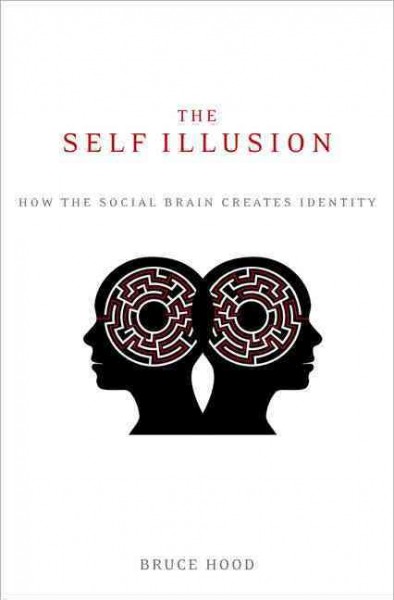
Book Review: THE SELF ILLUSION

The Self Illusion: How the Social Brain Creates Identity, Bruce Hood, OUP, 2012, pp: 349. ISBN 978-019-989759-9

Prof. Bruce Hood is the Chair in Developmental Psychology at the University of Bristol, UK. He started off his graduate work in Psychology  a couple of decades ago studying the gaze of new born infants, tracking their eye movements and what excites them to take in the world they look at. From then on grew his curiosity to know how a ‘self’ gets ensconced in the innocent minds of the babies and grows to the Himalayan proportions in the grownup egos — some turning out to be Osama Bins or Hitlers and others, well, a you and a me. Bruce presents lucidly a captivating and absorbing narrative of not only his research findings but also that of a plethora of Psychologists and Neuroscientists from different parts of the world.  He does not, however, preach sitting on a high pedestal condescendingly giving the reader exercises for self-improvement as we usually find in the books authored by Psychologists. (In fact that was my peeve about the excellently written work of Gary Marcus, “Kluge: The Haphazard Evolution of the Human Mind”, 2009).

Fig 2. Kanisza Square

But how could he? As so well argued by him, rather to the consternation of many Westerners unaccustomed to this kind of thinking, there is no entity, a ‘self’, present in you waiting to be improved. “Most of us believe that we have an independent, coherent self – an individual inside our head who thinks, watches, wonders, dreams, and makes plans for the future. This sense of our self may seem incredibly real, but a wealth of recent scientific evidence reveals that it is not what it seems — it is all an illusion.”  He illustrates the point using the Kanisza square (see Fig 2). Yes, you see a square alright. But remove the four Pac-Men in the corners. Where is the square? Continue reading

QUESTIONS NOT RAISED OR ANSWERED – Part 2

It is about 40 days ago I had posted the first part posing what I thought would be questions that will interest many readers.

Shri Panigrahi and Shri Peter have been kind to respond giving their observations. I am grateful to them for their comments.

I do not know why there are not many more reactions. The reasons could vary from the reader profile, website personality to flippancy of the questions. But as you may have already anticipated, there cannot be ‘the one correct answer.’ There can only be  different views.  So without going into much elaboration, I shall spell out my thoughts for the answers. Continue reading

‘SELF-CONTROL’ AND THE BRAIN


We have Sankara exhorting us in Vivekachudamani:  “The first step to Liberation is the extreme aversion to all perishable things, then follow calmness, self-control, forbearance, and the utter relinquishment of all work enjoined in the Scriptures.” And a little later he added:  “He who is free from the terrible snare of the hankering after sense-objects, so very difficult to get rid of, is alone fit for Liberation, and none else even though he be versed in all the six Shastras.”

“Mind control is self-control,” said the highly revered Swami Krishnananda of Divine Life Society. And self-control is the way to awakening, he added.

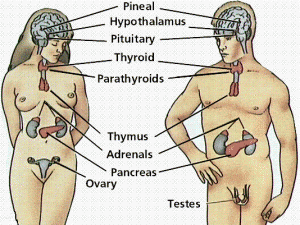
Fig 1. Endocrine Glands

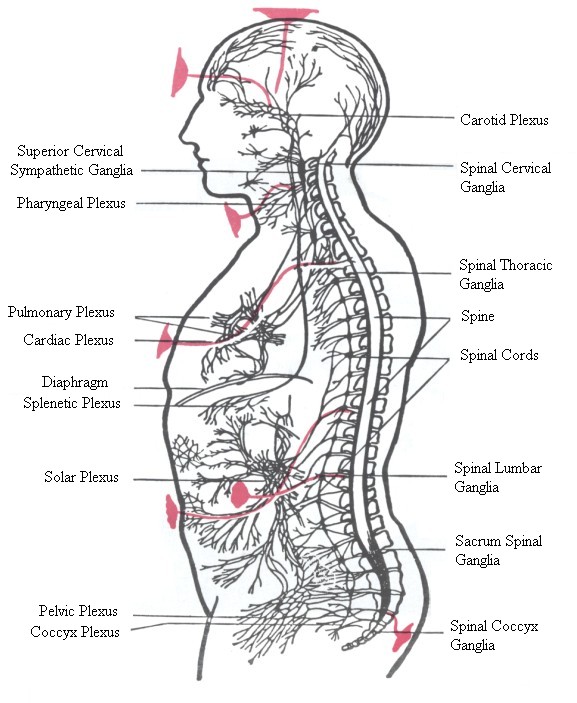
Six passions of the mind called Arishadvargas were depicted as the internal enemies of the man on the path to attaining moksha (liberation). These correspond to the hormones produced at the six major nerve plexuses as shown in the figures 1 and 2 and Table 1.

Fig 2. Nerve Plexuses

Psychologist Piercarlo Valdesolo writes “The power to resist temptation has been extolled by philosophers, psychologists, teachers, coaches, and mothers.” And then he adds, “Of course, this assumes that our natural urges are a thing to be resisted – that there is a devil inside, luring you to cheat, offend, err, and annoy. New research has begun to question this assumption.”

Continue reading

QUESTIONS NOT RAISED OR ANSWERED – Part 1

[Here are three questions that I did not come across a seeker raising them. Nor did I find any teacher discussing directly those specific issues and answering them in a logical way. Maybe my literature search is incomplete, I admit. Before I go on to provide my replies to these questions, I will very much appreciate to know the reactions / thoughts of the interested / knowledgeable readers – ramesam.]

The Questions:

A.  Bhagavad-Gita related: Continue reading

Sankara Bhashyas vs. Prakarana Granthas – A View

My studies of Advaita, the ancient wisdom of Oneness without a second, began with the small precise Monographs that teach its core philosophical essence without making us feel Advaita to be a remote inaccessible concept.  The Monographs (called Prakarana Granthas) are usually written in simple Sanskrit words without complex or compound sentences pointing the seeker directly to the Ultimate Reality. Some of them contain excellent metaphors “for easy comprehension” of the abstruse and abstract teachings, some others provide tools for one’s own analysis of one’s experience and yet others provide a step by step guidance on the path of Knowledge holding the hand of the seeker gently and with compassion.

Continue reading

ANESTHESIA, DEEP SLEEP, DEATH AND CONSCIOUSNESS – Part 3/3

[Part 1/3         Part 2/3]

To eff the ineffable:

We travelled the depths of Non-duality in Part 2/3.

As Jeff would put it, “I am realized, you are not” is a silly game. There’s no one – none – that’s not Brahman. You are already realized! So relax.

And let’s know what the brainy brain-scientists say consciousness is.

What consciousness is and how the brain produces it (if it does), is still one of the great challenges to science. Until a few decades ago, science was averse to dabble into this subject for lack of adequate investigative tools (both conceptual and instrumental). “Today consciousness research has become a passion for many scientists.”

But what is consciousness? It’s like asking what life is or what energy is. You know it when you see it. We say that “a brain that is fully awake and constructing experiences is fully conscious.” The thalamus, a sort of hub located deep in the brain for information flows from the senses to the upper reaches of the brain is crucial for consciousness. A person turns into a vegetative state if the thalamus is damaged or the information flows are inhibited. This does not mean that thalamus produces consciousness; it may just show that one is conscious – much like a thermometer which doesn’t actually make the heat, but tells you how hot it is.

Dr.Giulio Tononi of the University of Wisconsin–Madison and his colleagues are studying

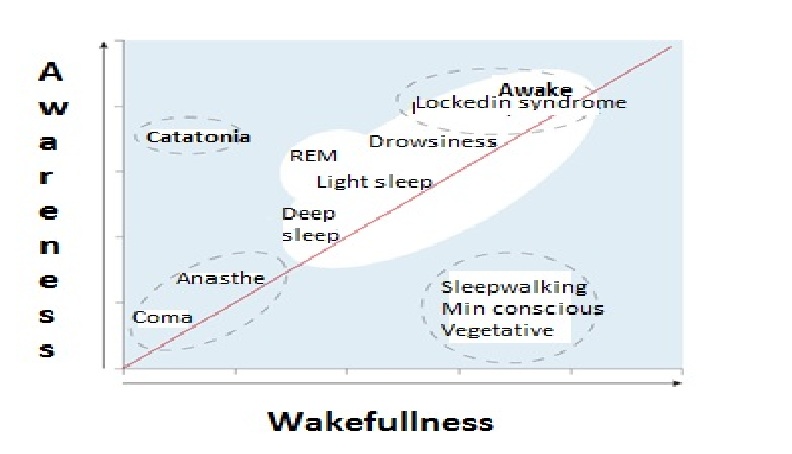
States of consciousness (After L. Saunders, 2012)

brains that are deeply asleep, under anesthesia or in comas to understand consciousness. As shown in the figure at the right, “awareness typically tracks with wakefulness — especially in normal states of consciousness. People in coma or under general anesthesia score low on both measures, appearing asleep with no signs of awareness. Sometimes, wakefulness and awareness become uncoupled, Continue reading

ANESTHESIA, DEEP SLEEP, DEATH AND CONSCIOUSNESS – Part 2/3

[Part 1/3      Part 3/3]

Before going into a consideration of Deep Sleep, once again a small detour.

Dennis raised in an e-mail the question of Sleepwalking. Where would it fit in the Model?

Some people amble around in sleep and even hurt themselves.  A few persons could commit heinous crimes in the state of somnambulism.  A well-known case is that of Kenneth Park in 1987 when he strangulated his father-in-law and killed his mother-in-law. However, he was let out by the court on the ground that he was sleepwalking when he harmed and killed people.  A similar case of acquittal also occurred in 1846. Apparently the body of the sleepwalkers is active but the mind seems to be asleep.

Neuroscientifically speaking, in the case of sleepwalking, the motor cortex of the brain is functional whereas the frontal lobe vested with executive functions is at rest. This means that a part of the mind (that propels the body to act) is active while the part responsible for reasoning and self-control is asleep. Continue reading

What is Moksha and what does Science say?

[A few friends asked me about Moksha to be explained in simple words without any mystifying scriptural references, quotations and citations. This is what I wrote to them.

The points are made accordingly with no hyperbole, no mystique but merely as barebones facts without any frills – bibliographic references, supporting evidence etc. for the sake of brevity. I thought of sharing it here so that it can be corrected / sharpened in expression and  improved in an overall way. ]

1. Moksha:

There is nothing mysterious about it. It goads the spirit of inquiry in us.

Our ancients’ inquiry was on:

i) Who am I? and ii) What is this world around?

Continue reading