The Ghost of Bharcchu

SarvajnatmanSarvajnatman, a well-reputed advaita Acharya of the 9th-10th century, was the author of samkshepa shArIraka.  As the title indicates, this book is a brief presentation of Sankara’s sUtra bhAshya in four chapters corresponding to the four adhyAya-s of the brahma sUtra-s.

Sarvajnatman sums up the essential nature of brahman in ten words. They are:

nityasuddha, buddha,  mukta, satya,  sUkshmasatvibhuadvitIya and Ananda

(eternal, pure, knowing, free, true, subtle, existent, auspicious, without a second and infinite (or happy)).

advaita teaches that you and brahman are one and the same. You being already brahman, the above ten words, therefore, describe you also. That means you, yourself, are Happiness.  So Happiness should be known to you like you know the back of your hand. You do not have to search for or attain Happiness.

But an enigmatic question arises: Okay, I know that I am already eternally existing, knowing and  ever happy brahman.  How come then I don’t know the Happiness which should be present right here? What ghost of an obstruction would block me from feeling it, from seeing it?

The shAstra replies: Oh, Yea, something like the Ghost of Bharcchu can cripple you from seeing the very things that are right in front of you!

“The Ghost of Bharcchu?  What’s that?,” you ask in wonderment.

Continue reading

On Reductionism


Dr. ChurchlandWay back in the sixties, that is over half a century ago, it was quite common to hear many spiritual teachers in India, haranguing to large audience how science was analytic and philosophy was synthetic in approach.  The strength of the ancient Indian wisdom, according to them, lived in its spirit of synthesis. So people were exhorted by these speakers to cultivate a habit of developing a conjoined view of diverse systems, rather than decompose them through a rigor of analysis. A current joke at the time was that a specialist was one who knew more and more about less and less until he knew almost everything of nothing.

Perhaps that approach was the need of the hour in India which had attained the status of an independent sovereign republic only a decade earlier through the coming together of many differently administered provincial units. But to extend that political logic based on the social needs of integration to the realms of philosophy and more so to Vedanta and pushing the spirit of questioning, almost derisively, to the bottom was an unfortunate development. How can I say so? Continue reading

Living In The Moment Eternally – 1

Appayya Dikshitar - (1520-93)

Appayya Dikshitar – (1520-93)

We, the traditional Advaitins, are a prejudicial lot – aren’t we?  Appayya Dikshitar’s words uttered in delirium when his brain was under the influence of the hallucinogenic Datura seeds are for us a beautiful AtmArpaNastuti in praise of Lord Shiva. But the mutterings of some other ordinary mortal with a differently affected brain is mere meaningless chatter unworthy of any notice. Let us not forget that both are actions done under conditions of an altered brain. And in both cases, an external agency is responsible for causing the change in the brain.

It was UG who famously said once that whether it was Beethoven’s 9th Symphony or pulling the chain in the WC sounded the same to him.  Some of the Zen Masters used to respond to the simple questions like “What is the time now?” with an answer that the mountain was running or some such response – totally frivolous and meaningless on the face of it. But their effort was to draw our attention to the way our mind functions in assigning ‘meaning and significance’ (which are actually not there) ever caught up in a habituated pattern which we  normally fail to detect.

Over six years ago, I prepared a comparative statement of the characteristics of an ordinary person and a ‘Self-realized’ man. I used the information  collated from many sources  that I could lay my hands on in preparing this tabulated compilation — almost like what a Purchase Officer does with the quotations (s)he obtains. There were several reasons behind this exercise of mine. Continue reading

Why do people talk so much about themselves?

“The ability to communicate—with almost anyone, about almost anything—has played a central role in our species’ ability to not just survive, but flourish. If you’re like most people, your own thoughts and experiences may be your favorite topic of conversation.  On average, people spend 60 percent of conversations talking about themselves.


Why, in a world full of ideas to discover, develop, and discuss, do people spend the majority of their time talking about themselves? Recent research suggests a simple explanation: because it feels good.

In an initial fMRI experiment, researchers compared neural activation during self-disclosure to activation during other-focused communication. Three neural regions stood out. (See the figure at top left showing the brain  cut vertically in the middle – the forehead is to the left and the back of the head to the right in the picture).  Continue reading

Expert on Truth vs. Knower of Truth

Sage Vasishta

Sage Vasishta

[Sage Vasishta points out to Rama the subtle difference between actually Knowing the Truth having obtained a clear understanding after a study of Non-dual Teaching and merely acquiring scholarly proficiency as an expert  and advises further on how a sincere seeker should proceed in the matter.  This discourse takes place in the 21st Canto of the Book II (Second Part) of the Chapter Nirvana in Yogavaasishta.  A slightly edited excerpt from “Yogavaasishta, Part VI” (by Shri K.V. Krishna Murthy, English rendering by Dr. Vemuri Ramesam, Avadhoota Datta Peetham, Mysore 570025, India, 2013, pp: 356) is presented below – ramesam.]


Sage Vasishta:  A man should not become an Expert on Truth but should be a Knower of Truth.  In my opinion, it is better to be an ignorant person rather than be an Expert on Truth.

Rama:  Sir!  Who is a Knower of Truth and who is an Expert on Truth?

Continue reading

Q.345 – The Purpose of Life, part 1

Here is a very basic question about purpose and faith. Five of our bloggers have provided answers and these are being posted in 5 parts.

Part 1 – Ramesam’s answer to this question

Q345: What is the purpose of life?

 If, as stated in Advaita, we are actually in a state of sat-chit-Ananda and we are actually this ‘Self’ already, why have these ‘illusions’ and this ‘ignorance’?

 How can we believe in lila? What could be its purpose? There is no convincing answer – I am sure you will concur. This then raises my more fundamental query. This ‘Self’ on which reams have been written – what is the proof that such a ’Self’ exists?

 The root problem is that in the end, even Advaitic teachings finally rely on ‘blind faith’ to put their point across. There’s nothing wrong in having faith. All religions ask for blind belief in the almighty to get you your promised ‘Kingdom of God’. It’s only in Advaita that folks try to push their case by saying: “No, it’s not pure faith, it’s by reason and discourse that we reach the truth etc”.

 To quote Gaudapada in his Mandukya Upanishad kArikA, “That which is stated in the scriptures ‘and is supported by reason’ is true  and nothing else”. The ‘reason/discourse’ argument for following Advaita is pure bunkum, in my opinion. It relies on blind faith not on a deity, but in an obscure ‘Self’.

 And even if reality is non-dual, why this seeming duality? Why does this mithyA of life exist? Continue reading

Eka jIva VAda – I Am Alone: Part VI

Part – V

Understanding Perception:

We don’t ever see or experience a ‘world.’

Our capacity to detect anything  is confined to a limited bandwidth of certain characteristics (in a so-called world) using our sensory organs:

                       Eyes      →   light, colors, shapes, distances, sizes

                       Ears         sounds, distance

                       Skin       →  heat, pressure, itch, softness, roughness

                       Nose      →  smells

                       Tongue   →  taste

                       Mind (?)   time, imagining (thinking)

[Note: 1. The normally held view about our senses as given above is valid only in a broad way.  Modern scientific research shows that quite a bit of collaborative overlap exists in their actual functioning.  For example, eyes and skin also have a role in hearing;  nose and ears (and even lungs) assist the tongue in tasting etc. Embodiment takes place from multi-sensory input.

2.  Notice that we are not endowed with any sensory organ to detect ‘time.’]

Continue reading

Invisible Energy In Empty Space

The Universe is overwhelmingly empty!

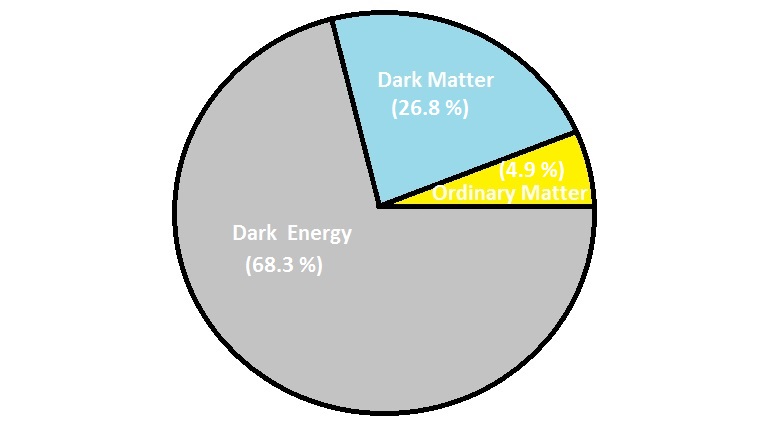
Up in the heavens, galaxies are interspersed by huge empty spaces. Matter constitutes less than one percent of the universe – about one atom in ten cubic meters of space.  structure of the universe (Planck 2013)Within an atom too, there is more empty space than substance.  If the atom is magnified to the size of a football stadium, matter (nucleus) in it will be no bigger than a golf ball, the remaining space being just emptiness.  However, many ancient Indian scriptures hold that there is energy aplenty in space.  Physicists unhesitatingly agree.  Evidence for energy in empty space comes both from Cosmology that deals with the astronomical objects of huge proportions and Quantum Physics which studies atomic- and subatomic-sized particles.

Continue reading

The Weird World Of Small Things

You are certain of your toothbrush being in the  bathroom when you walk in there after a good night’s sleep.  You have no doubt, the water comes to a boil in two minutes in the microwave for the delicious morning cuppa.  You are pretty sure how long it takes you to drive to the office.  That is all true. But the particles that constitute you or your toothbrush are not  predictable with that sort of certitude where they will be at any given time or when they appear at a given place!

Quantum Physics studies how the tiny particles like electrons, protons and atoms that constitute everything behave. Quantum Physics sobers us down quite a bit when it is a question of being sure of things.  It teaches us not to be so definite and deterministic.  It comes out with mind-bending mathematics and unbelievable concepts almost bordering Vedanta.  Dr. Niels Bohr, a giant among Quantum Physicists, famously said: “Anyone who is not shocked (by the concepts of Quantum Physics) has not understood it.”

For all that, Quantum Physics is not an esoteric theory. It comes with redoubtable experimental back up and unfailing proof.  Continue reading