Tattvabodha – Part 12

OLYMPUS DIGITAL CAMERA

Part 12 of the commentary by Dr. VIshnu Bapat on Shankara’s Tattvabodha.This is a key work which introduces all of the key concepts of Advaita in a systematic manner.

The commentary is based upon those by several other authors, together with the audio lectures of Swami Paramarthananda. It includes word-by-word breakdown of the Sanskrit shloka-s so should be of interest to everyone, from complete beginners to advanced students.

Part 12 examines the waking and dream states of experience.

There is a hyperlinked Contents List, which is updated as each new part is published.

Overview of Western Philosophy – Part 1

TTopazwo-33832his is the first part of an 18-part overview of Western Philosophy. Originally written to be incorporated into ‘Book of One’, it became far too long and detailed. I posted the first 15 parts to Advaita Academy around 5 years ago but these are no longer available. Since we have a current interest in the subject with both Charles and Martin posting articles and comments, it seems like an opportune time to begin to repost the series!

Note that the depth to which the subject is addressed is fairly shallow for the most part. I am not a philosopher by education or employment and most of my understanding has been gleaned from secondary sources – I have read very few original philosophical texts! But I hope it provides a general introduction to the key ideas of most well-known Western philosophers so that the reader may go to the original source (or a good commentary) if interested. Needless to say, I tend to ‘cherry-pick’ those aspects that related to Advaita!

What Western Philosophers Have Said

A site such as this would be unthinkable without reference to what has been thought and written by Western philosophers. Philosophers used not to limit their investigation to those areas that we now think of as philosophy. Aristotle for example wrote books on physics, biology, mathematics, psychology, politics and meteorology, to mention just a few. Their interests ranged across the entire spectrum of human endeavour. It should not be too surprising, then, to find that many philosophers do not seem specifically to have addressed those questions that concern Advaita – there were simply too many other diverting subjects to investigate. Nevertheless, since the question of what we ought to do with our lives in order to achieve fulfilment and happiness is rather more important than most, it is perhaps surprising that it seems so difficult to discover clear guidance from this intellectual elite. Continue reading

The Mystery – Part 2

bimal_cover

Continuing this new, short series presenting the booklet by Bimal Prasad, in which he answers some ‘Rarely Asked Questions’ on Life. Primarily from the perspective of Advaita, questions addressed include the nature of happiness, consciousness, mind and ego. There is also practical guidance on meditation in the final chapter. Answers are relevant and succinct, so that many of the issues of interest to the seeker are covered.

This second part looks at the distinction between ‘I’ and the body-mind and identifes ‘Consciousness’ as being who we really are. See the Contents List or go straight to Part 2 of the series.

The complete (electronic form) booklet may also be purchased from Amazon.

Serialization of Yogavasishta 3

yogavasishta2Professor Sri Kuppa Venkata Krishna Murthy, Chairman and Managing Trustee of I-SERVE, the Institute of Scientific Research on Vedas, has kindly given permission for Advaita Vision to serialize his 6-volume ‘Musings on Yogavasishta’. Written in Telugu, the work has been painstakingly translated by our Dr. Ramesam Vemuri and published by Avadhoota Datta Peetham.

Rather than reproducing successive extracts from the books each month, as has been done with our other two serializations, the books themselves will be made available for download in PDF format. Each part will be associated with a page at the main website, which will contain a Contents List for that volume. Links to all of the volumes will be provided on a general Contents Page.

The third part to be published is Part 2 (THE CONDUCT OF A SPIRITUAL ASPIRANT). (We began with Part 7 of the Series as it provides an overall summary of the Non-dual teaching and is a better introduction than simply jumping in at Part 1.)

Please go to the Contents Page to read the Announcement and general introduction from Ramesam. The page for this Third Volume, Part 2 (THE CONDUCT OF A SPIRITUAL ASPIRANT) also contains the download link for the PDF file (0.9MB).

Vedanta the Solution – Part 26

venugopal_vedanta

VEDĀNTA the solution to our fundamental problem by D. Venugopal

Part 26 examines the nature of AtmA, utilising the ‘descriptions’ from the Brihadaranyaka, Kena and Mandukya Upanishads. How can we ‘know’ the Self, when it is not an object?

There is a complete Contents List, to which links are added as each new part appears.

Tattvabodha – Part 11

OLYMPUS DIGITAL CAMERA

Part 11 of the commentary by Dr. VIshnu Bapat on Shankara’s Tattvabodha.This is a key work which introduces all of the key concepts of Advaita in a systematic manner.

The commentary is based upon those by several other authors, together with the audio lectures of Swami Paramarthananda. It includes word-by-word breakdown of the Sanskrit shloka-s so should be of interest to everyone, from complete beginners to advanced students.

Part 11 looks at the five organs of action and the nature of the causal body.

There is a hyperlinked Contents List, which is updated as each new part is published.

The Mystery – Part 1

bimal_coverA new, short series presenting the booklet by Bimal Prasad, in which he answers some ‘Rarely Asked Questions’ on Life. Primarily from the perspective of Advaita, questions addressed include the nature of happiness, consciousness, mind and ego. There is also practical guidance on meditation in the final chapter. Answers are relevant and succinct, so that many of the issues of interest to the seeker are covered.

See the Contents List or go straight to Part 1 of the series.

The complete (electronic form) booklet may also be purchased from Amazon.

Vedanta the Solution – Part 25

venugopal_vedanta

VEDĀNTA the solution to our fundamental problem by D. Venugopal

Part 25 continues to look at who we are, in relation to experience and consciousness. There is an especially useful analysis of the logical device of anvAya-vyatireka and an examination of the concept of witness-consciousness.

There is a complete Contents List, to which links are added as each new part appears.

Serialization of Yogavasishta 2

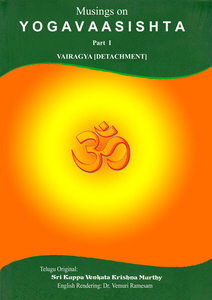
part1_cover300

Professor Sri Kuppa Venkata Krishna Murthy, Chairman and Managing Trustee of I-SERVE, the Institute of Scientific Research on Vedas, has kindly given permission for Advaita Vision to serialize his 6-volume ‘Musings on Yogavasishta’. Written in Telugu, the work has been painstakingly translated by our Dr. Ramesam Vemuri and published by Avadhoota Datta Peetham.

Rather than reproducing successive extracts from the books each month, as has been done with our other two serializations, the books themselves will be made available for download in PDF format. Each part will be associated with a page at the main website, which will contain a Contents List for that volume. Links to all of the volumes will be provided on a general Contents Page.

The second part to be published is Part I (DETACHMENT). (We began with Part 7 of the Series as it provides an overall summary of the Non-dual teaching and is a better introduction than simply jumping in at Part 1.)

Please go to the Contents Page to read the Announcement and general introduction from Ramesam. The page for this Second Volume, Part I VAIRAGYA (DETACHMENT) also contains the download link for the PDF file (0.4MB).

Tattvabodha – Part 10

OLYMPUS DIGITAL CAMERA

Part 10 of the commentary by Dr. VIshnu Bapat on Shankara’s Tattvabodha.This is a key work which introduces all of the key concepts of Advaita in a systematic manner.

The commentary is based upon those by several other authors, together with the audio lectures of Swami Paramarthananda. It includes word-by-word breakdown of the Sanskrit shloka-s so should be of interest to everyone, from complete beginners to advanced students.

Part 10 looks at the five organs of perception and the six means of acquiring knowledge.

There is a hyperlinked Contents List, which is updated as each new part is published.