
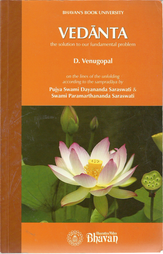
 Advaita Vision is pleased to announce the commencement (very soon) of the serialization of this brilliant book on Vedanta by Sri D. Venugopal, a direct disciple of Pujya Swami Dayananda, Swami Paramarthananda, Swami Siddhabodhananda and Swamini Pramananda. The book is designed to be the ‘next level up’ from an Introduction but does not assume any prior knowledge. We published an extract from this book – ‘Vedanta: the solution to our fundamental problem’ – in April 2013 but, now, Sri Venugopal has kindly given his permission for the entire book to be serialized so that all may benefit. The book is remarkable for the clarity of its expression and the copious cross-references to scriptures.
Q.348 – Temporary Realization
Q: 2 or 3 years ago I had a profound realization of the truth of advaita which stayed with me for many months. I fear that I have lost it forever. Do you think that it can come back?
A (Shuka): If you think you lost it, please understand you never had it in the first place, even for the 2-3 months that you think you had it. For, Advaita is not an experience, it is an understanding. The classical example used to illustrate this is a story about ten boys who cross a river. When the ten arrive on the further shore, one of them counts but nine in the group, obviously neglecting to include himself. A passer-by, noticing the consternation of the boys, counts them and finds all ten present; verbal testimony immediately dispels the previous ignorance. Once the boy has realized he is the ‘missing’ tenth person, he can never lose himself thereafter, for the truth is ‘he was never lost’. So also, it was always Advaita, however, due to ignorance which results in wrong identification with one’s body-mind-sense-complex, a person is lost. On being pointed out by the śāstra (scriptures) through a guru (teacher) that his real nature is indeed different from what he has been thinking, he gets the knowledge of his original nature, that he was ever free. All this problem is caused because of the usage of the phrase self-realization instead of self-knowledge. If you are serious about your pursuit, study from a sampradāyavit, a traditionalist, who knows how to handle the words of the śāstra, and employs the prakriyā (methodology) as a teaching tool rather than as a system; all and sundries will only compound the confusion. My best wishes to you. Continue reading
What is Death – Mythology ll (Tristan and Isolde) – part 5
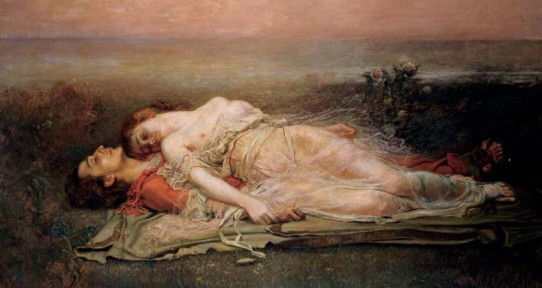
The power of the feminine principle (Shakti, Prakrit-Nature): Creation, Life, Nurturing – and its cycles. Also representing desire, as well as beauty. Woman, however, (embodiment of the Goddess) can also be redemptress (e.g. Mary in Christianity).
In Wagner’s opera ‘Tristan und Isolde’, desire is linked with Life, and Love with death – sacrificial death (Liebestod), which admits of multiple implications and interpretations. The Romantic hero – and Wagner was one, at least ideally – could only be redeemed by and through woman; in that opera love could not be fulfilled in earthly terms (for it was unlawful). The Romantic ideal was a combination of love, sacrifice, transcendence, union – union through the transcending of the human personality, of individuality itself. Is this not a universal theme, as well as being very German?. In Wagner’s own words, “What Destiny separated in life emerges as life transfigured by death”. Continue reading
Tat Pada Vicāra – 3 Upādāna Kāraṇa
 In the process of trying to understand īśvara (God) comprehensively, we discussed sṛṣṭi (creation), and established that this jagat (universe) is indeed a creation. We also saw that since it is so purposefully put together, there has to be an intelligent cause (nimitta kāraṇa) behind the creation; the, śruti (scriptures) reveals this person as īśvara.
The potter creates a pot out of mud, so the next question that comes abegging is out of what did īśvara create the jagat. What was the material from which he created the jagat? Continue reading
Origin and Meaning of the word mithyA
Seekers often ask questions about the meaning of the word mithyA. It is, after all, one of the most important concepts in Advaita. Someone has just asked about the usage of the word itself: Did Shankara use it? Does it occur in the Upanishads? I had to do a bit of research on this one and thought others might be interested in what I discovered.
The dictionary definition of the word gives: 1) contrarily, incorrectly, wrongly, improperly; 2) falsely, deceitfully, untruly; 3) not in reality, only apparently; 4) to no purpose, fruitlessly, in vain. According to John Grimes, it derives from the verb-root mith, meaning ‘to dispute angrily, altercate’.
It seems that it only occurs in one Upanishad – the muktikopaniShad. This is the Upanishad which tells you which Upanishads you need to study in order to obtain mokSha or mukti. It says that you can, in theory, get away with studying only one – the Mandukya, with its bare 12 sutras. If this alone does not enlighten you, then you need to study the 10 major Upanishads (Isha, Kena, Katha, Prashna, Mundaka, Mandukya, Taittiriya, Aitareya, Chandogya and Brihadaranyaka). If you still haven’t got it, there are a further 22 making up the main ones. Failing that, you are doomed to have to study the 108 commonly recognized ones. (After that, you start again!) Continue reading
What is Death – part 4 (Mythology).

(Asclepios or Aesculapius)
Part 3 of this essay should have ended with the clarification that the statement: ‘there is no other transmigrant but the Lord’, is but a doctrine, even though a very high spiritual or metaphysical doctrine, and, as every doctrine, it is (only) mithya, that is, ultimately not real, not the “realest” real. It can be stultified.
During my long written dialogue with Peter Bonnici centering on the ‘terrestrial garden’, I had said: ” They (myth and mithya) are quite different, though there is an overlap in the way we can make use of either of them in order to bring out a deeper understanding of something that may only be implicit”.
Peter’s eloquent reply was: “There is definitely a difference between the two. Though, as you say, there is overlap. Everything, including language and stories and concepts and symbols come under the category of mithyā– their existence cannot be denied, their usefulness at the transactional level cannot be denied, but their absolute independent reality can be denied. They are expressions of sat-cit, pure existence-consciousness. And they ultimately resolve into sat-cit, a thorn to remove a thorn is also discarded at the end. There is only one thing that isn’t mithyā: Brahman, Reality, the Whole. So myths do have value and are not to be dismissed. The analogy given is of using the branch to locate the moon”. Continue reading
Musings on Life and Death
 Hearing of our friend Peter’s death, Dhanya commented Death is a strange phenomenon in our world. One minute the person is alive and available, and the next minute totally gone, thereby summing up in simple words how it feels to experience the death of another person.
Reflecting on her statement, I came to look at death from the perspective of the dying one – noticing that life turns into as strange a phenomenon as death.
Perceiving with these mithyA-senses and this mithyA-mind a mithyA-body-mind entity called Sitara that is part of a mithyA-universe, whirling and twirling around in orderly beauty. All of this is obviously ‘here’ and yet also dreamlike, for neither Sitara nor the universe has always been here, nor will they eternally remain here in this form. All phenomena are in a constant flux, forever appearing and disappearing to something that is itself neither alive nor dead nor even different from the appearances and disappearances themselves.
Life is such a colorful, diverse, multidimensional phenomenon and, to almost everyone, it seems to be absolutely real. Yet it does not serve any purpose except for one peculiar one: to realize that this full explosion of creativity is no more real than the moon’s shining.
What a strange phenomenon is life – and how blessed is everyone who knows him/herself as life, death and beyond.
Photo credits: luise@pixelio.de
Why do people talk so much about themselves?
[Excerpted from: Scientific American, Mind & Brain, Mind Matters, July 16, 2013]

“The ability to communicate—with almost anyone, about almost anything—has played a central role in our species’ ability to not just survive, but flourish. If you’re like most people, your own thoughts and experiences may be your favorite topic of conversation. On average, people spend 60 percent of conversations talking about themselves.
Why, in a world full of ideas to discover, develop, and discuss, do people spend the majority of their time talking about themselves? Recent research suggests a simple explanation: because it feels good.
In an initial fMRI experiment, researchers compared neural activation during self-disclosure to activation during other-focused communication. Three neural regions stood out. (See the figure at top left showing the brain cut vertically in the middle – the forehead is to the left and the back of the head to the right in the picture). Continue reading
Ecstatic Spiritual Practices
 Who doesn’t like to get high? Let’s face it getting high is what we human beings live for. Getting high can also be called getting happy. Getting very, very, very happy. People pursue a high in all sorts of ways, from negative ways like drinking alhohol and taking drugs, to more positive ways like spiritual practices such as ecstatic chanting and dance.
When we do spiritual practices like ecstatic chanting and dance we feel we are entering another ‘zone,’ a place that is not available to us in ordinary life. We may feel we are progressing on the spiritual path. We may even assume that the goal of spiritual life is to always feel as high, or even higher, than when we do when we engage in ecstatic practices. Continue reading
Vision Of Truth (saddarshanam) – Part 12
विद्या कथम् भाति न चेदविद्या
विद्याम् विना किम् प्रविभात्यविद्या ।
द्वयम् च कस्येति विचार्य मूल
स्वरूप निष्ठा परमार्थ विद्या ॥—१२
vidyA katham bhAti na chedavidyA
vidyAm vinA kim pravibhAtyavidyA
dvayam cha kasyeti vichArya mUla
svarUpa niShThA paramArtha vidyA—12
विद्या कथम् भाति = how does knowledge shine? न चेदविद्या = if there is no ignorance; विद्याम् विना = without knowledge; किम् प्रविभात्यविद्या = does ignorance shine; द्वयम् च कस्येति = the two; विचार्य = having enquired; मूल स्वरूप = original nature; निष्ठा = abidance; परमार्थ विद्या = knowledge that ‘I am the self’
If there is no ignorance, how does knowledge shine? Without knowledge, does ignorance shine? And whose are the two? Having enquired thus, abidance in the original nature is the knowledge that ‘I am Atma’.
Everything in the universe is in duality. When one talks of happiness, it is a relative term, relative to sorrow. With respect to sorrow, we can say there is happiness. The term happiness has no meaning in the absence of sorrow. Light is opposed to darkness. It exists since darkness also exists. No darkness implies, there is no existence for light. This is the world of opposites, the world of duality. Joy-sorrow, victory-loss, peace-agitation, like-dislike, worry-security etc are some such antithetical couples. They mutually exist because of the other and have no meaning without the other. Continue reading